


Ron
Forum Replies Created
-

My right w/s has been cracked from top to bottom for about 5 years. Everbody wanted to replace it but I told them the refer would go out as soon as the w/s was replaced! LOL. Finally with the new refer, I got a new w/s. Really seems funny looking over and seeing no crack.
-
We don’t advertise the name given to our coach. We do have a name we have kept to ourselves and you won’t find it anywhere painted on the outside or labeled on the inside. The name, well for us, tripping with the bus is comparable to a good therapy session. We refer to our bus as “Wheel Therapy.” We are in a happy place even when surrounded by idiots on the highway.
Later today we depart Southern Pines for our annual week working with the USGA’s Men’s Open Golf Championship at Oakmont, PA. After the Open we will be spending a couple of weeks free roaming parts of PA, OH, and WV. Then back home to continue polishing newly exposed areas of stainless.
If you see us out there on the highway give us a hoot.
-

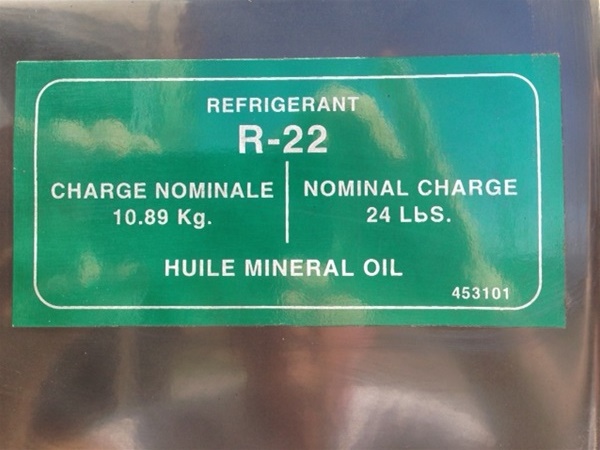
Rotated by the site fairy…
Jon, I stood on my head and took this photo of the decal on the door beside the compressor. I know I have an oddball coach, but the Prevost parts manual on page H3-2299-02 does list the part numbers of all the R-22 and corresponding R-135A O-rings and hoses for the OTR air system. And since the installed 05G 37 compressor is not intended to be used with R-135A freon, I’m kinda convinced R-22 is what I’ve got. Leave it to me to come up with a coach that’s weird. 🙂
What’s more important to me than the 15% or so performance difference between the two freons is how to go about troubleshooting a system that was working well just a short time ago. Section 22, Guide 15 of the H3-45 Maintenance Manual “The cooling mode indicator light is illuminated but the air conditioning does not function sufficiently,” suggests I check the circuits that turn the compressor on, but it’s already running continuiously. They end the decision tree by telling me to run a performance test on the compressor, then check coolant level and expansion valve. How does someone short of Carrier ops check a compressor? My feeble mind needs something like input and output pressure and temperature limits. Perhaps I just haven’t done the right research to find them.
I think expansion valves are supposed to be cold on one side and hot on the other, but I haven’t found any normal temperature ranges. The 68F and 93F I have certainly isn’t going to ice up the evaporator, but what’s it supposed to be and what do I do to change it other than taking an amateurish last resort stab at resetting a critical superheat adjustmemt?
With vigorously swirling bubbles in the filter/dryer sight glass, can I assume there’s no serious restriction there? At this point, I’m getting frustrated that I not only can’t put my finger on the probable cause, but can’t come up with a logical troubleshooting sequence either. Those wiser than I would tell me to take it to the experts, but I would feel so very much better if I could get smart enough to keep the system running myself. Some of us are just more stubborn than others. That great OTR system once frosted the windshield! What happened? Something should be obvious, even to the untrained eye! Buses can certainly be exasperating!
-
Although my cruiseairs are all working great, when I need to service my cruiseairs in the future, I would like to contact AAP for authorized service centers in my area, but this link seems to be broke. I get an “air-brushed artist” site when I click on the link.
Can you fix the link?
-
Okay, sorry I brought it up again!
-
Every thing is cool now (I think).
It could be because my memory’s not as sharp as it used to be.
Also, my memory’s not as sharp as it used to be.
Later,
DS
-
The amount of effort required to create a “leak free” coach is going to vary depending on age, type of coach (slides, no slides), and the conversion.
The more push in fitting, the older the coach, the greater number of air operated devices, etc. all determine the complexity of the pneumatic system and how difficult or easy it is going to be to eliminate leaks. There is no single answer because all coaches are different. What appears somewhat consistent however is that there are certain things that always seem to show up as problems such as the check valves and regulators listed above.
Before anyone should jump into a leak repair project it helps immensely if a person has a basic understanding of how the coach pneumatic systems are set up so you are able to focus on the area of leaks. Chase the big leaks first. If the leaks got worse fast, then it is likely the culprit is going to be easy to detect and the leak rate will slow down quickly one the big leak is found.
Unfortunately as coaches age they become afflicted with many smaller leaks that take a lot of time to isolate and repair. As Peter stated it is possible to get a coach leak free. But it is an ongoing process to keep one leak free.
-
I believe the XLII overhang increase on a 45 footer is equal to the width of the rear compartment door that is behind the tag axle on 45 footers. The balance of the extra length is in the bays.
-
Congrats Tom and Bill. You have a really nice coach and Al has done a great job maintaining it.
Now let’s all help Al spend his money. The sooner the better because being without a coach does create a degree of pain.
-
Roy,
If it turns out to be the regulator, it is not a Generic item you can get at NAPA. It is specific to Powertech. Call Jeff Jones at Powertech, and he can help you through any problem you may have. His direct number is 352-435-4416
-
I’m not sure why CC would have modified lighting to the Prevost gauges, but your dimmer does show CC labelling on the wires. If I was to guess, CC ran those through their dimmer circuit board. That board on my coach was mounted behind the glass dash where your speedometer is likely located.
The board located in the steering bay supplies 5V for the dash Sunmulon switches. This power board is unique as it dims the front switches when you turn the lights on. The switches elsewhere in the coach get their 5V for lighting from the ECC in bay 1.
-
Thanks Ben. As usual excellent advice.
-
When I read the first question in this posting, I started to respond, then in further reading to see if anyone had covered the points I was going to make, noticed that someone opened the “can of worms” about Lithium Iron Phosphate battery charging….I decided to not touch that one based on the book of information that would be required to adequately cover the subject of charging, autostarting, and lithium cell power management.
I will mention this: Everything you understood about lead-acid batteries goes in the trash for the characteristics of Lithium Iron Phosphate battery construction and chemistry.As for the regular, either flooded or AGM lead-acid type battery, any autostart system that just looks at battery voltage alone is seldom accurate in starting based on actual battery capacity left. Because of internal resistances and electrolyte stratification, an autostart MUST know what the discharge RATE is to be accurate. The voltage that would represent 50% of battery capacity could be 21.8vdc or 23vdc, depending on if the current flow out of the battery is 1 amp to run a clock only, or 200amps running air conditioners, microwave, refrigerator, etc all at the same time. Some autostart systems utilize an ammeter shunt PLUS voltage to calculate amp-hours out of the battery bank, others use different voltage values held for certain periods of time to account for the current coming out of the battery bank.
An autostart that looks at only one voltage to start the generator to recharge is only accurate for ONE discharge rate/load current value.Anyone having an autostart that only starts on one set voltage are better off to err on the side of “worst-case” to prevent over-discharge of the bank. The drawback to that is they may not seem to get much dry-camping time.
Hope this helps.
-
The new CAC did not make any difference in engine temperature. I didn’t hook up the iPad this trip so I don’t know what the inlet temps are. The fan is working, we tested it while at Prevost TN working on the a/c and checked both speeds.
I had one inlet temp code and a couple of “special instruction” codes on the way back from TN. Neither turn on the CEL, and both can be cleared. I have seen these since I got the coach. All depends on outside temp and if you are pulling any big hills.
-
We stayed in the south lot in an area roped off for a group of us that were viewing the race from one of the suites.
Never again.
All was good up until the moments after the race when the morons in plastic motorhomes thought it would be fun to set fire to the trash barrels. That wasn’t enough so some of the morons tipped the barrels and started rolling them. If the burning trash took out a few Winnebagos that would have been OK, except as the barrels rolled the trash fell out and the burning trash was blowing underall the RVs including ours.
I guess we are not party folks. We left so our bus wouldn’t catch fire.