Prevost Community Forums

Find answers, ask questions, and connect with our
Prevost Community around the world.

  • OTR air troubleshooting

    Posted by Ron on June 6, 2016 at 7:08 pm

    As a rank amateur at maintaining air conditioning systems, I need some serious guidance. I discovered my old technique of topping off freon until the sight glass bubbles disappear can lead to overcharging the Prevost OTR system! I’ve sheepishly brought the level back to the halfway point on the lower receiver tank glass and ignored the dryer glass bubbles, but while that level is correct for R-135 freon, I’m not sure it’s the same for R-22. I’ve got a 1998 seated coach that was made just before they changed freon, so it’s still on the older stuff. Prevost pubs sent me the later R-135 maintenance manual and I’m assuming it’s a bit off. Bringing up an earlier coach series manual on the Prevost website should show me one using R-22, but it doesn’t. Can anyone help with a fudge factor for adjusting printed R-135 pressures and levels to R-22?

    Please check my logic on AC troubleshooting. I think I should resolve freon issues before looking for electrical problems. That is, assuming the system either activates unloaders to reduce compressor output or disengages the clutch when the selected temperature is reached, it should be obvious that the electrical control end is basically working so long as the clutch is engaged and the compressor heads are cool on the suction side and hot on the high pressure side. Does that sound like a reasonable statement if I manually bypass the liquid refrigerant solenoid valve, ensuring an unrestricted flow? If so, it would appear that the only things I can do to affect all the temperature and pressure readings I’ve taken are adjust the freon level, clean the filters and fins or fiddle with the superheat adjustment on the expansion valve (something I’m really hesitant to do). With the freon level now correct and no air blockage in the condenser or evaporator, the system is still putting out ambient temperature air. I’m hoping someone in the group can help me decide what to do next. Thanks, Ron

    Archived replied 10 years, 2 months ago 8 Members · 10 Replies
  • 10 Replies
  • Jim/Chris

    Member
    June 6, 2016 at 8:16 pm

    Ron Are you sure it’s freon 22 ?

  • Archived

    Member
    June 6, 2016 at 11:38 pm

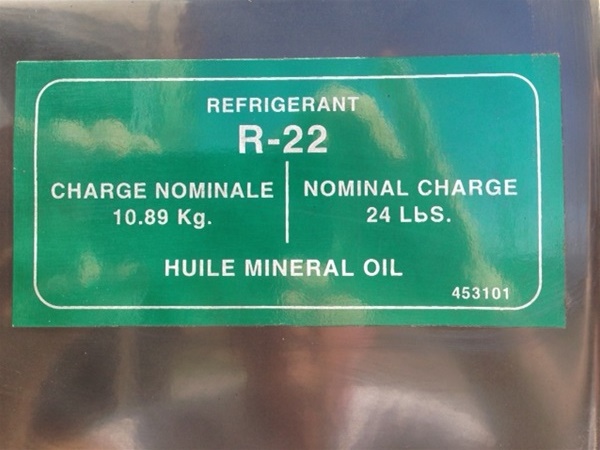
    Darrell, I’m fairly confident about the R-22 because the compressor is the 05G 37, not the 05G135. There is a decal on the door calling for R-22. The system has been working well with me servicing it with R-22 for the past several years. Thank you for asking.

    Do vapor pressures at the compressor of 98 psi inlet and 250 psi discharge sound reasonable to you? How about 88F inlet and 193F discharge with an ambient temperature of 83F? Any insights you can give will be appreciated.

  • glen

    Member
    June 7, 2016 at 6:40 am

    The Prevost OTR system used R12 prior to switching to a 135A refrigerant.

    The only R22 used on our coaches to my knowledge has been in Cruiseairs which are installed by the converter.

  • Ron

    Member
    June 7, 2016 at 1:15 pm

    Rotated by the site fairy…

    Jon, I stood on my head and took this photo of the decal on the door beside the compressor. I know I have an oddball coach, but the Prevost parts manual on page H3-2299-02 does list the part numbers of all the R-22 and corresponding R-135A O-rings and hoses for the OTR air system. And since the installed 05G 37 compressor is not intended to be used with R-135A freon, I’m kinda convinced R-22 is what I’ve got. Leave it to me to come up with a coach that’s weird. 🙂

    What’s more important to me than the 15% or so performance difference between the two freons is how to go about troubleshooting a system that was working well just a short time ago. Section 22, Guide 15 of the H3-45 Maintenance Manual “The cooling mode indicator light is illuminated but the air conditioning does not function sufficiently,” suggests I check the circuits that turn the compressor on, but it’s already running continuiously. They end the decision tree by telling me to run a performance test on the compressor, then check coolant level and expansion valve. How does someone short of Carrier ops check a compressor? My feeble mind needs something like input and output pressure and temperature limits. Perhaps I just haven’t done the right research to find them.

    I think expansion valves are supposed to be cold on one side and hot on the other, but I haven’t found any normal temperature ranges. The 68F and 93F I have certainly isn’t going to ice up the evaporator, but what’s it supposed to be and what do I do to change it other than taking an amateurish last resort stab at resetting a critical superheat adjustmemt?

    With vigorously swirling bubbles in the filter/dryer sight glass, can I assume there’s no serious restriction there? At this point, I’m getting frustrated that I not only can’t put my finger on the probable cause, but can’t come up with a logical troubleshooting sequence either. Those wiser than I would tell me to take it to the experts, but I would feel so very much better if I could get smart enough to keep the system running myself. Some of us are just more stubborn than others. That great OTR system once frosted the windshield! What happened? Something should be obvious, even to the untrained eye! Buses can certainly be exasperating!

  • tom

    Member
    June 7, 2016 at 1:42 pm

    WWow! Was yours a seated coach?

    In all the forums I have never seen or heard of an R22 refrigerant system.

    The only way to really check a system initially is to hook up the gauges. Are the pressures within range?

  • michael

    Member
    June 7, 2016 at 3:25 pm

    It’s the same old coach I’ve been working on for the past hundred years or so. I personally took the seats and luggage racks out way back when. Take another look at my 3/12/14 Homebuilders post, “More homebuilt H3 photos.” ‘Still got a long way to go on the interior.

    I’m with you on the R-22. I thought it was only used in houses, but the 53′ trailer refrigeration units use it as well.

    Here’s hoping there’s someone reading this who can bring “hook up the gauges” down to my level. Ballpark R-135 readings will be fine for now. I have no idea if the 98/250 psi I saw on the gauges is even close and if it is, why I’m getting nothing better than 68/93F at the expansion valve. You more experienced AC tinkerers can jump in here. Most everyone knows more about this than I do. I’d really appreciate any and all opinions.

  • Dan

    Member
    June 7, 2016 at 4:37 pm

    My bad Ron. I didn’t look at the user name or I would have known. I suspect the R22 might be either exclusive to the seated coaches or a bus company ordered it with an R22 system.

    But refrigeration is all the same in the respect the refrigerant still is going to have a high and low pressure value, and the system has the correct charge when those pressures are met. The label even suggests that in how it is worded regarding the capacity.

  • Archived

    Member
    June 7, 2016 at 5:35 pm

    I attached a copy of the Carrier A/C compressor manual in the “articles” section. It has some good info. However, I’m still looking for a procedure for “hooking up the gages” and a specification as to what the gages should read. I need to do a little work on my OTR AC also but I’m a very gun shy after reading about various coach fires cuased by improper A/C service.

  • Bryan

    Member
    June 8, 2016 at 5:49 am

    Many of the charter coaches used to run R-22….I think I have only ever seen 1 motorhome with R-22 in the OTR system.

  • Archived

    Member
    June 8, 2016 at 12:08 pm

    Forum gurus are forgiven for not immediately recognizing a name now and then, especially when some of us drop out for months at a time. It’s hard to believe you’re able to keep up with as many folks as you do.

    Thanks to you and Jeff for pointing out how rare R-22 is in these coaches. I noted only that separate hoses and O-rings were offered for R-22 or R-135 on H3-41, H3-45 and V.I.P. 45 coaches R-012 up to W-2284. My coach is W-2312… go figure. The older R-22 may be getting scarce the way R-12 did, but fortunately I’ve got enough R-22 to last a while.

    Dan, like you, I’ll not risk a fire by just winging it. Apparently, to get the freon charge correct, you fill to the middle of the lower receiver sight glass as a rough guess, then refine it by using the pressure gauges. I guess I was just being lazy in hoping someone would spoon feed me an accurate and simple way to do it. Thanks for the compressor manual. It helped a bit, but my research has just begun. This ain’t rocket science. With enough effort, even I can do it. YouTube has already taught me how the AC gauges operate. Clever little thingies! I’ve never needed that knowledge before. Now I do. When I’m sure I’ve got it down, I’ll share it with you. Meanwhile, I’m back to my online AC technician training and lurking here to pick up pointers from those of you who are a lot smarter than I.

Log in to reply.