


gary
Forum Replies Created
-

Thanks Bob and John! Will do! John … do you remember what the cost of the valve was?
-
Wecome Folks,
Kinda new to all this Prevost stuff myself. Couldn’t live without OTR air in my bus. Will freeze you out on the hottest day. Have to mix heat to stay comfortable (wifey complains) Bought converted 1991 XL with 51,000 miles on that had been climate controlled garaged for 8 years for $57,000 bucks. Genset (15kw Kubota had 25 hours) Looked like it rolled off showroom floor. We have already wrapped up around another $20,000 in it, which is easy to do. Replaced everything inside electrical, tires, batteries , water pumps, everything charged. (3 cruise airs) Cruise airs do the job but spent a lot of time last summer on the beach (Gulf Coast) and there were straining to keep up at 105 degrees. If you find a older coach don’t be afraid on it. Just got mine out yesterday on service from Prevost Ft Worth for air problems. On our year model had everything to fix. Even did a recall that had been set in 1996 for brake system. Once again, Welcome and good luck.
-
Having made more grease traps than almost anyone on the planet I can address David’s remarks easily. If you dump greasy waste in your drain system you are going to have problems. The grease, fats and oils seem like a viscous material, but over time they coat the walls of pipes and form an adobe like material. I wouldn’t worry a whole lot about the holding tank because before the tank gets plugged you will not get any flow down the drain.
Cities across the country spend billions keeping municipal sewer systems flowing and fighting blockages from fats, oil and greases. If you do a lot of cooking and dishwashing in the coach just use paper towels to wipe pots or dishes to minimize anything containing grease from carrying that down the drain.
If you do have concerns about grease in your drain system you can deliver your problem downstream. It is not legal or very moral but if your grease has not converted itself into the solid adobe like material Dawn or something similar will emulsify it and cleanse pipes and holding tank walls, allowing it to flow into the municipal sewer system where your problem now becomes the sewer authority’s problem.
-
Tom,
I would start by going to salvage yards for bus parts. Radiator shutters actually are very beneficial in that they save fuel. If when they close virtually no air passes through the radiator and it reduces the load imposed by the fan. Lore has it that the radiator fan can take as much as 30 HP but I have no verification of that.
If you want to see how something that blocks air flow can reduce the load on a fan, run a vacuum cleaner with nothing impeding the air flow into the hose. Then stick your hand over the end of the hose and you will immediately notice the speed of the vacuum motor increases since the load has been reduced.
-
Jon,
It must be early. Per my earlier post I calculated my front wheel weights to be 7,900 lbs. Michelin says that for 315 XA2 tires I should be at 110 psi–not 105 and not 115. Like most, I add 5 psi for safety which brings me to 115psi. Maybe I’ll come down 5 psi from 120 psi to 115 psi. What I won’t do is come down to 105 psi. At 115 psi or even 120 psi, I’m below the 130 psi maximum pressure allowed by Michelin. Although 120 psi will carry 8,530 lbs, that’s not what is driving me to 120 psi nor most others that overinflate their tires; it’s safety. Underinflated tires are dangerous.
Net-net, I should inflate my front tires to 110 psi per the weights I’ve measured plus added calculated weight not on the bus when weighed. Anything less may be dangerous, anything more (but less than 130 psi), may affect ride and/or thread wear.
-
Gary,
Having an “H” may have advantages.:)
-
Karl,
Not true. At the time the coach was checked and verified as being OK that ended the seller’s responsibility. Forget about the skins for a moment and instead apply the same logic to the engine. If part of your purchase agreement was to be verification the engine was in good health, and it was in good health because you had XX months of trouble free performance, why would you expect anyone to own the problem if the engine developed a glitch a couple of years after you bought the coach?
The same could be true of every part of the coach. From leaks in the roof to leaking air bags.
Most importantly is the fact you bought a coach from the converter as did a great number of owners. Just because they say the Prevost chassis, or the engine, or the transmission is in great shape, that doesn’t mean because they said that they are obligated to repair any of that if problems should arise at a later date.
To put it in medical terms, if a physician ties a women’s tubes (those are probably layman’s terms) and the woman gets pregnant will the physician volunteer to provide total support for the child to college graduation even though the procedure worked for 10 years?
-
OK so it’s not something I can just remove and replace or clean, it requires someone to get under it or put it on a pit. Thanks.
-
Don’t know about your conversion but it sounds like a pop off valve and the compressor start stop valve are not balanced in their adjustments.
You must first determine the pressure you want to hold in the tank/system then adjust the pop off to hold pressure to some point higher than that.
Adjust the compressor start stop switch to start at the lowest pressure you want to allow the system to go down to.
Adjust thecompressor off switch to stop the compressor at a little under the pressure set on the pop off valve.
The compressor start stop switch commonly used is a “well pump switch” and available at Tractor Supply, Ace Hardware, Northern Tool, WW Grainger and of course your neighborhood well service co if you live an a rural area.
This is not complicated, the pop off valve usually has a tapered valve to a seat, held closed buy a spring the spring pressure against the valve is adjusted by a threaded rod and locked in place by a lock nut at the pressure you desire.
The well switch is adjusted with a nut moving an arm to actuate a micro switch.
The switch is the grey cube with the white wires going to it.
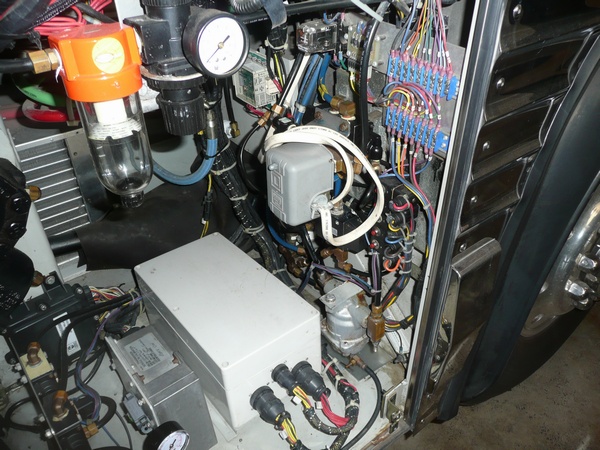
JIM
-
Tom,
Put it on your calendar, we waiting until after April 15th just for you!
-
Tom,
Thanks for posting pictures of the inside of that thing. My Dad made his living as electrician specializing in machine controls. He can not wait to get his little fingers on the old control box. He hopes to fix it so I will have a spare. How did you get it apart?
DKO
-
As soon as the bus was in my garage the shield came off. It is nothing but eye candy and actually inhibits a good pre-trip inspection.
But on the current coach I am wearing my bra. I suspect that will create a few mental images among the twisted minds that populate this site. The bra is a PITA and I am still trying to decide if protection agains dings is worth the effort. Any CC owners who still have the shield want to jump in on this? It’s a toss up regarding whether the bra or plastic looks worse, but at least I can roll up the bra and throw it in the bay when parked.
-
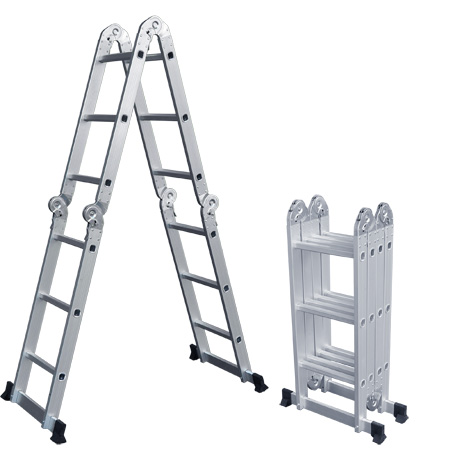
Bill, That is not the exact ladder, but the concept is the same as the one I have used for 22 years. It is a step ladder, can be opened as a bridge, or can be fully opened so you can get on the roof. When folded the space it takes is not much and except for my tools, there is nothing else more important that I bring with us.
A google search of folding ladders will provide you with pages of options.
One comment. Not knowing how you will use your coach, space in the bays may be critical or not so important. When you know how you want to arrange the bays to fit in all your stuff (we all carry a lot of stuff) just consider the ladder to be vital and thus easily accessed.
-
Worth a try Fred, hope it gets you going.