
Dick
Forum Replies Created
-
Mark,
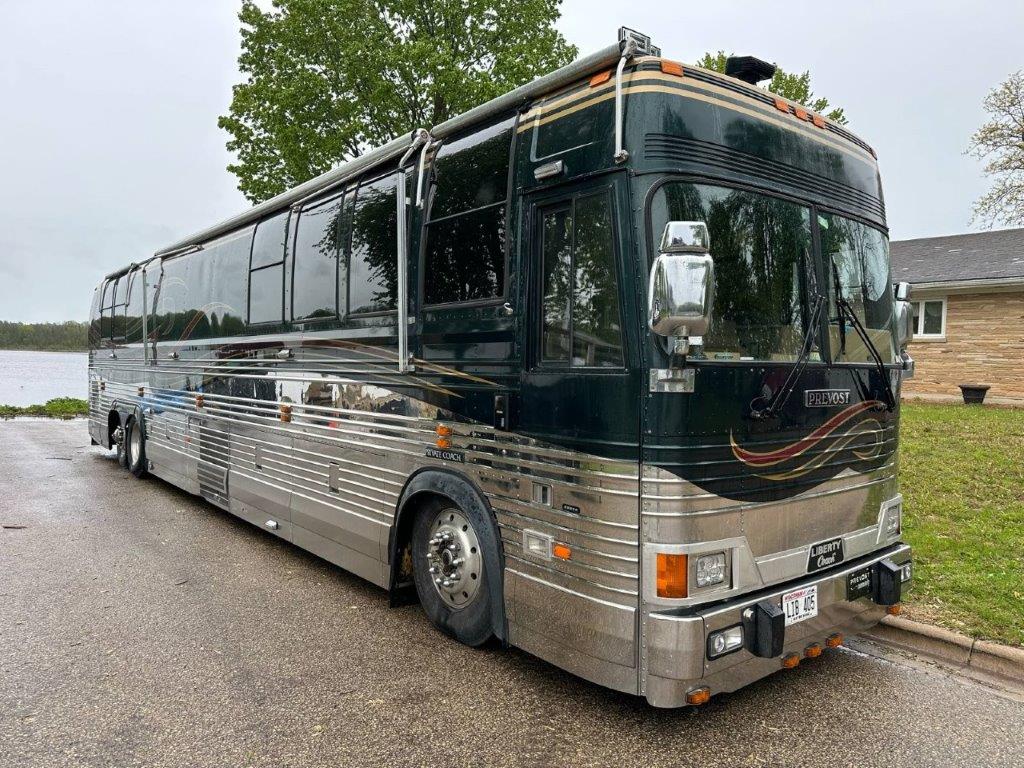
How tall is your new liberty? We are 13’4″ to the top of ours… and haven’t had any troubles in or out of the Fort.
Bill -
Looks like a nightmare to me.
Bill – Your dues will be going up regardless of what Jon says…
-
FWIW a brake chamber leak, either on the service side or the emergency brake side should show up on the gauges. I don’t understand why that was not the case here, but for those who may not understand what is going on here is the Reader’s Digest condensed version.
Emergency brakes are released by a large rubber diaphragm (on older style combo brakes) pushing against and compressing the spring that holds the emergency brake in the “on” position. If the diaphragm starts to leak both pressure gauges will show this by cycling up and down. If there is any question while driving, pull into a safe spot and apply the emergency brake. The pressure should remain constant because when the emergency brake is applied all air to the chamber is shut off, so there is no leak.
On a pre-trip inspection this will show up as a pressure drop on the gauges as soon as the emergency brake is released. If the leak cannot be overcome by the bus engine driven compressor the brakes will automatically apply.
Service brake leaks also show up in the gauges. When the brakes are applied (all air brake systems regardless of vintage) a steady pressure drop will be noted. As soon as the brake is released pressure will build and the pressure on the gauges will be fairly constant. A service brake leak will only show on one of the two brake system gauges.
A pre-trip inspection will show this as a pressure drop on one gauge.
The leaks discussed above can occur in the brake chambers, air lines to the brake chambers, or at fittings from the relay valve. A leaky or failed relay valve can also exhibit similar characteristics on the gauges, but relay valves generally are reliable. I fully agree with the 5 year brake chamber replacement plan. A lot of good brake chambers will get thrown away, but the cost of one on road service call is going to exceed the cost of replacements.
If a problem with the brake system exists, block the air line, and in the case of emergency brake cage the brake, and keep driving to the service facility. Do not get a tow.
-
While they were replacing the electric, they should have moved the sewer outlets closer to the middle of the sites as well. Not everyone carries that much hose….but then again, not that many pull trailers that long either. Without that, it wouldn’t be as bad.
-
Having had them fail in trucks, I am surprised too that the gauges did not cycle like crazy. Last time it happened to me in a truck, I noticed it right away, and was able to get off the road before a problem started.
I have not yet had that issue with the bus, and I hope I never will.
-
Thank you for your comments and experiences at the Fiesta. This will be a new experience for us 😉
June
-
Geo:
Leave Panama on Thursday of this week. Arrive at bus Sunday afternoon. Should finish paperwork Monday, have plates on by mid morning Wednesday. Then scare the blazes out of everyone on the road. Already have insurance, so you are covered. See you at Fun & Sun.
-
No kick heater up front Tim. I have one in the galley contolled by the SMX and one in the bathroom contolled by a Techlink button with the thermostat on the face of the kick heater. It would have been nice to have one up front.
-
Dick
MemberDecember 6, 2015 at 4:02 pm in reply to: PC/Parliament Air & Coach Concours Winter AutoFestHey Admin, On the “fun-n-sun” web site, fun-n-sun.org, they advertise this event thru 2/29. Can you confirm?
-
I agree with Steve.
…….. them and the horse they rode in on!
-
Eric, Start at that assembly. That is a protection valve. Work backwards.
Bob, the solrnoid valve is the Liberty way of providing a check valve against leakage through the compressor.
There is no air leak big enough to keep both compressors running. According to Eric the house aux compressor cycles on and off, I suspect rather frequently because the volume of the “pressure tank” it sees is only the volume of the house systems and air lines based on his description. There is no check valve that prevents aux compressor air from going back into the accessory tank because that is how the tank is pressurized when the coach is not running. I suspect, and Erci can verify this, if the accessory tank pressure is at zero, he can turn the aux compressor on and it will not pressurize the tank, so whatever blockage is in the system it is preventing accessory air flow to and from the house systems. The problem is in between where the accessory tank feeds the Prevost systems and the house system connection point.
-
And no worries MM, if you left your shitter full you could flush it from Berlin.
Later
bv
-
Unplugged vs plugged in to a 50amp service….If in 50amp shut waterpump off, in case of a leak. If a XL I would shut off 24v and 12v disconnects on chassis batteries…otherwise good. If in no power or 15amp type power then you may need to do more, especially when it gets cold out…
-
My bus is a 95 XL Chassis and it reads nearly 12 volts from ground to the blade the bulb is touching with the bus not running, the key not on but the running lights switched on.. That means the running lights are 12 volt not 24, right?
Also the three lights I looked at had no gasket under the between the plastic light and the metal bracket. Not normal?
Davy