


Peter
Forum Replies Created
-

I agree 100% with Jon.
Another year of free membership for both Jeff and Steve! Drinks all around!
-
It is nice to have a no leak coach and over the next year or so I am methodically going to replace valves and fittings to see if I can make that happen. But having done this dance on 2 previous coaches I know for sure as soon as i get it done I am going to restart the process of checking leaks.
What I did do on the previous coach however was to isolate the problem circuits that were not necessary when parked and shut the air off to them via a “key on” solenoid valve that I installed in their air circuit. In that manner if the problem circuit started losing air again it did not affect me when I did not need it. However, if a solenoid valve such as I installed fails to open air will not get to that circuit, and one that has always been an issue for most folks is the belt tensioner in the rear. You can do without air to the seat, but you cannot run the coach without air to the belt tensioners so on critical circuits if you install a solenoid valve, make sure you have a manual by-pass in the event ot a solenoid valve failure.
-
This is cool!
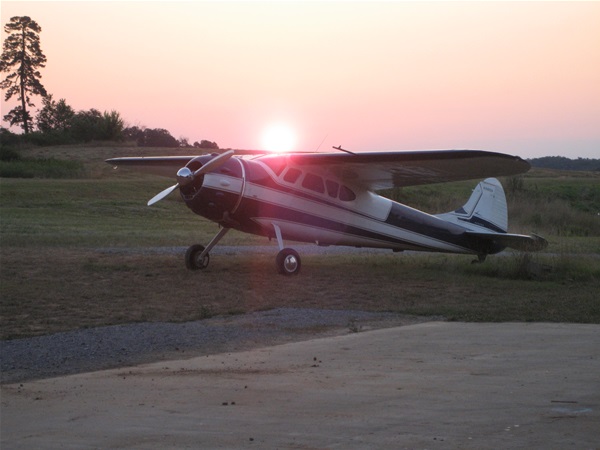
Looks like we may have something here. That’s a very nice Cherokee. If I was smart I’d have something like that.
Steve, I’m not going to make the Chino fly-in. It’s a long ways to CA from GA and it’s close to the time of our gathering on the mountain. My good friend Jeff Pearson is one of the hosts and I’m sure it will be one for the records.
A close friend of mine has his 195 for sale and it’s a very nice airplane. The price is, I think, very reasonable considering the quality of it. He bought a 310 and isn’t going to keep both of them. If you would like I’ll be glad to hook you up with him. I’ve had mine for nearly 30 years. I bought it in pieces and restored it and I can’t imagine ever being without it or the Swift. I had another Swift years ago and sold it and then later bought another one. It’s the only airplane that I’ve sold and then later replaced. It’s a sweetheart.
If there’s anyone who would like to come to our October event, you’re for sure invited.
Here’s the first attempt to upload photos.

-
Yes, I wrote Aux compressor was in the middle bay. It’s the front CS like you say.
Later
bv -
The fresh water tank is leaking when nearly full.
-
Even worse? Wondering why none of the outlets in the forward/mid section work, getting out the manuals, checking the circuits, breakers, etc.. and then after about 30 minutes having the bright idea to check the GFI breaker in the kitchen. Yep, that fixed it.
These coaches are very complicated systems and when you start throwing in the fact that each and every convertor does things a little (or sometimes a lot) different. It’s hard to know everything and to understand how some fixes one coach may not help on another coach.
Jeff looked at me like I had been dropped on my head when I asked him about installing check valves on the Liberty. Guess they are not as needed due to their air system design as say a Marathon. Wouldn’t have known that if I hadn’t asked and shown my ignorance, which Jeff took in stride and diplomatically answered 🙂
-
FYI:Prevost only carries the 24V – but for those of us with my vintage Liberty Classic, we need the 12V as well.
Just ordered a couple of the 12V solenoid coils from Norgren as spares.
Norgren part #: for 12V solenoid coil 54452-02
http://store.norgren.com/us/en/detail/54452-02/solenoid-coil-12-vdc
-Joe
-
I hope everyone understands there are many ways of checking for leaks and all but one will fail to detect all leaks.
Soapy water will show leaks that blow bubbles like at fittings. That will not detect leaks internal to a valve for example, or leaks you cannot see such as at the bottom can on an air bag.
Your ears are good leak detectors if the leak is big enough.
For smaller leaks, but those still audible a stethoscope will work. A stethoscope is a big help isolating the area of a leak, such as in the engine area where the sound of an audible leak bounces off of everything and makes pinpointing it difficult.
Small leaks that are in fittings or even internal to a valve can be detected by a device such as Jeff uses. It is an ultrasonic leak detector, but it requires the leak to be in other than a rubber device such as a pin hole in a rubber air bag. It also takes a degree of “tuning” so the leak is audible.
The four leak detectors above will catch a lot of leaks. But the only way that will isolate every leak without fail is to pressurize a system, starting with the source and use a pressure gauge or a bubbler to note pressure drop. With such a device you start at the beginning and follow an air circuit until you get to the point where no leak is detected. At each point you have to open the circuit and connect it to the tester. This laborious process is the only way to isolate every leak.
-
Don, are they coming on and just not blowing cold? Where are yours located?
-
I went by Iron Horse. They do not work on Crusairs. They referred me to Krause Bus Service http://www.krausebus.com .I called them. Their bread and butter is entertainer coaches and they are currently very busy. They asked if I was in a hurry, which I’m not, asked me to call back in a week or so to see if they can work me in.
-
Yes I agree but sometimes I get in at night and need to see and work with both hands
-
Questions from a naysayer:
Since using fill through valve stem caps my air loss in tires is approaching zero with seasonal adjustments being the primary reason to add air. How well do the sensors seal?
I have 3 toads, all take completely different tire pressures. What is involved in reprogramming the pressure for the toad sensors? How long does it take to program the sensors?
The monitor looks good.
-
Yes I use it every week to light up the corral where the horses stay to feed them and check on them