


Brian
Forum Replies Created
-

I seriously doubt if Prevost or the converters would use anything other than DOT fittings. If they have used non-DOT approved fittings I have not seen any. Conceptually the push on are great, but the enemy is time and since the seal is a rubber O ring that ages, hardens and eventually leaks we are destined to have problems.
We will not have aging issues with compression fittings. But when we get to the point where we have to replace leaky fittings we are also going to have to create new manifold blocks that use compression fittings. On my coach I have no less than 3 air manifold blocks that use swivel type 90 degree push on fittings. The leak potential is at the push in connection point or at the swivel. The block is too small to allow the use of conventional 90 degree compression fittings so a new larger manifold will be required or I will have to use new push on swivel 90 degree fittings.
I believe Hector said almost all his leaks were from push in fittings. When a compression fitting is leak free, age will not cause a leak.
-
I’ve never seen a coach with shoulder belts. I don’t think changing out a seat with integrated shoulder and lap belts is as easy as it sounds. Our seats are air seats that go up and down as necessary so our tender bottoms never feel the discomfort of a rough road. I cannot speak to all seat designs but the ones I have seen are built in sections and I doubt if they possess sufficient strength to carry the G loads of an accident. The four tiny bolts holding the sections together sure don’t appear strong enough to do any more than hold the pieces of the seat assembly together.
Our seat belts are attached to the floor of the coach rather than the seats and use very heavy bolts and anchors. Those appear more substantial than the bolts holding the seat sections together. If I had to put in a shoulder belt I would seek out a structural body member to attach to behind the seat. With slides that might not be easy.
I’m not as concerned about pitching forward and the restraint to prevent that as much as I am about something heavy like a tree or truck ending up in the living room because 53,000 pounds of bus hitting such objects at any speed are going to be more than the limited front framework of the coach can handle. Big trucks have a heavy engine leading the way to the accident. We have a heavy engine pushing us to the accident.
-
1/2 price for new, great deal John…
-
Yes Jon, we have exactly what you describe in your 6:45:13pm post – “smaller … mounted horizontal … bigger one vertical”.
I thought you were saying in your 7:01:34am post that there were two valves to open in order to get bypass flow to the ground. One manual valve in the bay that sometimes sticks, and then the solenoid activated valve triggered by the switch in the bathroom.
-
Brian
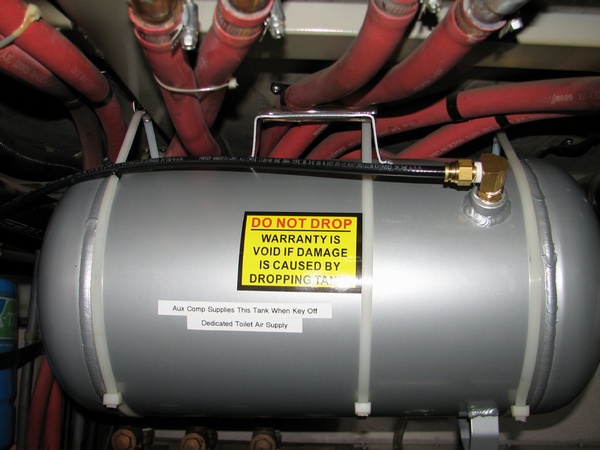
MemberNovember 14, 2012 at 7:31 am in reply to: Where to tap an aux compressor into air system?I took a little different approach and added a 2nd aux tank to feed only the toilet. With key off, the aux compressor only feeds the 2nd tank, with key on, it’s tied into the main aux system. Tank is aluminum and only weighs a few pounds. With the key on, I now have almost doubled my aux air volume which in turn cycles the engine compressor less while running.
-
Good Point about the Showers ! And there is also Laundry to consider ?
-
There may be as many as three thermostats in the plumbing bay.
There will be one for the electric heater on each side of the coach (upper left of the picture) which is like a house thermostat.
The thermostat for the A/H exchanger does not look like a house thermostat (upper right of image)
This is on the panel in the plumbing bay on the driver’s side

Also, check in the flea market section on this forum. I posted an ad for inverters and a Webasto plus extra parts. The contact for that is listed in the post.
-
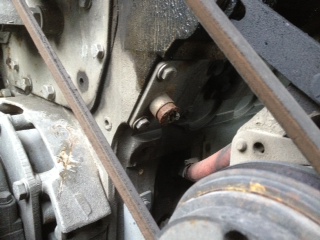
Is this it or what is left of it? Do I have to remove the 4 bolts that hold the plate? It doesn’t look like it is screwed into the hole,
Thanks
Richard
-
Bob,
Go here http://prevostparts.volvo.com/technicalpublications/en/wiring.asp and you will find access through that page to all the supplier documents for your coach. Look in the lower left corner after you go to “technical manuals” and you will find listings of suppliers manuals.
I don’t believe you can take the whole caliper out unless the pads come with it so you may have to break the caliper in half. The caliper bolts are torqued to around 450 ft/lbs and the bolts are a one time use and must be discarded once removed.
If it was me I would leave that issue to dead last and once the coach is powered up try to break it free with the engine power. Usually rocking it back an inch is all it takes to free a sticking brake.
-
Just because some leave their tanks open should not cause a smell. The hose should fit tight on the ground fitting. If it doesn’t then it doesn’t matter if the valves are open. You have to realize not all RVs enjoy the same holding tank capacity that we do.
My routine is that the hose comes out when we are leaving, if staying for two days or less. Longer stays it comes out then and both tanks are emptied and the valves closed. I leave the hose attached at this point and empty the tanks every two days. Like many, if not most, I use the gray tank contents to clean out the black tank.
I use the tank flush on the last use and cleanout prior to parking the coach after a trip.
I’d say you’re procedure is common for those with large tanks.
-
I didn’t get mine yet… have spent a lot there lately too !!
-
My first ever visit to a Prevost Service Center (Jacksonille) and the 2nd thing accomplished after a walk around inspection of my Coach,and they set me up with a $50000 credit account …. don’t know if that was because of the walk around inspection or not,but it is handy when ordering parts….hmmmm
-
The bus air systems, particularly the aux suspension systems seem to be misunderstood. There are articles on this site that will help with the understanding of the system. The reason for stating 120-125 PSI system pressure for leveling is because some coaches, CC and Marathon are two that come to mind, tend to be heavy on the front so it may take all of that to raise the front. On the other hand only 70 PSI may be required to raise the rear. The pressures are all dependent on how much weight is on the axle. You have weighed your coach while fully loaded so you know your axle weights, right?
My comment about leveling is not to suggest you use the compressor for that purpose. In a perfect world your bus should not lean at all. If it leans after three or more days I believe that is the acceptable standard according to Prevost. If you have a coach in which the system logic requires aux system pressure above 35 PSI (approximately) to retain tag axle air bag pressure your leans may not be the cause of a leak in the air bags or valves associated with the leveling system, but may be due to loss of air pressure in the aux system dumping tag axle air bag air.
If you are confused you are not alone. As I have suggested on another thread it is always better to cure the underlying cause of problems such as aux system air leaks rather than adding a band aid fix such as relying on an aux compressor for leveling.
The reason I pulled your chain on axle weights is not to help you understand you may have to run high pressures to raise the front of your coach but because you do not know how much pressure to put in your tires unless you know the weight they carry which is another whole topic.
-
I would say the batteries the DDEC draws only iin ma 25 ma for 24 volt systems that would be 00025 in amps they only draw 400 ma running that is less than a 1/2 amp fwiw
good luck