
-

Thanks, Gil. Sounds great. I’d like to ask you more about this later. Gotta get this first valve in…and I have a chance now since I have found out something that solves the mystery of the “T Check Valve.” 🙂
Susan
-
Al, thank you so much for this information. Now I know exactly which valve to get. And I don’t have to look for a T-type check valve any more.
That’s because what I have is actually a regular T with a check valve screwed into one of it’s openings.
Oy. Vey.
No wonder I couldn’t find one.
Don Wolf over at Panterra, who did the Angola conversion, figured that one out. LOL. Thank you, Don.
And thank you, everyone, for being such patient mentors during all this. You are the best. I got lots of great coaching (oops) along the way. Sorry about that pun *and* the confusion. 🙂
Susan
-
Susan,
Take comfort in knowing every single one of us was a newbie and a lot of us gained experience just after we needed it.
A lot of the advice we offer here is to prevent others like you from making the same mistakes we did.
-
Not to sound repetitious but…thanks so much. You’re the greatest. The help from you, Tom, and Al and Gil and Hector and everyone…just priceless. Susan
-
Wanna hear the good news as you struggle with check valves and replacing air lines?
In the not too distant future I can almost bet you will be offering suggestions and advice to new owners. We have seen that many times over.
-
That’s something to look forward to. I will celebrate it. (more than my birthday, Christmas….)
Susan
-
Kind fellows,
Here is a picture of the replacement inline check valve that I have purchased to replace the one that I broke. I am worried that the innards of this one are not identical to the ones inside the former valve. Here are the specs on this new one:
Max. Pressure: 500 psi. Temp. Range: -20 degrees to +180 degrees F.
A spring-close design prevents slamming when valves close to stop backward flow. Body is brass. At
least 1 psi is required to open valves. Install in any direction. Connections are NPT.1/4″ male x male $10.22
And here’s a picture of the (on the right…I have a question about the DOT compression fitting later in this message):
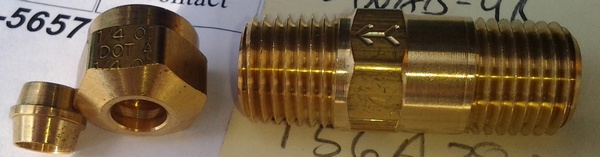
It does say that it has a spring inside, as the former one did, but I don’t think it has the stainless steel ball, and the seat is made of a different material. Will this check valve work OK?
I tried to get one from the place in Minnesota but I didn’t see this malexmale one. I ended up going with this one from McMaster-Carr, referred by Panterra. This one is less expensive but I am not sure it will be adequate to the task. ??
I also looked for the valve in about 5 local places, including a custom hose&coupling house and a pneumatics shop. Nada in stock. So I ended up ordering this one.
Re the DOT compression fitting–I was given this nut and
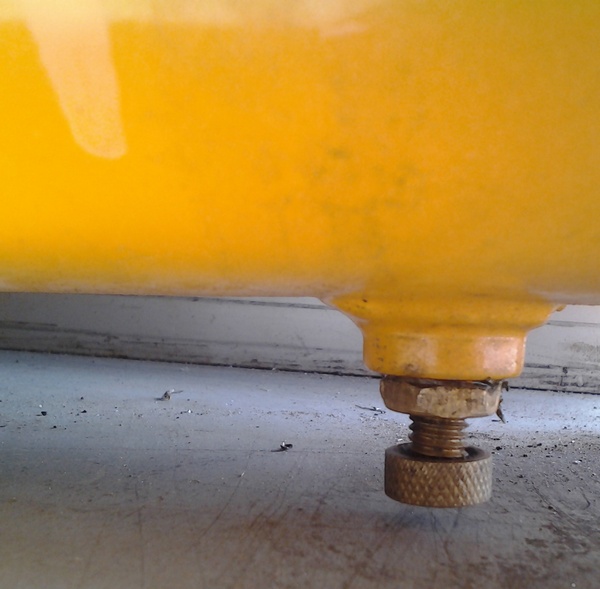
. But they didn’t give me one of those little tubes that you push into the hose to prevent the end from getting crushed. I need that little tube, don’t I? And a quick third question about releasing moisture from the tank. This moisture release screw (below) is on the very bottom of the tank (duh), very close to the floor. Is it sufficient to loosen the screw? Or does the screw have to come out? I’m hoping the former because it’s in an awkward position. Thanks a lot, Susan
-
The easy question to answer is the air flows in the direction of the arrow so when it is installed the arrow should point to where the air is going (away from the compressor). I think if the check valve seat is a pliable material rather than relying on metal to metal it should work OK.
I don’t know if all DOT compression fittings have the internal tube. The fitting parts you showed could be perfectly fine. One key to success on compression fittings is to only tighten them according to the book for their respective size. Somewhere in the Prevost maintenance manual it lists the standards for tightening compression fittings. I just cannot remember where it was that I saw it.
The bottom drain should not require the removal of the screw. I suspect it has a hole in the center of it and when you loosen it air and water is purged through the center.
-
Susan
I check this site about 2x a day and I didn’t see your post until now. Yes A-1 coupling in Tualatin will have every hose and fitting you will need. They are on the Tualatin-Sherwood hwy next to RV Outlets, on the south side of the road. There is a Chevron station and a Napa store on the corner of the entrance.
Greg
-

Susan
I check this site about 2x a day and I didn’t see your post until now. Yes A-1 coupling in Tualatin will have every hose and fitting you will need. They are on the Tualatin-Sherwood hwy next to RV Outlets, on the south side of the road. There is a Chevron station and a Napa store on the corner of the entrance. Looks like you found it and they didn’t have it Surprise Surprise. They is now 4 of us in the McMinnville, Sherwood, Wilsonville and West Linn area.
Greg
-
Figures I’d be the one to stump a custom hose & coupling place. ha ha Oh well, I’ve almost got it back together again. I’m just draining water out of the tank now…an astonishing amount of water….
I look forward to meeting up, Greg and everyone! I have joined Bus Nuts but have not yet renewed my FMCA…gotta do that. At any rate, I look forward to talking more. Gotta post about this water now!
Susan
-
Jon, you said that about a teaspoon of water comes out of the release valve? Here’s how much I have gotten out of mine so far, and it’s still coming.
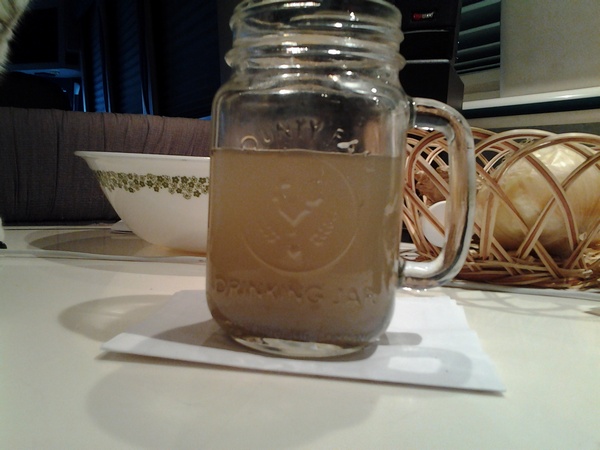
I have to jiggle the lock screw (turn it, bump it with cotton cloth) to get the drip to start up again and then it drips for a while and stops. Does that indicate sludge/sediment in the tank?
I am astonished. Don’t know what to think except that it must not have ever been released before…?
Omigosh. lol…should I be very afraid?
Susan
-
I am thinking that if I drain all the water out of the air tank and there is sediment, sludge, or whatever else in there besides the water, would it have the effect of releasing that stuff into the system (stuff that had fallen to the bottom of the pool of water and, being underwater, not gone out with the air at the top of the tank). ???
Maybe I should just get a new tank?
Thoughts would be much appreciated.
Susan
Log in to reply.