


Archived
Forum Replies Created
-

Thanks Jon and Jack, I guess ther is no way to tell what is the problem except to get in to the compressor etc.
-
Michael: You could have had a major fire from the battery fiasco. I have never seen batteries that were that bad! You dodged a large caliber bullet this time.
I hope you now see the benefit of preventive maintenance so it won’t happen again. We don’t want to see a picture of your bus burned to a crisp!
-
Say hello to them for me Dale, you guys will have a great visit. I now see your bus “Bubble Tight” in no time.
-
Whenever I do maint. on the batteries, I clean all the connections and when I re-install the batteries, I give them all a liberal coating of bearing grease (or some other suitable heavy duty grease) and this will in turn, slow down corrosion if not stop it completely.
It aint all that neat and sanitary, but it works.
BCO
-
Michael,
It’s imperative that you now correctly
setup your inverter/charges to match the new AGM batteries and assure
the charging parameters are set correctly. The batteries came with
instructions on setting Bulk, Absorption and Float voltages. If the
shop tossed the paperwork, here’s the settings:Bulk/Absorption 14.2 – 14.4
Float 13.2 – 13.4
-
As it turns out, the existing house batteries were (apparently) old lead acid type. We had never paid attention to the house batteries because we don’t dry camp – the bus is ALWAYS powered by 50 amp shore power or the generator. At any rate, when we had the problem diagnosed by Atlanta Custom Coach, we were told that we needed to replace the house batteries. So, I bought a new set of 8 Lifeline AGM’s from Tom Chilcote @ Trans-Specialists and had them installed (the bus is at Atlanta Custom Coach now ready to be picked up). This morning, ACC owner Todd Lay e-mailed me pictures of the old and new batteries. I’d say this was the problem for sure!
Some of the old batteries had actually exploded!
Tom made buying/getting the replacement batteries very easy and almost painless! He quoted an outstanding fair price versus retail and had the batteries delivered in two days! (Ordered over the weekend, shipped Monday, arrived Wednesday). I can’t say enough about Tom’s generous help! If you’re needing batteries (house or chassis), Tom Chilcote is THE man!
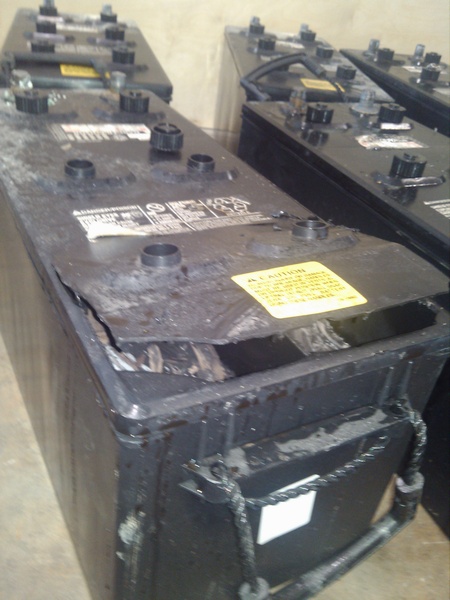
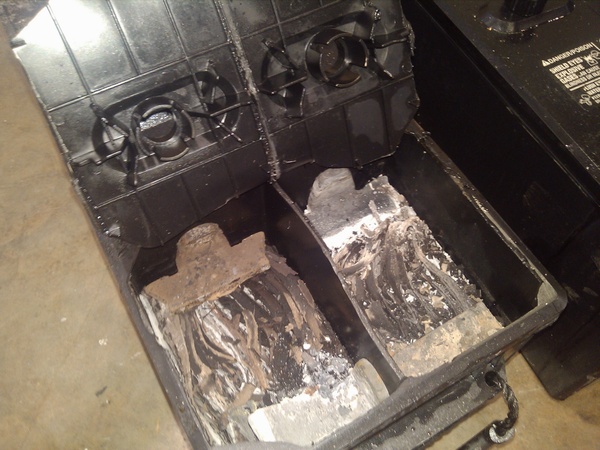
This is the new battery installation:
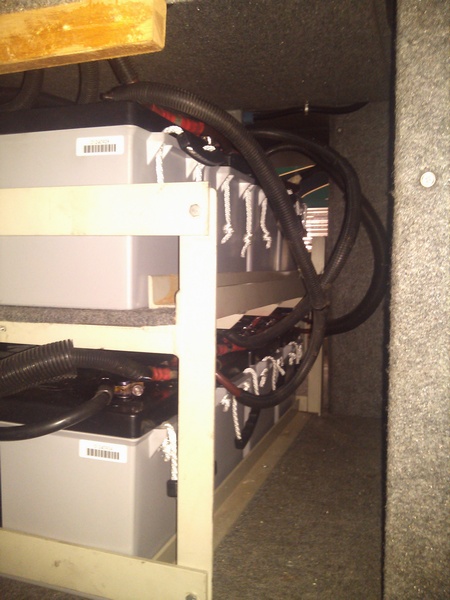
We’re picking the bus up today and going “camping” at Paradise Valley this weekend!
-
The low pressure condition is low refrigerant as Jon indicated.
Unfortunately
the charging of one of these units on a bus is a series of compromises. The
original design of the unit intended it to be used as a close coupled system
meaning the evaporator and condenser were close together. The condenser was
water cooled producing a condensing temperature that would seldom exceed 100
degrees F based on a water temperature of around 85 or less.In
order to put the system on a bus the water cooled condenser was replaced by an
air cooled condenser. This increased the condensing temperature and reduced
system capacity below the published data for water cooled systems. The condensing
temperature could be increased to as high as 140 degrees F. Keep in mind that
the condensing temperature is typically 25 to 30 degrees higher than the ambient
air temperature entering the condenser.With
R22 refrigerant, having the unit trip on high pressure at 425 PSI represents a
condensing temperature of 161 degrees F.ALL
compressors and manufactured air cooled units are ARI/ASHRE rated at a
condensing temperature of 130 degrees F. Any time the condensing temperature is
higher than 130 degrees F the published cooling capacity of any unit will be
reduced. Based on an estimated published cooling capacity of 14,000 BTU/hr. I
would expect the actual cooling capacity to be reduced to about 10,000 BTU/hr.
capacity when close to trip off on hi pressure.The
critical charge of a system like this is caused by a condenser with insufficient
capacity for the conditions it is operating in. The condenser has three
functions. The top rows are used to DE superheat the refrigerant. The
refrigerant will reach the condenser as a super-heated refrigerant vapor. The
temperature will often time be 75 degrees hotter than the condensing
temperature. The superheat is caused by the heat of compression and the cooling
of the electric motor inside the compressor.The
second stage is where most of the heat transfer takes place due to a change in
phase of the refrigerant from a vapor to a liquid. The bottom of this area
represents the condensing temperature.The
third section is sub cooling and is located on the bottom rows of the condenser.
The sub cooled liquid refrigerant may be sent to a receiver then to the liquid
line feeding the evaporator. Sub cooling needs to be sufficient to ensure that
the pressure drop of the refrigerant in the liquid line between the condenser
and the expansion valve is less than the sub cooling. Any pressure drop or
increase in refrigerant temperature greater than the sub cooling will cause the
refrigerant to flash to vapor and deliver liquid with bubbles to the expansion
valve reducing capacity.Imagine
a condenser 14 rows high, the top 2 are DE superheating, the next 10 are
condensing and the last 2 are sub cooling. The bottom 2 should be full of
liquid refrigerant. If the system is undercharged, the bottom 2 will not be
full of refrigerant and the sub cooling will be reduced causing the liquid to
flash to a gas prior to reaching the expansion valve. If the system is
overcharged, the liquid refrigerant will back up into the condenser reducing
the condensing section to maybe 9 or even 8 rows. The reduction is heat
transfer will reduce capacity due to a high condensing temperature.System
charging is easy when you are operating within the intended design standards.
When operating outside of the standard as indicated above, the charge becomes
critical and compromised. The goal of a properly charged system is to provide
the maximum amount of cooling without damaging the compressor. As Jon pointed
out this is generally when the suction line from the evaporator is as cold as
possible. There must be enough refrigerant in the system to reach the expansion
valve in a liquid state. The refrigerant is then metered into the evaporator
were it expands, a phase change takes place and the coils are cooled. If insufficient
refrigerant is in the system, only a portion of the evaporator will be flooded
and capacity will be lost. A similar condition will take place if the superheat
on the expansion valve is set too high. The expansion valve should be set for
8-10 degrees of superheat. In this case superheat is the temperature rise based
on the inlet refrigerant temperature and the outlet refrigerant pressure
measured at the compressor and calculated to be a temperature. The proper
superheat ensures that all refrigerant has made a phase change and is now a
vapor at the compressor inlet. A superheat that is too low will allow liquid
refrigerant back into the suction side of the compressor and destroy the
compressor in a short period of time.And
now that you understand a basic system, add a reversing valve so you have a
heat pump. The reversing valve will swap the evaporator and condenser sections
to provide heat instead of cooling. Anyone see a problem?Charging
to get maximum cooling is a compromise in a bus installation. If you want it to
work perfectly in a bus installation with heating capability you will have to
decide if you want to charge for maximum cooling or maximum heat.My
recommendation is to charge for maximum cooling and never use it as a heat pump
for heat.You
already have several ways to heat the bus without using the heat pump. -
EC-1 spec coolant has a limitation for the acceptable percentage a system may have of the conventional coolant. Without some digging I don’t remember offhand what it was.
When I changed to EC-1 I drained and filled with water 4 times. Then I used coolant system flush and I drained and flushed that 4 times, each time I brought things up to operating temp to open the thermostats and I also circulated everything using the Webaso circulating pump. Despite all of that I still had a significant red color of the old coolant. I know I was well below the limits but was kind of surprised at how much water I had used to flush out traces of the old and it still was a pink color on the last drain.
-
When I changed from 2 year to 6 year, it really didn’t seem to be much of an issue and if you leave a little of the old stuff, it’s not a major problem like if you were changing to Evans waterless. We simply elevated the front of the coach and drained at the usual places in the rear giving it plenty of time and opening as many valves as possible.
-
It takes a long time for the use of colors to define anti freeze to die down, Note this link that talks about the coolant types and colors.
http://www.irv2.com/forums/f25/antifreeze-requirements-for-diesel-engines-23650.html
This post is 5 years old, and while technically correct in defining the types of heavy duty diesel engine coolants you can bet the farm the colors mentioned are no longer valid. I have seen both 2 year coolant and 6 year extended life coolant in red. Without some label or tag to indicate what spec coolant is now in a bus there is no way of knowing.
I think within brands such as this one there may be different colors to define their specific products, but not to differentiate between their products and those of other manufacturers of coolant:
http://www.deloperformance.com/products/coolants-antifreezes.aspx?gclid=CJ2G0ZCakrECFY2b7Qod4iRkjw We have no reliable way to differentiate coolant types beyond testing. When in doubt, consider the coolant a 2 year coolant.As a comment relating to coolants, they are a pain in the butt to change on our coaches. Just burping the coach is an effort. Any who have changed coolant in the generator know how difficult getting air pockets from the generator and cooling system is. Changing coolant in the coach is far worse. For that reason I suggest when coolant change time is due, replace every hose you can find in the system (except maybe those bulletproof blue hoses on the engine) and put the six year coolant in place. Not cheap, but a whole lot better than having to do it again in 2 years.
-
With my 8V92 equipped coach, I literally had to drive the temp gauge by backing off and gearing down to sacrificing uphill speed to keep temps reasonable even after a new radiator. With the S60, if I select performance mode to keep rpm’s up, I can throw a brick on the throttle pedal and go make myself a sandwich while climbing grades. Obviously, speed still decays but 210 is max.
My use of OTR A/C does not seem to effect cooling and it shouldn’t directly. Other than the drag on the engine by the compressor, unlike a car, the heat load is transferred from your bays and not through the radiator.
If your fan is working properly, temps are above 210 (on an accurate gauge) and the use of cabin heat reduces temps; I would strongly suspect an occluded radiator. My 8V92 equipped coach overheated, cracked both heads, and damaged a cylinder or two at about 50,000 miles. Coach was 5 years old at that time and COOLANT HAD NEVER BEEN CHANGED. When I purchased the coach at 99,000, it still ran hot and we found and replaced the occluded radiator which was not replaced by DD at the 50K mile repair. I am not a chemistry expert, but the green coolant is reported to suffer from additive degradation and particulate dropout, both of which mean maintenance is paramount to avoid a radiator issue. I believe the recommended coolant replacement interval ( for green stuff) is 2 years. Both of my coaches were switched to the HD red stuff which supposedly has no drop out and lasts 5 years.
-
Charles,
Go back to the first group of posts on this thread and you will see Prevosts answer there. It’s blade number 85.