
-
Temps Up, Need Some Help
Posted by Davy on July 9, 2012 at 5:43 pmI am posting from the road so if this is in the wrong area, I apologize. You are welcome to move it.
My temps are running higher than normal and here is what the book says.
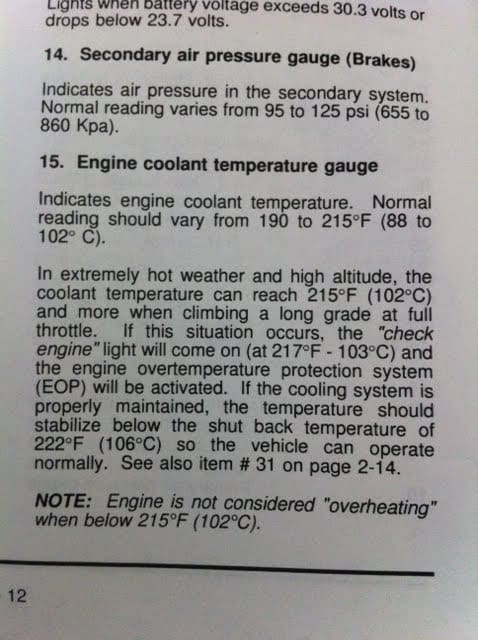
The outside temp is low 90s which is the upper limit for my driving preference and hot for Montana. I am above 4500 feet above sea level and have been over 5500 today. I am going west on I-90 and stopped at a rest area in Bozeman now.
As I topped the pass going into Billings my temps climbed to about 210. I turned the bus air off and it cooled down nicely as we were going down the other side. As I climbed each hill going west the temps would raise little more but come back down fine. I left the bus air off completely.
Eventually the temps would climb near the 215 mark and I would pull over and it would cool down almost immediately. I checked the gauge in the back and it was usually within about 5 degrees (cooler) of the dash gauge.
I turned the bus heat on going up one long pass before Bozeman and that seemed to keep it in check.
When idling the temp is below 195 and does not raise at all.
The oil temp has been between 195 and maybe 205 the whole time. It hardly ever eased pass 200.
I have driven this way before with no problems but I was only pulling my old cheap jeep. This time I am pulling nearly 15K, it is hot and I am definitely high altitude.
I still have to cross the divide at Butte. I have stopped here because the temp will be in the 60s later and I figure that has to help quite a bit. I can also remove the car (2400 lbs) from the trailer and my wife can follow. That will help with another variable.
I have no low coolant warnings and the fan seems to be working great. The three belts that run the gear box for the fan belt are in good shape. The fan belt itself is about 1 year old.
Suggestions? Thought? Something else I can do? You think this is normal for the load I am pulling with the heat and altitude?
DKO
Tom replied 14 years, 2 months ago 11 Members · 21 Replies -
21 Replies
-

You are pulling way more weight than I ever have. I would think that as long as it is below what the book says, it should be ok. It would appear everything is working since you say the temps drop as soon as you stop or remove some loading from the engine. As sure fire way would be to dump the trailer and go up the same hill and see what you come up with for temps.
A bus with a side radiator is not as efficient as a truck with a front radiator for cooling. Most newer trucks today will run around the 195 to 205 range going down the road. My bus pulling only my car will run close to 200 in high ambient heat conditions pulling those same hills you mentioned. I have been out that way the past two years and I don’t have bus air.
The Freightliner dealer in Belgrade is capable of running diagnostics if you think you have an issue. I had a wiring issue on my engine fixed there and they were fine. I think they are still open nights if you want to call them. Prevost told us about them.
-
With the load you are towing the advise I have recieved from big rig drivers and also a very good truck shop is to down shift to the point the rpm stays about 2000 rpm going uphill. The truck shop guy says the higher rpm moves the coolant thru the engine faster to give better cooling. It may mean your speed is a little less but not that much slower. On my bus the dash air being on makes the engine fan run in top gear. Maybe turn on dash air then adjust the dash control to the warmest temp. On my bus the fan stays in the fast mode. Just my thoughts.
Just always go down hill, runs cooler and better MPG
-
Keep down shifting going up hill so that your RPM’s stay above 1800. You may only make 35 or 40 MPH but this will keep you from having the engine at full throttle and will help keep the intake air temps lower as well. Leave the dash air on as Larry has said.
-
DKO,
I agree with the suggestions above, but you should rule out a mechanical problem. What you are experiencing may be early indications of a cooling system issue.
I would suggest you lock the fan. This thread covers how to lock it mechanically and electrically:
With the fan locked your temperature control becomes the engine thermostat and if your cooling system is good I expect it will cycle between 190 and 195. If that is the case it points to the fan clutch or the relays controlling the fan clutch. If your temps repeat what you are experiencing your problem may be the ambient temps combined with the load you are pulling or a radiator that might need recoring.
Heat will destroy a perfectly good engine in a short period of time.
BTW, I am assuming you have a series 60 engine.
-
Loaded (gcvw approx 67000-70000#) I regularly see 210 on grades. My last trip with an ailing fan clutch locked in high I still saw 210 under high load which indicates to me that’s the best MY cooling system will do. Wouldn’t hurt to lock your fan clutch temporarily for a check and do keep revs up for fan speed and circulation. Still over 210, I would check the gauge and then suspect that my radiator is becoming clogged.
-
DKO: Did you get any answers yet? Just wondering what you may have found out…
-
DKO,
Joel has offered some good advice. One thing of note…….Joel mentions 210 as what he will maintain. I hope I am interpreting what Joel has said properly because he said a mouthful.
I wouldn’t give 210 a second thought because if it hits 210 and holds at that point it means his cooling system is rejecting the heat and he apparently can pull his load up the grade he experienced all day long. The time to get concerned is when the temps keep climbing which is why both of us have suggested you lock the fan. I would bet Joel’s cooling system is in great shape. In fact the 210 almost identical to the 208 that I think is the cut in for the second fan speed so that suggests to me with his fan locked, or allowing the fan clutch to engage as intended his gauge is likely going to read the same. There could easily be a gauge error in fact.
But if yours are climbing and the DDEC system is taking control because they are in the danger zone you could have a defective clutch, bad clutch relays, or an occluded radiator. That is where locking the fan comes into play because it will tell you a lot.
-
Thanks for all of the advice and cautions.
I left at 10:00 last night with the ambient temperature
of 71. The pull that really had me concerned was crossing the divide right
before .
It is a climb of several miles and pretty steep and I know I would not have
made it as things stood in the afternoon at above 90 degrees.There is pretty good pull right
before that one and it gave me a chance to test it out. Just before hitting the
hill I turned the heat on high, kept the RPMs up and everything worked great.When I came to the divide I did
the same thing and shifted down to keep my RPMs near 2000. I topped out in 3rdgear at 38 MPH, 1900 RPMs and a shade less than 210 on engine temp. It was
about 69 degrees at the foot of the climb and considerably colder at the top.While rejoicing and praising God
at the top, I slowed down to about 25 and eased down the west side with no
problem at all. The engine temp was below 195 before I was good and started
down. The oil temp never rose over 200.I did not turn on the dash air
because I can not turn it on separately from the rest of the bus air. I have
separate fan controls and temperature controls but only one switch to turn it
on. That switch is a three position rocker switch with is AC, OFF or Heat.I was on the road before the
suggestion about the locking the fan came in but I may try that when I leave
here in two weeks going right back the same route.I certainly want to stay on top
of any trouble in the cooling system. I “think” it is OK but I do not want to
take any chances. All suggestions are welcome.We have been in , and with temps at 90 when driving with
this load and I have had no issues at all the last few weeks. The variable
yesterday was the high altitude. I think the high altitude combined with the
high heat and the much heavier load than normal brought on the problem.Just to clarify, I have never hit
the warning level described in the book at 217. It looked close to me so I
backed off so it could immediately cool down.Thanks again for your help.
DKO
-
FWIW, when I anticipate a long steep hill I put the transmission in performance mode and I manually shift to 5th. That causes the transmission to downshift sooner. On my previous coach 55 MPH was at 2100 RPM in fourth gear and if the hill was steep enough to slow me to below 55 I dropped into fourth manually as soon as I was below 55. Even if I could then accelerate to speeds back into 5th I just stayed at 2100 in fourth. Usually I could see the temps cycling from around 200 to the first fan speed of 204 (205, who can read one degree?). Nobody expects us to climb the steep hills at 65 or 70 MPH and if I could maintain 55 everything was working as it should.
My point is anticipation is key to driving in the mountains. I observed the adage “drive it like you stole it” because the higher RPMs in lower gears are good going up the hills and work just as well with the retarder going down the hills.
BTW, if you want to brag about climbing the steepest hills and passing everyone on the way up go right ahead. It’s OK. We understand.
-
With my 8V92 equipped coach, I literally had to drive the temp gauge by backing off and gearing down to sacrificing uphill speed to keep temps reasonable even after a new radiator. With the S60, if I select performance mode to keep rpm’s up, I can throw a brick on the throttle pedal and go make myself a sandwich while climbing grades. Obviously, speed still decays but 210 is max.
My use of OTR A/C does not seem to effect cooling and it shouldn’t directly. Other than the drag on the engine by the compressor, unlike a car, the heat load is transferred from your bays and not through the radiator.
If your fan is working properly, temps are above 210 (on an accurate gauge) and the use of cabin heat reduces temps; I would strongly suspect an occluded radiator. My 8V92 equipped coach overheated, cracked both heads, and damaged a cylinder or two at about 50,000 miles. Coach was 5 years old at that time and COOLANT HAD NEVER BEEN CHANGED. When I purchased the coach at 99,000, it still ran hot and we found and replaced the occluded radiator which was not replaced by DD at the 50K mile repair. I am not a chemistry expert, but the green coolant is reported to suffer from additive degradation and particulate dropout, both of which mean maintenance is paramount to avoid a radiator issue. I believe the recommended coolant replacement interval ( for green stuff) is 2 years. Both of my coaches were switched to the HD red stuff which supposedly has no drop out and lasts 5 years.
-
It takes a long time for the use of colors to define anti freeze to die down, Note this link that talks about the coolant types and colors.
http://www.irv2.com/forums/f25/antifreeze-requirements-for-diesel-engines-23650.html
This post is 5 years old, and while technically correct in defining the types of heavy duty diesel engine coolants you can bet the farm the colors mentioned are no longer valid. I have seen both 2 year coolant and 6 year extended life coolant in red. Without some label or tag to indicate what spec coolant is now in a bus there is no way of knowing.
I think within brands such as this one there may be different colors to define their specific products, but not to differentiate between their products and those of other manufacturers of coolant:
http://www.deloperformance.com/products/coolants-antifreezes.aspx?gclid=CJ2G0ZCakrECFY2b7Qod4iRkjw We have no reliable way to differentiate coolant types beyond testing. When in doubt, consider the coolant a 2 year coolant.As a comment relating to coolants, they are a pain in the butt to change on our coaches. Just burping the coach is an effort. Any who have changed coolant in the generator know how difficult getting air pockets from the generator and cooling system is. Changing coolant in the coach is far worse. For that reason I suggest when coolant change time is due, replace every hose you can find in the system (except maybe those bulletproof blue hoses on the engine) and put the six year coolant in place. Not cheap, but a whole lot better than having to do it again in 2 years.
-
When I changed from 2 year to 6 year, it really didn’t seem to be much of an issue and if you leave a little of the old stuff, it’s not a major problem like if you were changing to Evans waterless. We simply elevated the front of the coach and drained at the usual places in the rear giving it plenty of time and opening as many valves as possible.
-
EC-1 spec coolant has a limitation for the acceptable percentage a system may have of the conventional coolant. Without some digging I don’t remember offhand what it was.
When I changed to EC-1 I drained and filled with water 4 times. Then I used coolant system flush and I drained and flushed that 4 times, each time I brought things up to operating temp to open the thermostats and I also circulated everything using the Webaso circulating pump. Despite all of that I still had a significant red color of the old coolant. I know I was well below the limits but was kind of surprised at how much water I had used to flush out traces of the old and it still was a pink color on the last drain.
Log in to reply.