


Archived
Forum Replies Created
-

Travelite, I made a small post awhile back about installing a Niehoff C802 (450amps 24 volts) C803(500amps 24volts) This is a great air cooled alternator… Balmar decided to help me out and build a SMART 3 stage programmable regulator for these alternators.
Prior to this I went and purchased a new Delco 50DN. With that said, if anyone needs one let me know..
-
Jim,
I would second the comments to have the PDI performed by Marathon. We looked at a 1999 Marathon several years ago and ended up passing because of the PDI performed by Marathon in Florida. They do a very thorough job and dont pull any punches with the condition. The coach wasn’t in bad shape but it had a long list of items that needed repair. Marathon can also give you an estimate on the cost to fix the deficient items. It will help you negotiate the appropriate purchase price taking into account what it will take to get the bus in top shape.
Good luck,
Loc
-
Archived
MemberAugust 1, 2012 at 7:49 am in reply to: New to me 1994 Prevost LeMirage XL Angola Conver.Joe,
Congratulations on your new bus. We had a 1992 Angola XL for 5 and a half years. It was a great coach. I purchased it in 2002 with 156k miles. It did not have an Angola manual and I did not have any drawings. The best thing about an Angola is that the converter took a no-nonsense approach to its systems. Meaning that they were very logical and uncomplicated. This made repairs much easier. The guys at Panterra are a great resource if you have questions.
My coach had two Vanner 2500 watt inverters and two separate battery chargers. The chargers were located behind the front bumper as were the house batteries and was used only for charging the house batteries. I would generally only run one charger as the bus was typically either plugged in or running down the road (we didn’t do much dry camping). I don’t remember if the BASS panel (the large electrical panel with all of the breakers and guages for battery and shore power) had one of two breakers for the chargers. I could run everything in the coach except the roof airs and the hot water heater off of the inverters.
When I parked the coach, I generally shut down the 12 volt and 24 volt master systems in the engine bay.
I would suggest at least two items for preventative maintenance:
First, take your bus to a good diesel shop and have them change/flush the coolant and thoroughly inspect the radiator (take the hoses off and really look inside). We blew the engine in our bus at 208k miles because of a clogged radiator. Evidently a previous owner had run automotive anti-freeze in the bus and that resulted in catastrophic failure. The 8V92’s do not like to get hot. Even though there are sensors and shut downs to prevent a failure they did not work for me. Two years after rebuilding the engine and replacing the radiator I found the new radiator was about 20% obstructed. It will cost you several hundred dollars for the service, but it is much less painful than the $12k we spend on the rebuild.
Second, find a mechanic (it will not be easy) that knows how to work on Espar heaters. Have him tune them up and make sure they are in proper working order. You don’t want to find out they are not working properly on your first cold camping trip. Mine were very tempermental. The biggest issue that I had with mine were that they would smoke excessively on start up (not a big deal if you are at a concert and a fog machine is needed, but it isn’t a good thing in a campground).
Have a great time with the bus.
Loc
-
You can weld on our coaches, but you have to disconnect all electronics such as the DDEC and transmission ECUs. It would not be a bad idea to do the same with sensitive house electronics.
I don’t know if you saw the red flags, but I sure did. If your hitch holes are elongated that tells me some serious weight towing was done. Our coaches have towing weight limits and they may have been exceeded. For peace of mind I would take the coach to Prevost as soon as possible and ask them to do a detailed inspection of the rear structure looking for cracks or weld failures. Our hitches are attached to the engine cradle and if that or its supporting structure should fail there will be serious consequences.
-
Just a general comment……..before you buy make sure you have the coach you want. Is it equipped and layed out the way you want it? Think about how you will use the coach, especially if your usage is biased towards either of the two ends of the spectrum. Someone that dry camps a lot will have certain needs a person who goes from 50 amp shore power to 50 amp shore power will not have.
Once you are satisfied of the above and you have had the “eureka” moment, if you don’t feel comfortable doing the pre-purchase inspection take it to the professionals and make sure you are there right along side of them inspecting and learning every component, system and device.
There is no substitute for detailed proof of ongoing maintenance such as logs or records, and if you do not have them mentally adjust your offer to compensate for the fact you are going to have to bring all maintenance events up to date. Buying a coach is a serious expense, and the cost of coolant changes, Transynd changes, oil and filters, tires, batteries, shocks, air bags, etc. etc can be a very large adder to that expense.
The best ones to inspect it in FL would be Marathon. If they are selling it that might be even better because they can make it right and you may be able to negotiate some warranty on it.
-
Archived
MemberAugust 1, 2012 at 6:55 am in reply to: New to me 1994 Prevost LeMirage XL Angola Conver.Joe……since you are putting the coach to sleep by killing all power make sure you do the shut down in the correct sequence to avoid damage to the inverters. Turn the inverters “off”. Turn 120 volt power to the inverters “off”, THEN turn the DC (battery) master switches “off”. If you do it in reverse you can do possible harm to the inverters.
-
Scott,
This is the opposite of what they say on TV. “You can try this at home”……….most of the time when the coach will not rise to travel height the center solenoid valve coil on the five manifold stack that controls the leveling system has failed.
Set the coach at some uneven position relative to the ground and place the level low controls in the travel position. If it does not move (engine running, bus aired up) switch solenoid valve coils with any other one in the stack BUT VERIFY THE COILS ARE ALL 24 VOLTS.
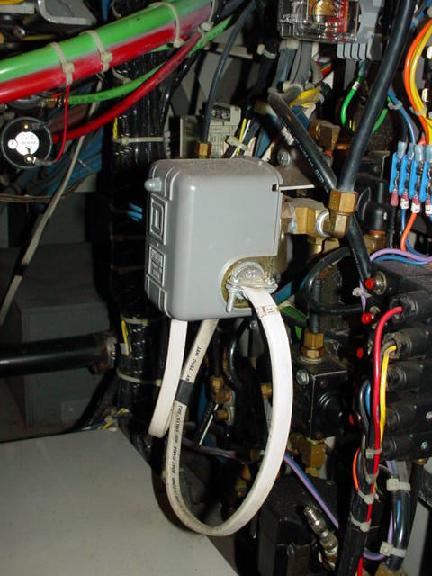
In the photo the solenoid valve coils can be seen to the far lower right with the multi-colored wires going to them. There is a snap ring at the red caps that holds the coil in place. You need to keep the wires at their respective positions when swapping coils.
Anytime an entire coach will not go to the driving or travel position it is almost always associated with the center coild or valve beneath the coil. If the coach responds by having two of the three leveling corners go to the travel position I would not be focusing on this coil or valve.
-
Archived
MemberAugust 1, 2012 at 1:23 am in reply to: New to me 1994 Prevost LeMirage XL Angola Conver.Just a small point of clarification. It sounds like you have inverter/chargers, which would be typical. When you leave your coach, do not leave the inverter on. Do leave the charger on. If you leave the inverter on and you lose commercial power you will drain your batteries. Those that have been around a while may simply referred to the combined inverter/charger as a charger or inverter and those that havve been around will probably understand what they are saying. I don’t want to assume you have that past knowledge.
Congrats on the new coach!
-
Scott, I would not my inverter supplied appliances subjected to switching back and forth between commercial power and inverter power. If I had 106 volts and my inverter toggled between being on and off I would force it to off. This would keep everything on commercial power and ensure the battery charger stays on. I’m assuming there was no other reason for the inverter toggling besides the voltage.
-
I was in a campground and one leg was running as low as 106 volts. As soon as this happened the inverters would go to invert, raise the voltage to 120 and return to float. Then back down to 106 and back to invert for several seconds up to 120 and float again. My question is does this hurt anything or is the system doing what it’s designed to do. It made me nervous watching switch back and forth every few seconds so I went to one A/C and only ran it while I was there.
-
Just had mine replaced I knew one was leaking. It turned three of them wouldn’t even return when you pushed them in. So four out of the eight were bad. I figure they were original so they’re 12 years old. It did make a difference in ride and handling.
-
Archived
MemberJuly 31, 2012 at 6:39 am in reply to: New to me 1994 Prevost LeMirage XL Angola Conver.Joe,
You came to the right place for help and we’re glad you joined up.
I believe some of the folks with our advertiser, Panterra, were with
Angola when your bus was built. You may want to give them a call and
see if they can shed any light on your manual. There are other Angola
folks who may jump in here. Your vintage bus, early 90’s, is pretty
straight forward and there are lot’s of owners here that can help
with your questions.You didn’t mention any kind of PDI, but you may want to look at
Jon’s Article to get a starting point with your maintenance needs.
Pre
Purchase Hopefully, you have tires and batteries with recent date
codes and up to date service records for the engine and transmission.As for your inverters, if you have AGM’s for the house and don’t
have a particular setting, you can use the wet cell settings, they
are close. You want charging numbers close to 14.4 for
bulk/absorption and 13.4 for float. Your chassis charger is
probably not a 3 stage unless it’s been changed and you don’t want
the single stage charger left on for long periods, you’ll cook the
batteries. If you have Lifelines, I can give you the mfg date if you
provide the date code.Fire away with your questions using the various forum topics and
welcome to PC. -
Archived
MemberJuly 31, 2012 at 6:04 am in reply to: New to me 1994 Prevost LeMirage XL Angola Conver.Welcome Joe.
As you likely know Angola is no longer in business, but Panterra Coach possesses the knowledge of their conversions. You may wish to contact them for questions relating to the conversion portion of your coach.
As to your question regarding inverters and chargers the best thing you can do initially is develop a baseline. Separate all the batteries and test them. As a new owner, unless you know them all to be good if one or more are bad or weak you can get unusual indications that drive even experienced owners crazy. Then set the charging protocol for the inverters to the voltages specified by the battery manufacturer for the battery type. Each type of battery, Gel, AGM, lead acid is going to have different voltages for bulk, absorbtion, and float.
Whether you leave the inverters powered up all the time is a decision based on where and how you store the coach. The ideal situation is to either keep the inverters powered up 100% of the time to maintain the house batteries or put the entire coach to “sleep” with all power shut down completely. If you leave the inverters “on” you have to be aware that if the power to the coach is interrupted the inverters and phantom loads could draw the batteries down to 0% power a situation that is very bad for batteries. I leave mine on all the time, but I store the coach 15 paces from the house and I am usually in my garage daily. I am not sure I would leave power on if I had the coach stored remotely.
As to the 24 volt chassis battery unless you know the charger to be a high quality three stage with charging voltages appropriate for the battery type you may wish to leave it “off”. Your chassis batteries should hold the charge for months unless there are loads that should not be there. A previous owner may have tapped into chassis power for some reason and without documentation the only way to know you are OK is to monitor the battery voltage until you know the batteries will hold a charge. The batteries should hold a charge a long time (months) even with the coach master switches “on”.
Most of the questions you will have are not necessarily Angola specific because our conversions, regardless of the converter share similar components and design logic for the most part. There are exceptions. Whenever you get questions just post them here. With hundreds of owners it is unlikely your questions cannot be answered. I’m sure that from time to time the answers may actually be correct.
-
Nice job Hector, makes one feel good to replace something when he can see it needs it. When I changed out all my brake hoses the old ones looked like new, but I had no idea how old they realy were.
Now I know.
JIM
-
Archived
MemberJuly 30, 2012 at 9:27 pm in reply to: New to me 1994 Prevost LeMirage XL Angola Conver.Congrads on your new bus and welcome to PC.