


Archived
Forum Replies Created
-

simple: From power company you have two hot lines line one and line2 and one commonn (ground) ordarly a red line 1 a black line 2 and a white ground(commmon). At you home or comercial connection you have a completely seperate wire a earth ground ;usually a long rod driven in the earth with a with attached earth neutral. No connection with power grid!This apears in your electrical system as a green wire and should never be mixed with the white(common white) as it will defeat the complete system safety. It’s main purpose is to give a place for elect power to go to ground in case the white wirre fails==the only way else would be thru you or thru your coach to groung causing death or a fire. In this case/subject I feel the connection is a loose or partial broken white(common wire) before coach. you can lay it on ground on way and all is good and move it and it wont work. would ck ends first and look for discoloration in cord or contacts. That to coach only. hope that helps. Bob
-
The four questions we used to get before there were so many motorhome conversions, and almost all conversions were entertainer:
Do you have a band on board? (Or who is on the fancy stagecoach?)
Did you win the lottery? (Like nobody earns one, right?)
How many does it sleep?
How much did it cost?
That was back in the day when bus drivers would flash the lights or wave at us. That was when truckers were more polite than they are today. That was when the only group was the Prevost Prouds. Today it is rare when other conversion owners wave at each other.
-
Russ, Or Bob
Can You give Me a Visual picture of the path that the A/C takes thru the cord to the coach appliances?
Thanks,
Rocky
-
Hey Fred,
I have a place on the Cumberland River , I thought I would learn the Banjo so I could sit on the River bank and wait for City Slickers to come paddling By !
I Love My New to Me Liberty ! And What a great forum This is !!!
Thanks,
Rocky
-
That I will get help on. The clutch went in today. Real slick. Time to start sliding engine in. With the trans change there are a few minor mount changes also. So sometimes it is a few inches then measure., In my case I hope all alowances are forseen and it will go in in one shot. Sure LoL.There are some old pictures of my 89 that now lives in Texas and the start of the 98 on photobucket. Just google:: pictures by robertglines1on photobucket. sort of a hit a mess bunch .all bus pictures only there. Bob
-
I’ll give the dryer question a shot….
Remember when we didn’t have electricity – well I don’t go back that far, but I easily remember when convenience outlets had just two sockets and everything that plugged in was just two wires. The three wire 240vac dryer kind of springs from that time. I don’t think you could purchase one like that today. Remember, we are discussing 220vac dryers, not 110vac dryers.
The old 3 wire 220vac dryer uses the two hot wires and neutral and NO safety ( green or bare ) ground wire. In the dryer there was a jumper between the neutral and the metal case of the dryer. This would provide a path for fault current if one of the hot wires should come in contact with the case and allow the breaker to trip. It is just not as good a situation as a separate grounded conductor since the neutral carries current and can have voltage slightly above ground.
The neutral connection is needed because the dryer controls ( timer, lights, etc. ) operate from the 120vac it gets from a phase to neutral. The dryer coil itself just uses the 220vac from phase to phase. Russ
-
Russ describes the situation very well.
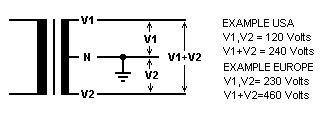
Our 240/50A circuits are not two phase but a split 240 Volt phase, the split phases are NOT independent legs. An open neutral requires current to return via the other leg, the actual voltage on your device now will be determined by what is turned on in the other split phase leg roughly following Ohm’s law (it is really an AC circuit so reactance comes into play). The two loads are now in series across 240V.
Do not use the coach until you have an electrician check out your wiring situation. Tell him to look for open neutral situation in either the cord, plugs or transfer switch.
Gerald
-
Is there any way you can post some youtube videos? The bus sounds like it’s been a great project, I would love to see it in person.
-
Best in this case.Have been in two camp resorts where both grounds were attached to same bar . My coach kicked out when I plugged in. One had no additional sites and I left. The other I actually fixed the problem. I know (bad Bob) I did show thier guy his mistake. Everything was there just didn’t realize differance in grounds. Home builders please pay attention to your ground seperation and neutral bond breaking at gen set/shore power. Bob
-
Jon,
Let me take a shot at this and see if I can make it at least less muddy.
By the time power is delivered to your coach either by the power company or your generator there are just four wires involved. The safety ground should never be a current carrying conductor except in a fault sitaution, so we can forget it for this disucssion. That leaves three and they are conventionally colored two black and one white ( or gray ). The white one is called neutral and the other two we will call the “hot” wires. Each of these wires, of course, should have a low resistance connection to their power supply. When they do, things are lovely and you have nominal voltage from each hot wire to neutral, which we’ll call 120vac for now. Neglecting the resistance of the wire and connections and the impedance of the source, any load you apply in the coach from hot to neutral will see 120vac no matter how large or small the load all the way to the point where the load exceedes the rating of the breaker ( or somewhat less ) and it trips.
If the connection to the center of the coils anywhere between the power company’s transformer or your generator is bad or open ( an open neutral or high resistance neutral ) things get much more complicated. Current flow always requires a path to and from the source. Now with an open neutral, it cannot return the way it normally would. You still have exactly 240vac nominal from hot wire to hot wire, but what do you have from a hot to this floating neutral every 120vac applicance or device in the coach is still connected to?
I’m going to explain by using an example that I think when you understand the example you will begin to get a feeling for what is going on. For this example I want you to imagine that there are only three 120vac devices in your coach – two 100watt light bulbs and a toaster. Now consider that in this example each of the lights is on a separate breaker and each breaker is connected to a different HOT wire. The toaster is plugged in, but not turned on as and the lights are off. That’s it, for this example all else is open and off in your coach.
First question – what happens if you simultaneously turn on both lights? What happens if you turn off one?
I’ll venture a guess that not many of you get the right answer – because it certainly is not intuitive.
Okay – when you turn them both on at the same time they light normally. When you turn one off – they both go off! Anybody get that right.
Now for extra credit, turn them back on and try to have a piece of toast. What happens?
You will probably hear a pop as one light blows up, the other goes out, and you have cold bread.
The 240volts gets divided across your loads depending upon the resistance of the loads. When both lights were on, and they were both 100watt bulbs, they had the same resistance and the 240V got divided across them equally and they both worked just fine. When you turned one of them off, you actually opened the circuit. See, with no neutral, the circuit is from hot wire, through appliance, through another appliance, and back to the other hot wire. If a switch is opened, and there are only two loads, it opens the circuit and both lights go out. Got it?
Now we added the toaster which has a much lower resistance than the bulbs. About 10 times lower so when it was added, the voltage no longer divides equally as the resistance is no longer equal. It would divide say 90% to the light bulb by itself, and 10% to the parallel toaster and light bulb. So that’s 216 volts to the light bulb by itself, and “pop” it’s toast – Ha Ha! The other bulb and toaster momentarily get the remaining 24volts before the bulb pops and the circuit is open again. In the case of this thread, a rather large load like a refrigerator would shift the voltage low on that phase of the system and high on the other phase which probably contained the plug strip that fried.
Everything electrical appliance that normally runs on 120vac is at risk with an open neutral. Stories abound on the rv forums about the damage an open neutral allows. That and lightning strikes are easily the two leading causes for device damage due to over-voltage. I will try to answer any questions and I hope this helped. Russ
-
So Jon in your opinon what is the one to have i have cruise air it wont get the bus down to about 74 in fl in summer and it is draging a&& to do that, i use to have a wanderlodge that had 3 roof airs it would freez you out but it was noisy.I wish i had otr for traveling without generator , my dash air keeps my belly cool but dose not help my back.
-
I mentiomed that: because been there done that two tv’s microwave surround sound Air cond. caused by loose neutral. two hot lines 1 and 2 fed high voltage to system. neutraul ground bonding is a huge subject. Number one place to start is your shore cord. If it is good and I mean wiggle it make sure if it is on reel it is always making contact.. 2nd allot of campgrounds and home power are still not wired correctly. get a cheap checker and check them if you have questions. By the way reading was 208 volts across plug in. corrected ground went to 121 across outlet. Bob
-
Gerald and Russ……..I respect both your opinions but help me understand how voltage increases with high resistance. I am completely clear on how amperage goes up and I suspect that is what Rocky is seeing, suspecting a compressor issue in the refrigerator.
Unless Rocky is inverting only the shore power to his coach is a direct pass through with each hot leg of the shore power feeding a 120Volt bus in the circuit breaker box. There is no cross over in his Liberty between each hot leg with the exception of the 2 240 volt circuits which are the range and outside grille. So how does 120 increase? The amps increase, heat build up, but I don’t get how you can turn 120 into a higher voltage just by opeing a circuit increasing resistance.
-
From what you are describing you may have a bad neutral connection either in your shore power or your coach inlet. This can distort the voltage on each split phase depending on the loads. Very unsafe, please have it checked. Could be a bad transfer switch relay with a burned up neutral contact.
-
The accumulator (expansion) tank setting is typically about 2 PSI higher than the water pump cut in pressure.
Your Paragon pump has a built in pressure switch so you can observe the upper and lower limits by watching the pressure gauge that is likely located on the opposite side of the coach from the pump. If you are close you are OK.
I have added a pressure gauge near my water pump(s) so I could monitor pressure without running from one side of the coach to the other.