


Archived
Forum Replies Created
-

Free is just a tad bit hard to believe. A Prevost shell has to be upwards of $400K in today’s market Clifford, and that is a lot of money to be just giving away, especially when you are struggling to hang on as Marathon seems to be doing.
Tony Stewarts bus is a Featherlite I think … but I am not sure. Aren’t they the one’s who tag everything “VIP?”

More photo’s can be found here.
BCO
-
I think that’s the best Tom I will leave it manual and with new air bags it should hold air with not much care . I think as long as they hold good with new bags .I will leave it manual fill thanks again Tom
P S it is cold out Trina won’t let me stay in house drives her crazy to the shop I go
-
You could snake a line across from the starboard side where you could tap into the aux line. I would leave it manual and not worry about more potential air leaks. With new bags, probably won’t require much attention. Since the fill valves are tied together and right out in front, why not just keep it as is?
-
I don’t know about all conversions but all of my Liberty coaches have used a regulator on the supply side for the generator air bags and as long as there was aux air their pressure was maintained.
For long term storage such as a month or more between trips I don’t bother to maintain air in the bus but as long as we are using the bus and have aux pressure the generator air bags are inflated. 14 PSI (sure to start a discussion)
-
Prevost calls for 120 to 125 upper limit. You can adjust the governor if you need it, but I believe the compressor relief valve is set at 140 so at some point if the governor is set too high you are going to pop open the valve.
There is no adjustment on the differential between cut in and cut out pressures.
-
Buddy’s question is a good one and I think everyone has the correct answer. Over the years I have learned things that influence my practices which vary depending on what I intend to do.
Whether in the garage or in a campground, if it makes sense to have the coach low to the ground that is what we do. Some of you may not mind the high step, but we have found if we are going in and out of the coach it is nice to have it down low. That is not always possible, especially on uneven campsites but when we can we lower it down.
In my garage after we have unloaded it and don’t intend to use it right away I raise it all the way up and put stands under it. That way I can go under it any time I want without fear of it dropping. Even with the pit it is safe to have stands beneath it. I do not lower it the 1/2″ or so to make it sit on the stands unless I plan on pulling wheels. If I am not using it for a few months however I do lower it on the stands and then dump the air in the suspension to get the bulk of the weight off the tires. Both Michelin and Goodyear reps have said the life of the tires is extended that way by storing them without weight on them.
The bottom line is to do whatever you want for whatever reasons you choose. If it was a seated coach you wouldn’t have options.
I think if you want to add further confusion to what is really personal preference answer what you do with the water pump or the aux compressor. Leave them on? Turn them off when the coach is not being used?
Since I have the coach parked in a heated garage I turn them both off when I am not using the coach although I have no problem leaving them on because I am near or in or under the coach almost every single day.
-
I’ve never dumped the air in any of them while at home in the barn. My thinking is if I have an air suspension problem, I would rather see it at home so I can handle the problem. I usually don’t dump the air in the campgrounds either, but this trip the airs all out and she’s on the bump stops. Easy in and out, no step needed.
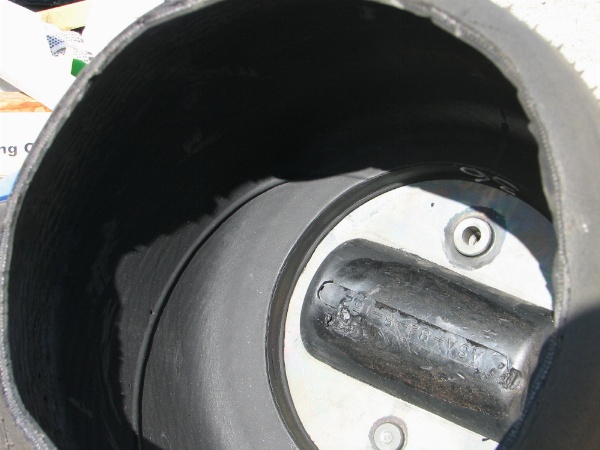
Your air bags have a stop inside, here’s one I cut open:
-
I leave everything turned on in my bus… I have often wondered what my options really are? Its just like we were camping in it. that way I know if somethings not working before we leave the driveway. I have always thought things are better when running… they seem to break when being turned on like light bulbs do !!
Also we use the bus almost every weekend too
I am interested in the replies here…. Jon where are you?
-
I’d say leave the air in the bags and put some 20 ton stands at the jack points for even support all around.
-
I store mine aired up and let it naturally fall over time. I’m thinking about just dumping the air when parked. I wonder if one way is better for the bags than the other.
-
As we get closer to our Branson rally Tom and I will be posting more details from time to time. Today we have locked in Lifeline Batteries for a seminar on Tuesday Oct. 15th at 9:00 AM. Batteries are very important to our enjoyment of our coaches so we look forward to having the experts available to teach us about them.
We tried to get Lifeline to provide sets of 8Ds for all attendees but I guess that will not happen. So take advantage of this rally and seminar to learn some important facts about batteries. Do not be afraid to ask questions. This is your rally and the seminar presenters are going to be there for you.
-
The oil analysis “kit” will provide instructions on the collection method. Generally the oil is to be collected soon after an engine has been run and is hot. I think it also is to be collected after the plug has been removed and a little has drained so the readings aren’t affected by an excess of what might be considered as sludge. In reality you want to avoid gravity separation which is why drawing it from a recently run engine provides a good mix and representation of the oil elements.
I can say based on experience that when an oil analysis is showing a spike in elements the chances are you have already run the engine enough to do damage. As Mark points out there is no better way to catch issues early than to do a daily engine check. If your coolant level hasn’t gone down in a long time and all of a sudden it is down and there is no coolant leaking onto the ground you may have caught a problem before damage can occur. If your coach normally needs oil added after about 5000 miles, but you notice it either never goes down on the dipstick or is going up on the dipstick you should be sniffing the end of the dipstick and trying to figure if fuel is entering the crankcase.
Just like an oil analysis is looking for change, so should your daily pre-trip inspection. If you do your daily inspection over time you really get to know your engine and what you are looking for is change. While this may seem obvious, when you are driving your gauges are also clues to your engine’s health. From use you should recongnize normal. Then when the gauges start to change from what you considered normal, start trying to figure out what that change means. Even a change as small as a needle width might be an indication you should investigate something further.
As our coaches get more sophisticated electronics for managing the engine and alerting us to potential or real problems keep in mind that the alerts we get are when values reach the minimum or maximum limits. We have the ability to catch issues before they reach any extremes if we pay attention.
-
I would be afraid, very afraid.
Where the hub bearings seat on the differential stub end is precisely machined for alignment of the two bearings, for the correct diameter relative to the bearings and to insure the bearings are rotating on exactly the same axis. If you have trouble pulling or installing a bearing the chances something has gone out of round because you do not mention damage normally associated with the transfer of metal due to spinning a bearing.
While I don’t suspect catostrophic failure if you do get the bearing to seat on the stub end of the differential I can envision never ending issues with failed seals and bearings over time.
There is no doubt if you sand away enough material to get the hub to slide into place it will go back together and may appear perfectly OK, but even a few thousandths of misalignment or a slight bit extra gap between the bearing and the mating surface could create unordinary stresses on the bearing or seal.
-
Hi
Rodger, sorry if these are simple questions but I getting that collecting the
samples is a very important part of this. Where is the best place to take the
samples from? Do you get the coolant from the slump tank or do I have to wait for when I change it out? or maybe from the coolant filter? Should I take the oil sample from the drain
pan when changing the oil? And where would I get the sample containers? NAPA? Thanks
for posting your results, it got me thinking about all this and how important it
is to have a history of this information.Fred