
-
Trying to demystify the Liberty Classic Air System
Posted by Chas on May 13, 2015 at 9:24 amSo I am trying to understand the air system on my coach. Jeff has explained how Liberty doesn’t install separate aux air tanks and that liberty ties into the prevost air/ping tanks for the convertor side of things.
Still not 100% sure I really understand it though.
so how does Liberty setup the air system on their Liberty Classic Lady Coaches (circa 1998)?
I see where liberty ties into the Prevost air system at the Norgren air dryer filter. From there I have a valve that I can use to isolate the two systems. but if I turn that valve off, where does the liberty side get it’s air from?
Also, what does the Aux Air compressor feed into? Does it basically feed into the same exact system (air/ping tanks) as the engine/prevost compressor?
What is the difference between an air tank and a ping tank (or is there)?
Also, does the air system continue to feed the airbags/level low system and keep the coach “level” after shutting down the engine?
After parking the coach, my air brake gauges will drop to about 120 psi and hold there. While the gauge on the convertor side, will drop and then come back up as the aux compressor comes on.
What systems require air while sitting parked? Obviously the belt tensioners get air from the system as do the generator bags. I guess the air door lock as well. What else? Basically wondering if shutting off the compressor while I am parked will cause anything important to not work? I know that if I do this, I should run the compressor for a while before starting the engine to get air to the belt tensioner bags. Also, if I am going to run the generator, I need to keep air in the bags so need to keep the aux compressor running.
And then lastly, I have a new air pressure switch that turns the compressor on when the air in the system drops (i think below 95psi) and shuts of at 125 psi. When the compressor gets to about 125 psi, it sounds like there is a release valve in the system that doesn’t let it air up past that point (compressor shuts off a couple seconds after I hear the “howling” noise). Would be prudent to tune the switch to turn on at say 85 psi and shut off at 120 psi (or lower)? And is there a pressure release valve that will make it so the system can’t get more then a certain amount of pressure in the system?
Mike replied 11 years, 4 months ago 17 Members · 36 Replies -
36 Replies
-

Charles I move this thread to pneumatic.
Your questions are good ones and I will attempt to answer them, but if I screw up I hope Jeff will jump in.
Air from the Prevost accessory tank goes through a protection valve to the converter pneumatic connection point. You might have a plastic tag hanging there that even says that.
I cannot remember my 97 exactly so I am answering in the context of my current coach which is likely similar. The air from the aux compressor goes through a spitter, into the Norgren trap and then to the Liberty manifold block. It back feeds into the accessory air tank. The Liberty side is fed from the Prevost accessory air tank and if you turn off the air from the aux compressor the tank will not get back fed with air. What is unknown is if someone added the valve or if for some reason Liberty installed one.
The aux compressor uses a pressure switch that looks like a well control switch. It is adjustable but typically it is set to a lower system pressure than the bus engine driven compressor provides. For that reason is is not often used for leveling unless someone has brought the pressure up to 120 PSI. Even then it is a poor way to level the coach because the pressure differential for the switch is usually greater than that of the bus compressor so before the aux compressor kicks back on the system pressure is usually too low for leveling, especially at the front.
On your bus with the key off consider the suspension system including the air bags and ping tanks isolated from accessory or auxilliary air. With the key off no matter what your aux pressure is it isn’t going to or from the suspension. However, since the Liberty aux compressor is maintaining Prevost accessory system pressure if it is high enough it can be used to level the coach, or tighten the belts, or operate the air lock for the door. But you need to turn the key on.
You might not have any need for the aux compressor when parked. I don’t know if on your coach you have any house systems other than the generator air bags that need air so even if it drops to zero on the accessory side I don’t see the need to run the compressor. Your generator air bags should maintain the 14 PSI recommended pressure but if it does not that is the one air system that is an easy fix. Even with the accessory air pressure at zero the generator air bags should hold pressure, eliminating the need to run the aux compressor.
As to the howling noise, let me ask a question……….if your brake pressures are low when parked, when you run the aux compressor do those pressures go up? I’m trying to figure the howling noise and hope it isn’t the aux air system back feeding into the brake air tanks. If so the noise can be associated with the bus air system dryer releasing pressure at the end of the cycle indicating you might have non functioning check valves or protection valves. FWIW, I have my aux compressor set at 80 PSI cut off, and the differential is such that it cuts in at 40 PSI. That is more than enough for my house air operated devices.
-
Thanks Jon for moving it… Saw the errors of my ways and tried to ask, but ran into some connectivity issues and had to get on the road.
Will read through your answer, as I am sure it will cover a good amount of my questions 🙂
-
Jon,
The aux comp regulator switch is new. The original had some corrosion and was causing a leak. Jeff put on a new one that is defaulted at cut in at 90 psi and cut out at 120 psi. I can adjust the cut in/out down (at the same time) as well as adjust the differential (lower cut in without lowering cut out). Right now it is set at the 90/120. I am thinking I will adjust it down to be closer to the original setup.
When I park, I let the air brakes fill up to 130 psi before shutting down. It will then settle at 120 psi and hold for days (haven’t really gone past 4 days yet, but even that it held). The compressor will come on about every couple of hours and run for 1-2 minutes. I can see the air gauge added to the convertor side drop and then raise as the compressor comes on, but the air brake gauges never waiver.
Before this latest round of air leaks work, I would park the coach, level it and it would hold for a couple days, then slowely drop a little. But the aux compressor would relevel it a little. Useally after two weeks it had dropped enough overall that I had to run the engine, air it up, relevel and then start the process over agian. We haven’t sat long enough this time to see if it’s acting the same way. We are holding where we are for 7 days so should be a good test before we get to our destination for the summer.
I seem to have the same arraingment of the system/tie ins from covertor to prevost as you mentioned.
When my coach airs up normally, it tops out at 130 psi, before purging/releasing air on the brakes and then stops till it drops to 110psi and then does it again. I never hear the howling so thinking it’s what ever the aux comp is feeding that is howling and it honestly sounds like a way it’s not allowing you to over fill the system, but I will let Jeff chime in on that 🙂
I did find a new small leak on the Norgren Air Dryer that I need to take the filter off and reset it (will try some assembly grease on the o-ring to help seal things as well) and see if that works. Otherwise will replace the filter with a new o-ring (didnt replace it yet this year, so it’s a year old).
-
Shouldn’t the “top off” or cut out be at 120 normally? That seems high to me.
-
Charles mine goes from the aux compressor then through the spitter cup then to the liberty manifold block then it goes back up the line to the Norgren filter then to the Prevost side. I don’t think you have air doors but if you do the air goes from liberty block to another Norgren filter then to air doors , mine has those valves two a yellow one and a tee turn drain
-
Peter,
I know my coach was messed with by someone before me because the Norgren water trap was not even hooked up. So I connected the system as follows:
Aux compressor, solenoid valve (used as a check valve), spitter, Norgren water trap, Liberty manifold, which then supplies air to all house systems plus returns to the Prevost Accessory tank.
If your water trap is after the Liberty manifold you are delivering moist air to all house devices.
-
Jon, PeterC and others…
Getting a much better understanding of the air system on “my coach” (as I know other convertors do things differently then Liberty). Also dug into the “Prevost Air System” article by Jon and went through Hector’s interactive Prevost leveling PDF as well as the Air System schematic from Prevost (for what should be my chassis/model in French).
Getting there, but still a very confusing system and the lack of “documentation” from the convertors is a diservice for such high end coaches and high end companies such as Liberty.
I still have a good leak and not sure where it is, but this process will help me narrow it down hopefully.
I know I still have some push fittings that need to be replaced. I will try to work on those while I am sitting this summer myself (or at least the ones I can get to without getting under the coach). For those I can’t change out, will get under the coach next fall when it’s up on the lift at jeff’s and get those swapped out (at this point it should be a small number as Jeff has been swapping them out as he goes).
One thing that was replaced was the “R 12” valve? (or something lke that) with mention that there is also the “R 24”? So what are these and where are they? What are they feeding/coming from?
I understand the leveling system, air bags and have a basic knoweledge of the brakes system so am really trying to build that knoweledge as much as I can.
-
There are three R12’s and one R14 they have to do with brake air , park brake air and anti compounding valve
-
Peter and I had a conversation this morning about the water trap(s) located in the steering bay on our coaches and we raised more questions than answers.
I stated how I reconnected my Norgren water trap taking air from the aux compressor line before it enters the Liberty installed manifold. Since that manifold receives pressurized air from the Prevost accessory tank, or the aux. air compressor the sequence of components on my coach protects the house systems from getting moisture from the aux compressor, as well as preventing moisture from going into the accessory tank via the aux compressor.
But Peter and I agree that might not be the case with all conversions.

We both fully agree that if possible all air lines from the accessory tank or aux compressor should originate at a manifold and each should have a shut off valve to help in future servicing and identification of system leaks.
Both of us are now going to do some research to determine how the coaches are set up as standard, and to try to make sense of why, especially as relates to what converters might have done to add to the systems, and where. But regardless of the outcome of our research, all air tanks and water traps should be drained on a regular basis because water in the pneumatic system is nothing but bad news.
-
I have just spent some quality time with my coach’s pneumatic diagrams. Our coaches are equipped with a black Norgren water trap that is located downstream from the Prevost accessory air tank. It is installed by Prevost and is just ahead of the converter pneumatic system connection point provided by Prevost.
Unless youhave a system modified by the converter, unless the aux compressor is connected to the air system in between the accessory tank and the water trap you may not have protection in your house pneumatic system agains moisture.
There are too many different conversion to make any blanket statement about what if any protection you might have, but just to be clear we all have susggested you will keep your house pneumatic system dry by servicing the Norgren water trap and that is no longer something we can say. Peter Campbell and I discussed at great length this morning the systems and although our knowledge is limited to only a few conversions I think we can safely say what we thought was a water trap intended to protect the house pneumatic system is not unless someone at the converter has repurposed that trap.
We all would benefit highly if we could obtain pneumatic drawings of every conversion so we could determine the proper procedures to maintain the systems.
-
Peter and I have once again discussed this issue at length and we are convinced the Norgren water trap offers zero protection to the house system against moisture entering from the aux compressor.
I have modified my system to get moisture trapping, and I believe Peter is likely to do the same. But we cannot tell anyone how to protect their house auxiliary air system because we realize converters all have their own ways of distributing air pressure from the aux compressor and any air dryer or water trap or spitter has to be a part of the air flow downstream from the aux compressor.
We both know a spitter in the line from the aux compressor is a start, but the reliability of one can lead to false confidence. If we can develop enough information about the different conversions to make some recommendations we will, but it is not so simple we can say just slap on a water trap because we also need to consider protecting the integrity of the Prevost accessory side of the system because in addition to air for the suspension we all need air to tighten belts, for the transmission retarder, steering column tilt, etc.
-
Chalk one up for Marathon, separating the house and Prevost aux air is a plus, as long as you’re diligent in draining the Marathon tank.
-
Jon, your manifold looks real pretty. Where is the water collector ?
-
I dont think my system has been “modified”. Serviced? Yes, but mostly be Jeff at this point.
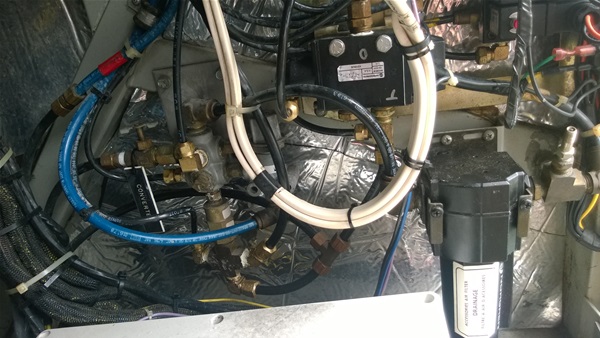
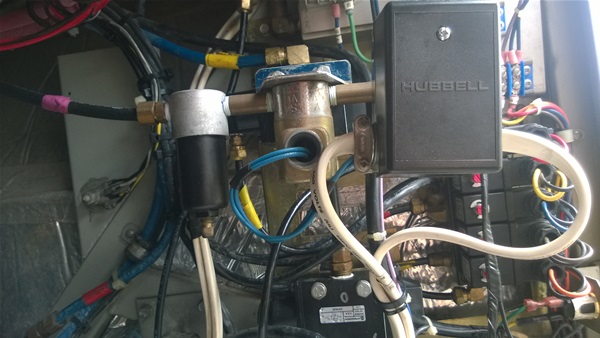
I see the line coming into the shutoff valve with the convertor tag on it. This I am assuming is coming from the Aux Comp. It then goes into the the 8 port junction (feeding 7 out ports).
The one on the top goes to the Norgren air dryer/filter, which I assume feeds into the Prevost System.
The other 4 lines (one of the 8 port junctions is blocked off). But of course one of them goes to a 3 port junction.
I do have a spitter/filter that it attached to a pressure switch that turns on the aux comp, but I havent figured out where the line that feeds the spitter comes from.
I did turn off my aux comp and noticed my air brake guages dropped over time (where they were holding at 120psi with the aux comp on). But I do have two leaks I now know about (Norgren Air Dryer and Door Air Lock). The Air Dryer I can deal with. The Door lock, well that’s a little more interesting (thin I will be calling Jeff tomorrow so he can have a little amusement tomorrow, I am sure he’s missing me after three weeks of parking at East Tennessee Luxury RV Resort 🙂 ).
Log in to reply.