
-
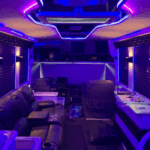
I considered installing a ducted minisplit in the bay that held my OTR system. That is the forward bay on my 1984 96″ coach. Dimensionally, I think it would have worked. I also think that you could get by with far less than an 80,000 BTU system. The two show-stoppers for me were the need for a 240v outdoor unit and the height of the outdoor unit as you get above the 18k size.
Another factor was my desire to eliminate the internal ducts that run the length of the coach at the floor/wall junctions. Removing those made a big difference in perceived floor space in my narrow coach. Don’t let anyone tell you that an extra six inches is no big deal.
-

Chad I’m finishing up my project but 95 actual temp yesterday and 105 heat index and we had it set at 72 and that’s where it stayed. We live in NW Arkansas and anyone is welcome to stop by on your journeys and see the system.
-
I am following this thread interested in how to install a system in my coach, as I currently have three roof airs in mine, but they are noisy.
-

I had less noisy Cruiseairs and now have noisy roof tops. I will put up with a bit more noise for the cool and dependability of the roof airs. I would never go back!
-
I keep seeing the hate for Cruisairs but what is the failure point on them? Is it just the road heat causing high pressure shut down or are the units just failing structurally (leaks)?
-
-
I wonder instead of ripping out the bus air, would it be possible to add a second compressor to the existing system, one not powered by the engine. Or, maybe the existing compressor could be driven by an electric motor (at lower speed unless you have an enormous motor to use. Would probably require a special pulley on the existing compressor, to be driven by either the Dd60 or electric motor (with clutch disengaged )
-

Cruisair and OTR air are 2 completely different beast. Don’t get the 2 different systems confused.
-
-
I do not think the concept of using the bus OTR for driving and when parked is a bad idea.
However there are several issues that have to be addressed. The first is the evaporator has to be sized to handle the size of the compressor. I see no reason the condenser side has to be modified. Obviously the controls need to be sized for the new system capacity.
The thinking about the motor driving the compressor has to be reversed. Stick with a single compressor, but instead of engine driven have it driven by the alternator or shore power providing the electric. The existing OTR compressor I believe can pull almost 30 HP so a decision has to be made about how much HP an electric motor driven compressor can be, knowing the likely limit is the 50 amp shore power which is also going to power everything else on the coach, including the condenser and evaporator fans.
The reality is even a 30,000 BTU system may be too big because the evaporator and condenser fans themselves suck a lot of power so while it makes sense to use the same system for driving and parking a whole lot of engineering will be needed, and then you will have a system with no backup if something fails.
I’ll stick with my OTR and 4 Cruiseairs which can be repaired with off the shelf components.
-
I would not want to use the bus air for both running down the road and when I am parked as you stated. If the bus air goes out you are in trouble to keep the coach comfortable. That is why I use the bus air while traveling and the roof airs while stationary. But if the bus air goes out I can start the gen set and use the 4 roof airs to keep the coach comfortable and I have one of the cruise airs still operating. The 4 roof airs are 15k each and the cruise air is 15 k and that will keep the coach more than comfortable while driving down the road if needed. Our last bus had 2 – 21/2 ton central air conditioners with no bus air and if one of them quit working it was a bad day in the hot summer!
-
Log in to reply.