
-

Harry: Hopefully I can keep this short. Again, Jon is 100% correct; and I’m not saying that to brown nose him, suck up to him, curry favor with him, or anything like that. He’s just right … again.
I’ve winterized our coach (in SE Wisconsin) three different ways. Please let me outline the process and results:
1. The first winter we had the coach, following written instructions I got from a Prevost (Marathon) owner, I first drained everything I could (black tank, fresh water tank, water heater), blew out the lines with the air compressor while I worked all the faucets and cycled the clothes washer a few times, and then poured RV anti-freeze in all the traps, the toilet, and into the clothes washer. Turned everything off in the coach. This was late November. The day after Christmas we headed south, first stop ETLC for some things. No water in the coach, couldn’t use the toilet. Got to ETLC, plugged in shore power, hooked up water to Jeff’s water, and filled the water tank. Turned on the water pump and NO water pressure. Toilet wouldn’t flush. But water was coming out of the water bay. It was coming out the bottom of the Mach 5 water pump. Called Jeff at home. He explained I didn’t remove the cap on the bottom of the water pump and hopefully there wasn’t any other damage. Long story short, the water valve for ice maker also cracked. Luckily only damage we got. I decided I would NEVER rely on “blowing out the water again” to protect the coach in the winter. You mentioned residual water in the water lines evaporating. As the temp drops, the less likely that will happen. There is little or NO air circulation in the water lines. I can’t believe any residual water would evaporate.
2. After Jeff and crew replaced the Mach 5 water pump, pulled out the refrigerator and replaced the water valve, and we determined there wasn’t any more damage we headed to Florida. While in Florida I made arrangements to obtain a copy of the Liberty owners manual for our vintage and model of coach which was waiting for us upon return to Wisconsin at the end of January; still with winter to follow. The manual contained detailed instructions for winterizing the coach with RV anti-freeze. I immediately read those instructions fives times, bought 18 gallons of RV anti-freeze (Liberty manual said have eight gallons before you start), used 14 gallons, and followed Liberty’s instruction quite rigorously. In a Liberty there is a process to pump RV anti-freeze into the fresh water tank so the residual water in it is protected. In the spring I filled the fresh water tank to about 1/4 full, ran all the water faucets everything until they were clear, made ice until it was clear, then pumped the fresh water tank into the black tank until the fresh water tank was dry. Then I took the coach to Camping World (about six miles away) and dumped the black tank (didn’t want the RV anti-freeze in my septic system). Put about 20 gallons of water in the fresh water tank, pumped it dry again, back to Camping World. The process worked. It has been down to zero while the coach was winterized like this, with no broken lines or busted components.
3. That was too much work. Now I follow Jon’s recommendations and keep the fresh water tank full, turn the water heater on, watch the temp in the water bay, run three 1000 watt heaters in the coach, etc. Over two winters with very cold temps (near zero a few times as I recall) I’ve had NO problems. Yes it costs me a few nickels to keep the coach heated during the winter, but I’m will to invest that money to protect our coach.
-
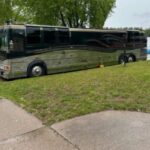
Thanks Dick, And I do agree that Jon does get it right now and again. What’s this about you having Jeff’s Home number? I had to beg him for his office number!
My master plan was to jump in the bus in December/January and head to Florida where we have family. It doesn’t look very likely that’s going to happen now knowing the winterizing required.
I don’t know what I was thinking in the first place because I know a coach has to be winterized! I’ll winterize as you guys have discussed and when I have a nice winter day I’ll take her out for a good hours run.
Harry
-
Harry: Why would winterizing your bus impact taking the bus to Florida on a trip?
I think you’re storing the coach outside, on dirt or gravel, without electricity. Is that correct?
If that’s the case, I recommend you look for a different place to store the coach. Concrete or blacktop, with 50amp electric (if the electric isn’t there, offer to have it put in). Do you have room at your home?
-
Hi Dick,
we have all kinds of land but all on top of a mountain. If there’s a relatively flat square yard in all the acreage I’ve yet to find it. So no chance to park around Home.
And the place I have is a 3 sided garage that I’m lucky to have. There is no place near me that is enclosed or has power. All I have to work with is what I have!
Harry
-
Putting a coach to sleep electrically is relatively easy. On some coaches there is a specific sequence required, but mostly it just involves turning all the batteries off at a master switch. Even later models with electronics that need to be powered up can be completely shut down if needed.
How long batteries retain their charge after shut down is affected by numerous factors but the two most significant are making certain everything is completely shut down including phantom loads and if there is any doubt disconnect chassis grounds to be certain. The other factor is the age and condition of batteries. If any of the batteries is failing it is possible that alone can discharge all the other batteries in a short time.
-
Dick,
Thank you for putting so much thought into working around the drip problem that I have when using the A/C.
I’m parked in the center of the garage (an island) so there is a driveway all the way around my parking area. The pipe would have to go up to the ceiling about 20 ft. and over to the wall about 75 ft. and then down the wall.
The warmest that it has gotten inside the coach this summer in TN is about 90 degrees (I’m OK with that). I only use this garage part time as I also have a rental garage in California when I’m out there (mostly during the winter months).
I could certainly go out to the garage every couple of days and empty the bucket (or get a bigger bucket). As you and Jon have stated, the water from the A/C will be reduced as the humidity lowers inside the coach.
Also, I could pay the kid working there a few bucks to empty it for me every couple of days.
Again, thank you for the suggestion of a more permanent fix.
Mark
-
The absolute best way to winterize a coach is to get in the driver’s seat and drive it where it is warm. If you can’t do that then you have to do it the hard way.
-
Somebody told me Harry , and don’t know if true, that even with both master switches in off position there is still a slight draw to ECM somehow. Think it was Bubba at Prevost Houston a few years back. Need to find somewhere with electric and keep as little as a couple space heaters going inside. What I done in a enclosed storage shed last winter after I sold my ranch and bus barn with it. It only had 110 ac and worked until I got my new barn built. Never drained anything except black/grey tanks.
-
Harry,
Thousands of RV’s and boats are winterised each winter up north by blowing the water out the lines using common sense and assuring all other items are drained such as tanks, pumps, filters, etc. I mentioned to use the pink stuff on the p-traps if you’re going to go the air route, or you could easily just remove the trap.
Don’t be led to believe that it can’t be done, it’s a safe and easy process used annually in the frozen north. I’ve done it many times.
-
Thanks for that Tom, As a new guy with a coach its all somewhat daunting. New guy needs to know what these things are, where they are and what could happen if you miss one?
I think for my piece of mind I’ll put in the pink stuff. That seems like the one that best covers All basis.
My new concern are the batteries drains. I know that Jeff has addressed this on my coach and hopefully has found it and corrected it.
My thanks to all for your help,
Harry
-
Yes to glens, Harry, you have parasitic loads on you coach like our #34, both chassis and house. It would be best to unconnect the batteries. But that can be a “ball of string of problems”. Take photos. Pink stuff in the lines you’re going need quite a few gallons. Do you know if hot water(s)has a bypass. And a DRAIN. Bypass meaning, you can cutoff the water heater(s) from rest of hotwater side of plumbing. Otherwise, in order to get any pink fluid coming out bath or kitchen faucets, the hotwater(s)(do you know if there is one or two) will need filling. That’s ten and a half gallons of pink stuff per hotwater heater. Then you’ll need to disconnect your water filter, drain it. You don’t want pink stuff there. We removed the original charcoal filled tank, in lieu if fiber canister types, but no pink liquid in them either.
Good luck
-
Jim reminded me of the PVC media water filters we “had” in our coach. I missed those too, they froze and cracked. Jeff and crew pitched those and plumbed them out of the system. Don’t use them.
-
Deleted User
Deleted UserOctober 3, 2017 at 2:15 amHarry, have you considered a portable gen and a large tarp to enclose the bay. The tarp will reduce the effects of wind, and trap heat,if you think the gen would be expensive, calculate the cost of a frozen bus
Just plug the bus in and turn on some heat then monitor the fuel level on the gen. You might not need to run it continually.
i thought this might appeal to you.
-
May be a dumb thought, but why not leave everything on, and let the generator auto start charge the batteries, as necessary. Just cost a few gallons of fuel. And he said he was going to drive once a month or so anyway?
Jim Brown
-
Hi Jim, My 91 doesn’t have auto gen start!
Jeff and Lindsay
91 Marathon XL

Log in to reply.