
-
Storage questions…..
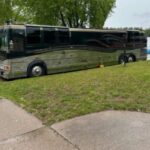
Posted by Archived on September 28, 2017 at 5:08 pmOk, so I keep the ‘Elegant Lady’ in a storage facility plugged up to a 50 amp outlet. The garage seems to stay about 6-8 degrees below outside high temp. I run the fantastic vents for 5-6 hours to remove heat from the inside which will build to about 5 degrees higher than the garage temp. Like today, 89 outside, 81 in garage, coach 87 degrees. Vents on, lowers to 83 degrees (drivers side window open about 2 inches).
Running the roof airs will pool water on the floor which is a risk hazard. The water doesn’t evaporate quickly because of humidity.
I have been leaving the aux compressor OFF that keeps the 4 slide seals inflated, valves and doors operational. Normally, the compressor will come on every 4-6 hrs. to stay full.
What would you do since I’m inside a storage garage? Am I hurting anything?
Questions:
-Compressor on or off?
-Hot water tank on or off? (I have it off)
I keep the fridge on along with the ice maker. I take ice out every 4 or 5 days I visit the coach. I also flush the toilets at that time too. I also run hot water (that’s not hot) in the sinks to ‘rotate’ the water in the tank.

Thanks,
Mark
Michael replied 8 years, 11 months ago 16 Members · 57 Replies -
57 Replies
-

This is only an opinion so don’t think I am confusing my response with fact.
Definitely aux compressor OFF because it is a huge water producer and in a high humidity environment you need to be avoiding any potential to put moisture in the air system of the coach.
My guess is the coach refrigerator might be the source of heat and if it worries you about the rise in interior temps leave it off. Personally I would leave it off unless loading and unloading it for storage doesn’t make sense such as going back out with the coach in a short time.
Leaving power to the coach to maintain the batteries is a very good idea. I would make sure the water pump is off. I would turn off all circuits except the forward and aft outlets, the inverters, and any circuits that might be dedicated to the Crestron or coach control systems.
For sure the HW tank would be left off. I would not use the fans unless I also had one or two windows cracked to admit air. We keep ours stored for several months, we do not use the A/Cs, open windows or have fans going and do not feel it is needed.
-

Mark,
I’m in high humidity, Florida the old folks home and can easily see 85+ in the garage and the bus. I have fans that move air out of the garage and keep two cruiseairs on humidity control. They each run every 6 hrs for 30 minutes at different intervals and I’m able to keep the humidity in the bus in the 42% range. I have plastic totes under the condensation drains on the two cruiseairs and have to empty them once a week.
Hope that helps. I never turn off the fridge, but do shut down the ice maker.
-
Hi guys,
I guess I’m a little confused with this conversation. I see motorhomes all the time parked outside summer, winter, spring and fall. To my knowledge they don’t have power and would not leave something open that I know of?
Why wouldn’t you turn off the engine, batten down the hatches, turn off the power to the coach and house batteries and go home?
What am I missing? Do you do things differently because you’re fully enclosed and you have options, or are there other things involved that I’m missing?
Harry
-
Don’t try to equate a motor home to a Prevost conversion.
While your early model coach has less phantom loads and no computerized devices to control the house you likely do have some house loads and unless you put the entire coach to sleep by shutting 100% of the batteries down you still need to maintain the house batteries so the inverters should be powered up to do that.
Later model conversions really need to be hooked to power and power to certain systems should be on all the time.
Tom’s point about humidity is valid and very important. You need to be vigilant to protect a coach against high humidity and moisture because the death of a coach is mold and mildew. Those motor homes you refer to may be growing mold and mildew and while you cannot see it happening, when you open the door after a long period of inactivity the smell will hit you in the face and you risk an illness trying to live in a coach with that condition.
It is a rare day when I am not in or around my coach and its proximity to me pays huge dividends because I can respond and react to its needs very quickly but the greatest benefit to my coach is the fact it is sheltered, out of the sun, out of the weather, in a garage whose annual temperatures swing from a low of 50 to a high of 80, but doing it gradually as the seasons change thus preventing condensation, excess moisture, heat and cold. Those motor homes you see sitting on someone’s lawn are exposed to every single aging condition possible.
-
Harry,
I like to keep power to the coach so that the batteries are charged at all times.
Also, I want the Crestron to stay ‘alive’ because we have ‘Liberty i-link’ which connects my i-phone to the coach. I check on it every few hours to see what it going on.
A couple of times I checked on the coach, I found it to be inverting (power off). So, I called the facility to see if the power was interrupted and it was (for a short time). I think the lady was surprised that I knew it without being there (17 miles from home).
From my i-phone I check:
-house battery levels
-engine battery charger/level
-water tank level
-inside and outside temp
I can turn on/off most anything from home. Like I mentioned above, I turn on the two fantastic fans to bring fresh air into the coach. Even in the heat of the summer, the most the interior temp reached was upper 80’s.
Today, when I physically go out to check the coach, I will run the washer on a short 30 min cycle. I will select ‘hot’ water so that the water in the tank will be circulated.
We have lithium Ion batteries so if I were to shut the coach totally down, I would have to manually start each battery at the battery itself (not sure how to do that, the info is in the manual).
Mark
-
I agree with Jon 100%.
I kept the race car (plus tools, parts, etc.) in the garage attached to our house for 10 years before I built the race shop. It was unheated with three sides and the ceiling roof exposed to the cold of winter and temperature changes throughout the year. The walls, double garage door, and ceiling were insulated.
Over the ten years various tools and parts eventually became covered with surface rust. It was very common to go to the garage to work on the car when it had “warmed up” outside to find anything metal to have a very thin coating of moisture. Condensation from the car, parts, and tools being cold and suddenly having warm moist air “condense” on the cold metal which then was perfect place for rust/corrosion to occur. Pick up a box off the floor and there was moisture under the box that had come up through the concrete because concrete is porous and the garage likely didn’t have any vapor barrier underneath it. If the race car tires were sitting on the concrete floor (rarely the situation as it was up on jack stands) and I moved the car, there were little squares of moisture on the concrete where the tires were, again moisture coming up through the porous concrete.
Now I have the race shop. Thick poly vapor barrier under the concrete, well insulated with 6″ walls, and pex tubing and a boiler to provide heat to a minimum of 55* all year round. No more condensation.
The Prevost does sit outside. Zoning laws won’t allow a building big enough for the coach and a race shop. But the coach is ALWAYS plugged into a dedicated shore power circuit that’s on a 100amp breaker. In the summer the Cruise-Airs are set to 82 degrees A/C. When it gets cold the minimum is about 40 to 45 with three 1000 watt heats in the coach. If its would get really cold I will turn on the Webasto. Once OAT gets into the high 30’s at night I turn on the electric water heater to keep the water bay warm (fresh water tank is FULL). If is gets really cold (I do monitor the water bay temp) I’ll turn on the the water bay heater (1200 watt heat gun Liberty installed on a thermostat).
The coach sits on 5 1/2″ to 6″ of reinforced concrete with a thick poly vapor barrier underneath it. When I move the coach, there is NEVER EVER any little moisture squares where the tires had been sitting. There is NO moisture coming through my concrete.
Leaving a coach, car, trailer, or anything sitting on grass, gravel, or even concrete without a vapor barrier underneath subjects it to moisture coming up through the ground which will promote corrosion of whatever you have sitting on the unprotected surface.
I wish I could have the coach inside, at not less then 55* year round, but in my situation that isn’t feasible. I think I have the next best thing.
-
Thanks Jon and Mark,
I didn’t know there was a “must do” in the process? That you can control the process from your iPhone I think is terrific Mark. Sorry Jon!
There are so many things to learn and think about and there are so many differences from the age of a coach. I understand that of course from a coach from 91 VS 2000+. Even that can change a lot based on the converter but Remains a commonality with the Prevost bus.
My bus will be kept in a three sided garage keeping most the bus out of the elements. But there will not be power available at least not this winter. My plan since we have relatively mild winters with little snow is to put a couple hours on the coach every 30 days. Just to keep things lubricated, batteries up to speed and road ready for our first summer travel. It should also chase off any critters!
Don’t tell Jon, but I plan to talk to the folks attending the seminar to find how they would do things based on what I just mentioned. I can’t just ask Jon because he will say something like “you know Harry, you should live in that coach learning the cold sports from the warm and the buttons from the toggle switches. Then when it’s cold. I mean Real cold, you should sleep under the bus so you fully understand the bottom components in a cold weather situation . If it’s too cold you just suck it up buttercup! Oh and while under the bus make the sounds associated with the OTR”! Jon ain’t you a doozy?
Oh and Jon, I did this with my iPhone… Just try that with that flip thing you use. Because you see, real men so use an iPhone!
Man that felt good… Jon’s still sitting right?
Harry
PS. Dick I saw your post after I posted. You always agree with Jon, anything to stay teachers pet!
 I meant that to be funny Dick so don’t go all prickly on me. Your cars are too fast for me to run From!
-
I know you are attempting to be humorous Harry but storage of the coach, especially when it has the potential to be in sub freezing temps with no power, high humidity and no way to mitigate the impact, some sun exposure while most is in deep shade has the potential to do serious damage. Serious is another word for expensive.
The age of the coach is not important, nor is the ability of the coach to send messages via a phone. What is important is preventing the damage Mother Nature will impose if certain conditions are not met.
Paint damage, damage from mold and mildew and freeze damage are three very important things to prevent because once they occur the cost to repair is breathtaking.
-
Hi Jon,
I understand and agree with every word of that but does not mitigate the facts on the ground. I have a garage open on one end with no power and was very lucky to get it! And I live in Murphy, NC with the weather they have here.
All I can do is make the best of what I have and is why I’ll be seeking information. I’d love to have my coach in a temperature controlled garage but its just not available.
I’m sorry Mark, I didn’t mean to take over your thread!
Harry
-
Harry,
I hope you realize this goes beyond saying you have a three sided storage facility and no power.
My point is you cannot accept that is what you have without a solid gold game plan to protect your investment. Yes you have limitations but they are not acceptable and long before you experience issues you have to have the plans in place to avoid them.
You have what is in essence outside storage but with some shade. That offers some protection from the harmful affects of sun that damages paint and fades interior fabrics and finishes. But the protection ends there. Will blowing rain, snow or ice be a consideration? We live in a high humidity area and if it does not cover the exterior with mold and mildew it still can lead to a musty, mildew smelling interior.
And while we have a lot of 90 plus summer days, we can also have some very cold days so the storage without power forces the possibility of draining water, filling water lines and devices with RV anti freeze and going through a real project to prevent damage, including all the subtle things we rarely consider such as the washer internal parts like the pump, or the water lines going to the icemaker or refrigerator, or maybe the RO system.
Freeze protection is no small project because P-traps have to be drained and get anti freeze otherwise the coach reeks of the holding tank odors. Those freeze protections really suck because it makes you think twice before you want to go somewhere in the coach in the winter.
My head hurts sometimes just trying to keep track of all the normal needs of my coach and it gives me a lot of comfort knowing at least it is protected. Your burden is far greater than those of us who just have to worry if we should let the refrigerator run, or if it should be turned off.
-
Hi Jon and thanks again for your input. I’ll have to come up with something based on the options available to me. It almost seems like my having an older coach could work to my advantage?
I know my coach has resided in Austin, TX it’s entire life until now. I know the last 4 years its been stored outside and I’ve not detected an off smell of any kind. Of course it’s been with Jeff for the last three and a half months and who knows what he’s done to it?

Now we’re adding colder winters to the coach and a touch of snow (although the bus will not be on the road with snow) I’ll have to find out what others have done with similar aged coaches to mine. I don’t know what else I can do?
Maybe Jim will have some ideas for me since he had a similar bus to mine. I know he lives in Colorado now, not sure where he lived when he had his Beaver bus?
Harry
-
It’s pretty cut and dry Harry. I did without power years ago and no covered storage. Since you have no power, you only have one option and that is to winterize the bus before the cold temps come. Here’s my take on it.
Drain the water tank, water heater and fridge ice maker line
Devise a way to attach a hose to your water pump inlet and pump the RV pink anti-freeze completely through all your faucets, shower and toilet. Or, blow all water from the lines and you’ll still need the pink stuff for the p-traps. Don’t forget the washer.
Dump your grey and black holding tanks
Fully charge house and chassis batteries
Put the coach to sleep with house and chassis cut-offs. Plan on dead or week batteries after an extended period unless you plan on exercising the coach often and I would. Not just let it run on hi idle, get it on the road and heated up to normal temps.
Go home and have adult beverages until spring.
-
Except for heat and sun damage, Austin is not going to expose the coach to the potential for mold and mildew or freezing. You cannot think for a minute that just because it was outside in Austin it is OK to be outside where you live.
Storing a coach is a real pain and if not done correctly can have a bad outcome. A lot of people leave the north in the fall and come back in the spring. Or they put the coach where there is power. A last resort is draining and the use of RV antifreeze because it is a big project to do it right and just as big a project to undo it. This is where your knowledge of your specific coach and your specific systems and layouts come into play because nobody can do more than generalize until they know your coach.
-
Harry,
This thread is for anybody who has questions about storage.
Your questions may very well help someone else in a similar storage environment.
Mark
-
Mark, if plugged into 50 amp I wouldn’t worry too much. Keep heaters a going. Work everything else and check often. My fridge has been running nonstop for about 7 years or better, since I had it put in.
Harry, Had my ranch 75 miles southeast of Austin towards Houston( southwest of La Grange Tx.) and seen temps cold enough to freeze everything solid if not protected. High teens several times the 10 plus years We owned it. . My always had a good insulated shop to keep coach in but kept heaters running on low the whole winter just to be safe. Heater went down in well house one winter and even through pvc was wrapped, still froze and split. Are you renting/leasing the storage place.
Log in to reply.