
-
Ouch!
Posted by Davy on March 11, 2013 at 12:07 amSome of you may be familiar with Nick at the Gypsy Journal Blog. He posted this picture over the weekend.
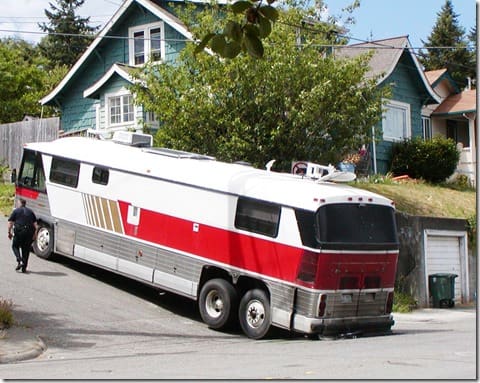
I think this was several years ago. You can see the drive wheels are off the ground. You can read the whole post HERE.
This is his description…
I proved that you can drive a bus up a hill that is steep enough that your front tires are on the ground and your rear bumper is buried on the pavement, but your drive wheels are off the ground. I also proved that while you can drive yourself into that predicament, you can’t drive back out of it. That requires the assistance of a very, very large wrecker, several police officers to direct traffic, a haz-mat crew to clean up the 36 gallons of antifreeze that pours out when the wrecker snags your bottom heater hose, a host of curious onlookers, and the news media.
I may be overy cautious some times but I can see this hapening very easily if I were not careful. Man, that hurts to look at! That could ruin your whole week!
DKO
Archived replied 11 years, 3 months ago 15 Members · 28 Replies -
28 Replies
-

My driveway is steeper. Many of the members on PC have seen it and will agree.
As a result I have no choice but to be aware that anytime our coaches are going to have to go across a transition in a road, railroad crossing, driveway, etc. that changes abruptly, rule number one has to be “GO SLOW”. The driver of the bus in the photo definitely carried some speed to cause the coach to slide on its tail far enough to get the drives off the ground.
But even going slow will not prevent problems or damage. The same acute angle transition going down instead of up has the potential to do a lot of damage under the center of the coach. The bottom line is at some point a driver has to observe rule number two and that is “USE THE LEVEL LOW”. We have the ability to raise one end or one side or the whole coach if needed to cross or get past these types of changes in elevation. One thing a driver has to always remember is that if we have gone slow, raised the coach and we still hear the grinding sound of metal on concrete we better stop and back away before we end up like the MCI.
Those who ignore situations like the MCI encountered and just keep plowing ahead often end up getting their photos on the internet and have an opportunity to spend time with their new best friend, the local tow truck driver.
-
Jon,
I know you have wrote about the elevation gain on your driveway but I never imagined it being that steep. I would dread going home. lol
DKO
-
I never could change the slope, but all the transitions were made for our original 40 foot coach. At normal road height I could back from the road, right up the driveway where it leveled off just prior to entering the garage. I never had to raise or lower any part of the coach and I could back right in without slowing or stopping.
When that coach was replaced with the 45 footer I had to raise the front as high as it would go and with the rear at road height the center of the belly would just clear the crest as it transitioned from the upslope to the level just in front of the garage. Then I had to lower the front just before I hit the satellite going into the door opening.
Now the same drill applies, but I have to stop just before the rear enters the garage and lower the rear as low as it will go while keeping the front as high as it will go. Then I have 1/2″ clearance above the rear spoiler to the underside of the door opening. If I forget to lower the rear I will either knock off the spoiler, or knock down the garage. Then I have to lower the front before the satellite enters the door opening. Liberty made a rubber baffle in place of the original steel one because now when I lower the rear so the spoiler goes under the door frame the generator radiator baffle hits the ground under the center of the coach.
So needless to say when I see a raised railroad crossing or a steep transition like the MCI encountered my brain is already aclimated to stopping, raising the bus and going slow.
My driveway does scare some folks, but after 13 years of use I don’t even think about it being perilous. The beginning of every trip however is the best air system brake test there is.
-
Jon, I’ve seen a picture of your driveway. Even the picture is scary. I’m guessing backing up the hill puts a real test on the transmission.
-
I try not to dilly dally on the steep part backing up. It is certainly a brake test coming down, but I haven’t any indication the transmission is affected.
-
I was just thinking about going up my daughters drive in N.H. – not sure I can make it.
Would it be better to consider backing up a drive like that since the overhang is less on the front than the aft? Is there a way to determine if a particular drive would be impossible without trying it?
Wave
-
Wave,
If you ever see Jon’s driveway, the first thing that would come to mind is, that’s impossible! If you don’t high center your Daughters driveway, it will back up.
-
Every different bus that has come up my driveway, all of mine, plus other coaches we always used a spotter to verify clearances. The driver and spotter use cell phones and when the spotter says “stop” the driver stops and raises the coach where needed or just quits trying depending on circumstances.
I would recommend trying. Just go slow. And make certain if the coach needs to go up or down or whatever that the driver knows how to make it do what it is supposed to the first time. It is real easy to crush the bottom of a bay door or a tailpipe or the sewer connection.
-
Jon,
I have received a bunch of invites to a Prevost Call or Webinar on this… I don’t have anything as steep as you have but I do have one dip that concerned me to the point I got out and got down on my stomach to make sure I would clear on the back… I cleared the plastic skirt on the engine rails by about an inch…
I won’ be able to be on the call… can you share more about this “Level Low” how it works…. where I can get more information about?
Thanks
Bill
-
This is helpful info. Blocking a public street in New England could be interesting. Out here in Okla. they start honking after ten minutes but just north of Boston I think it’s different.
Jon, would there be a photo of your drive on here?
W
-
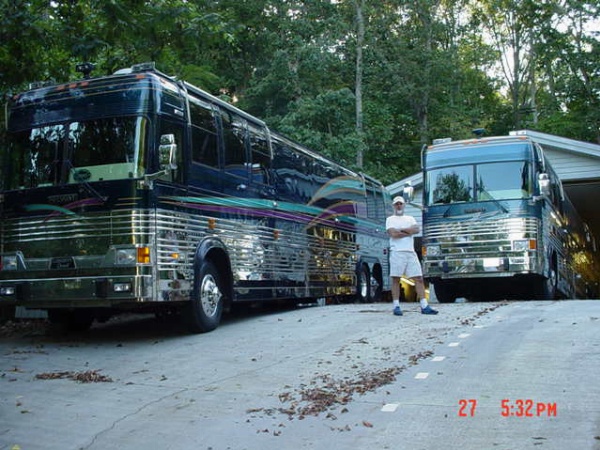
Here’s a photo that almost shows the whole story. This is the transition at the top from the upslope to the garage floor.My coach on the left is fully raised at the front and the drive is at road height. If either was any lower the generator baffle would drag or get crushed. What it doesn’t show is that as the rear of the bus just enters the garage the nose is down so low on the driveway the rear bumper is as high as my hip. Mango Mike (the good looking guy) has the rear of his coach already in the garage and he has cleared the transition. This doesn’t really show the steepness of the driveway, but steep is not a problem as much as how to transition from level to steep. The mirrors on my coach are just below the garage floor level so I haven’t yet seen the garage floor at that point. The rear has to be in the opening before my mirrors are high enough to see the floor. I do need to see the floor so I don’t back into the pit. After 4 years of estimating I finally broke down and painted the white marks on the driveway to guide me in centered over the pit.
As to how to operate the level low all I can say is each converter has a different way to control leveling. Some use the Prevost system without modifications. Some use their own modified version, and some use the Prevost system with another system (such as HWH) as a supplement.
The important thing to understand is to place the control from the “road” or “drive” position into a manual position. Then when in manual, select the position you wish to control such as front, left rear, or right rear. Then on all systems there will be a switch or control that will allow you to raise or lower the position selected. Before any attempts are made to cross an area in which the coach has to be raised or lowered make certain the coach is where you think it is heightwise, and that it is going to stay there until you choose another position or restore it to the driving height.
If you anticipate the use of the level low practice using it. Understand that it takes time to raise or lower the coach. Also even if you do not plan on going places where you have to raise or lower the coach you need to learn how to do it anyway. That is how you level the coach in a campground, that is how you cross railroad tracks or some driveways without damaging the coach, and that is how you deal with preventing the rear from dragging when you come out of some driveways.
-
G.O.A.L.
Get out and look. It took me a while to figure out what that was on all those truck mirrors but it’s a good reminder for all drivers I’d say.
-
Wow! That is quite a drive. Is the picture in Jim’s post your drive as well, Jon?
DKO
-
That’s my driveway. Until folks try to back up it all they are worried about is how steep. It is about 285 feet long from the bottom to the top, and it rises 80 feet.
But what gets everyone is if they do not place the RH drive wheels on the edge of the concrete as it makes the little bend by the telephone pole, their front wheels on the left will not track properly to stay on the concrete or to keep the LH side from getting scraped by the shrubs on the left.

Log in to reply.