
-
Chassis Charger
Posted by glen on September 12, 2016 at 8:25 amKnow this has been discussed and cussed but am putting my coach in a storage unit with 110 volt ac 20 amp ac power after selling the place and my bus barn. Looking at a BatteryMinder 24 Volt Charger Model 244CEC1. If I clamp it on the 24 volt side or wire it direct to shut off switch, I would assume she would start if I left it for a couple months as the only place I’ve found is a couple hours away from where we will build and get my new barn built. I don’t have any phantom loads. Have always had it plugged into 50 amp service and inverter on for house batteries and this old coach never had a charger for chassis batteries. I hope the 20 amp ac service is enough for inverter/house batteries and 24 volt charger for chassis batteries. Gonna shut the fridge down. Thanks Folks.
DON replied 9 years, 10 months ago 9 Members · 19 Replies -
19 Replies
-

Peter.
The Marinco 28220 is a good charger for our chassis batteries. I have one installed on my coach. As I understand it,this charger has diodes in the battery leads that prevent the alternator from backfeeding power into the charger. I haven’t specifically confirmed that to be true from Marinco but Roger at Signature Coach told me that was in fact the case. This is the same charger that he retrofits to his customer’s coaches. So, if the diodes are truly there, there would be no need to ever turn off the charger or even turn it off when running the engine.
-
Good info Peter,
I know a lot of you say don’t leave a charger on, but mine has been on the whole time, and maintains the batteries perfectly. Vantare says leave it on, and it comes on anytime the Ignition is off. No problems with batteries……….knock on wood!
The outlet it is plugged into is only hot when the bus is plugged in or Gen running.
-
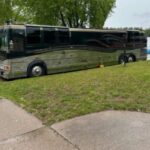
I am another one, with a lifetime of big boats, that learned that the charger stays on all the time. I am on my third coach with such a setup, and I have never had a problem with chassis batteries. My belief is get the right charger and charge on!
-
Jerry wrote: “it comes on anytime the Ignition is off. No problems with batteries……….knock on wood!
The outlet it is plugged into is only hot when the bus is plugged in or Gen running.”
Your first sentence implies (at least to me) that there is a relay in the 120 volt circuit for the charger that is “off” when the coach switch is “on” and “on” when the coach is “off”. Is that the case?
Or is the outlet for the charger only hot when the bus is plugged into shore power or the generator is running?
If the later is the case, then if the coach’s Detroit Diesel is running and the coach is plugged into shore power or the generator is running while you’re going down the road … then the Guest charger would be energized.
Which is the case?
Whether the the Guest charger has 120volt power or not, having the diodes in the wires to prevent back feeding from the chassis alternator would be a good idea. At least I would think that!
-
I am of the school of thought that says don’t turn on the charger.
First, it is not needed if your coach is right. If your batteries drain in less than 2 or 3 months something is wrong and you need to correct that problem. The charger just masks the problem.
I am on a 5 year schedule using only Delco 1110 or 1150 batteries. In 26 years they have never failed to go the full 5 years. So if I were to leave the charger on, and one of the batteries was developing an issue, the charger would cover up the problem to the point where I might have a failure on the road. I would rather experience slow cranking in my garage prior to a trip so I can avoid replacing chassis batteries while traveling.
-
Dick,
The power for the Battery charger receptacle is removed anytime the ignition switch is on. It only has AC power when the bus is plugged in to shore power, or the Gen is running. This was done by Featherlite when built. All 3 of the Vantare’s I have owned have been this way.
-
I can only speak for the way a Marathon is wired. Marathon told me there are two ways they retro wire a chassis charger. A cheap way and a more expensive way. The cheap way is with it plugged into the engine duplex outlet provided there to plug the engine heater into. That outlet is powered through a CB in the 120V panel.
The more expensive way is the way Marathon is now wiring their later model coaches with a relay on the ignition circuit which is the same way Vantare wires their chassis charger. If you are using a chassis charger that does not have diodes in the battery leads and it is plugged into that outlet, it may be a good idea to turn off the CB before starting the engine to prevent the alternator from backfeeding power through the leads and damaging the charger.
-
Please explain how the battery charger would be affected by the alternator.
The charger is hooked up to the battery. Whether it is on or off there is DC voltage at the end of the cables. The only difference between the engine running or not running is the voltage to the cables is either 12.8 or 13.8.
I understand diodes might be needed to prevent any voltage from reversing course and back feeding the charger, but that has nothing to do with whether the alternator is putting out voltage or not.
-
Geez!! Jon, for the same reason the charger is disconnected when the ignition is turned on. Who knows what damage can occur in a powered up charger receiving voltage from an outside source? Do you? So why take a chance on leaving a diodeless charger powered up when the alternator is charging the batteries? But since you aren’t an advocate of chassis smart chargers anyway, you don’t have to be concerned.
-
My 2008 Marathon H has a chassis charger installed by Marathon when built. When I turn on ignition switch the chassis charger turns off. I love it.
Bill S.
-
Looks like a great charger, here’s the protection items:
Protection
Ignition Protection
Over Current
Over charge
Reverse Polarity
Thermal Protection
Short Circuit -
Chuck, you have to put my views on this topic in context.
My first bus had some creative wiring done by a previous owner and after several days I was having battery problems. I had to recharge them often. I couldn’t leave the charger on because it was a converter, not a 3 stage charger so finding the problem was the correct solution. I found the problem and then realized once the issue was corrected my batteries would go for months with out the need to recharge. I learned about 25 years ago that lesson, and found out if they did not hold a charge they were starting to fail. I did and still periodically monitor chassis battery voltage when the coach is unused.
Subsequent to fixing the original problem I just rarely charged chassis batteries unless I was doing work on the coach that drained them.
Even if I did leave a charger on all the time, I have a hard time given how my coach is set up figuring a way to have the charger powered up at the same time the motor is running. When we get ready to leave on a trip I unplug shore power and then start the coach. The charger is on a circuit not powered through inverters so it is a dead circuit until we stop and plug into shore power or I turn on the generator.
But what is the difference whether the alternator is putting out charging current or not? I understand diodes are likely needed to prevent back feeding power to the charger, but that would hold true regardless of if it is pure battery power or alternator power.
-
For whatever it is worth, when I bought my Norco Gen 4 charger (12vdc charging for each of the 4 chassis batteries) the Norco tech said that the charger should be disconnected from the 120 vac power. The alternator voltage can confuse the charger and could damage the charger. I did not get into the how or why I just need to remember to unplug the charger before starting. I will need to make a tag that I can swap between the charger plug and the battery disconnect in the engine compartment since I do not have an auto disconnect receptacle like some – that is nice!I agree with Jon that could context is important. My coach is 2 hours away in storage and if I go to start it it is because I am leaving to go on a trip. The thought of having to trouble shoot which battery is bad is not something that I would be happy about. This charger should be able to tell me which battery is having the issue then hopefully I will be able to temporarily use the generator battery to start the bus. If f I need the generator I may be able to use the bad battery along with the house battery “boost” to start the generator. This should buy me some time to see what I need to do for a more permanent solution. Let me know if anyone sees an issue using this approach.
-
As Andy explains the 4 position charger that makes sense to leave connected, not only because of his distance from the coach, but because if it doesn’t start after a 2 hour drive he is greatly inconvenienced
I do understand if there is charging current going to the batteries from either the alternator or the charger and the other is turned on how the voltage regulator can get confused. But I have often had multiple charging sources going to batteries for various reasons and ther has never been an issue.
Log in to reply.