
-

The dash gauges are brakes and there is a means of preventing a leak in the accessory air from depleting brake pressure so you are not looking at the right gauge. If you do not have a gauge for accessories, add one. It is important.
You solved one problem, not you need to fix the one you have and the starting point is to find that leak. If it leaks as fast as you say it will sound a little like trying to shove a tornado through a keyhole, There will be none of the usual magic to isolate that leak.
-
Thanks Jon for all your help!
The only thing that I can see that the aux air runs in the coach is the floor slide and air toilet. With the coach off and aux Compressor on and as comes up to psi I can hear something in the rear Suspension moving. I’m a bit confused as why the power floor slide works with the bus running so it’s getting air from the engine driven compressor system when the aux compressor it not on. Man I’ve got a lot to learn! Lol
ress
Jeff and Lindsay
91 Marathon XL -
Try turning the regulator pressures on the toilet and floor slide all the way down. Then urn them up one at a time to reveal which one may be causing your problem.
-
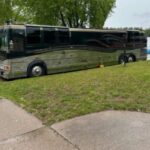 Crafty b, your bus has 3 major air systems: 1) “front brakes”, 2) “rear brakes”, 3) and last but not least “auxiliary” which is mainly for the air ride and leveling.There are a lot of sub-systems that operate off the “aux” system like your toilet, Detroit engine belt tensioners, generator air bags, step well cover, door lock, pocket door(s), dump valves, parking brake, air ride seat, etc. My bus has two air compressors, a Detroit engine driven one, and a 120vac for when the engine isn’t running. Your bus probably has these 2 also. Leaks are common and need to be minimized.The following is more info from my logbook that I got from PrevostService: Let’s start with where the air starts; the supply system. The heart of the supply system is the engine driven air compressor. It feeds an air dryer that removes moisture and oil. The dryer feeds the wet tank and a return line to the compressor mounted governor. The governor signals the air compressor to stop producing pressurized air and the dryer “sneezes” to unload the pressure line when the governor set air pressure has been met.
The wet tank then supplies air to the front and rear brake main tanks and the auxiliary tank. To isolate the front and rear braking systems, air entering these tanks does so through a check valve at each tank. Once air is in the main brake tanks it cannot escape back into the supply feed.The auxiliary air system cannot have the same priority to supply air as the braking systems. To ensure the braking systems are fulfilled before the auxiliary system, the supply line is fed through a protection valve to the auxiliary tank. The protection valve opens when either side of the valve reaches a specific pressure which is somewhere between 60 and 75psi. If your coach’s air systems leak over time you may have noticed that air builds in the front(secondary brake) and rear(primary brake) systems first. At the rating of the protection valve you then hear the rush of air entering the auxiliary system.
That is basically the entire supply air system. It supplies all 3 main air subsystems, rear braking, front braking, and auxiliary. Once those systems are filled the governor effectively turns off the compressor and each of the 3 systems are protected from their air returning to the supply air system.
Let’s start with where the air starts; the supply system. The heart of the supply system is the engine driven air compressor. It feeds an air dryer that removes moisture and oil. The dryer feeds the wet tank and a return line to the compressor mounted governor. The governor signals the air compressor to stop producing pressurized air and the dryer “sneezes” to unload the pressure line when the governor set air pressure has been met.
The wet tank then supplies air to the front and rear brake main tanks and the auxiliary tank. To isolate the front and rear braking systems, air entering these tanks does so through a check valve at each tank. Once air is in the main brake tanks it cannot escape back into the supply feed.
The auxiliary air system cannot have the same priority to supply air as the braking systems. To ensure the braking systems are fulfilled before the auxiliary system, the supply line is fed through a protection valve to the auxiliary tank. The protection valve opens when either side of the valve reaches a specific pressure which is somewhere between 60 and 75psi. If your coach’s air systems leak over time you may have noticed that air builds in the front(secondary brake) and rear(primary brake) systems first. At the rating of the protection valve you then hear the rush of air entering the auxiliary system.
That is basically the entire supply air system. It supplies all 3 main air subsystems, rear braking, front braking, and auxiliary. Once those systems are filled the governor effectively turns off the compressor and each of the 3 systems are protected from their air returning to the supply air system.
-
Thanks Don!
That all makes sense to me! Now I understand
how the aux tank is getting air when the 110 compressor
is not on. I will have to get the soapy water out and
see what I can find. It’s a big leak so I hope I can locate it
deep in the bus. For now can I just shut the 110 compressor while driving
and only run it when parked for using the microphor toilet which I’ll probably
replace if it does not operate properly? The Previous owner had it completely
checked out and the valve and flapper were replaced so it should work.
Should lol
-
Yes
Make sure the air dryer for the engine driven air compressor has been serviced recently so it’s NOT introducing water/moisture into the air systems. Same goes for the 110v air compressor. It is very important that it has a good air/water separator filter immediately downstream so as NOT to introduce water/moisture into the aux system.
Fix the leak(s) asap.
Log in to reply.