
-

Yes. A transmitter has less value to me now that I don’t own a plane. It has value in finding air leaks in door seals, but probably not in the case of owners of coaches with OTR. Open the fresh air intake on an OTR coach, start up the coach and the AC and use soapy water to see all the bubbles where air is leaking out, including the door seals and roof.
But the detector is a valuable tool.
-
Hector: Please recommend a source for the back flow preventer for the aux air compressor. Just today I replaced my aux air compressor and need a replacement check valve as the old original one is not as air tight as I would like and after cleaning made a notable improvement but not absolute air tight. Nor bubble tight as you might say..
I really like your idea of doubling the back flow preventer especially down stream and distanced from the compressor.
Thanks in advance
-
Roger,
I didn’t keep the paperwork, but I added one on my coach and I just did a search on Amazon. They were about $15 to $20. I bought two and used one on the compressor which has a built in check valve, and to the belt tensioner circuit which did not have one whereas my 97 did have one.
-
When you think you do not have a check valve, look again. The Thomas Aux compressor has a fitting that could be passed by for a coupler and not a check valve.
Pictures show differant types.
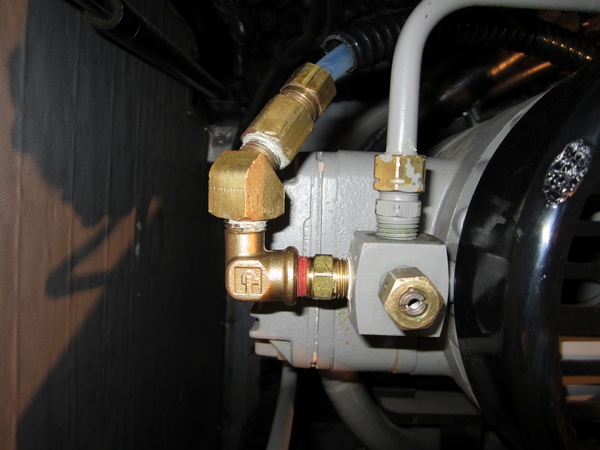 .
.
I’am telling tech service there is not one in the line. Tech service sends me a picture of what I should be looking for…….dah
You learn something new everyday you work on one of these monsters.
I hope this helps PC members fixing air leaks. This $80 valve Pic # 2 can dump a lot of air in a few hours through the Thomas compressor.
hours.
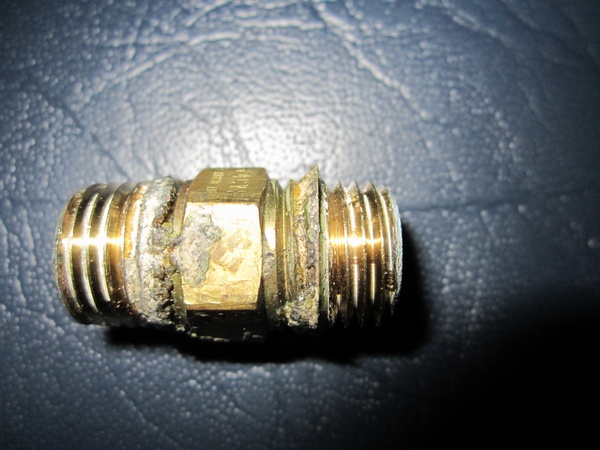
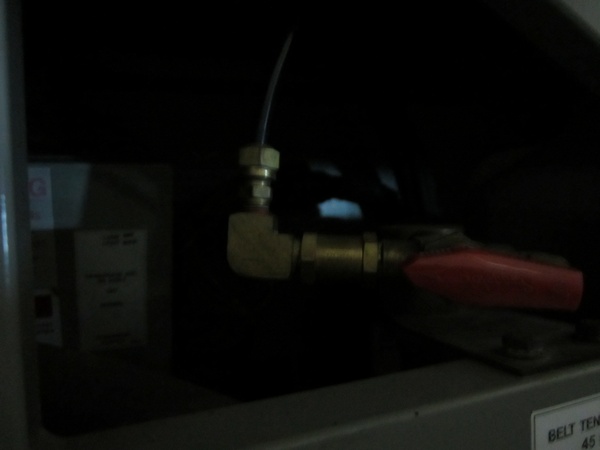
The last picture is the check valve installed by Prevost for mini air bags in engine compartment.
-
It is a good practice to keep an external compressor check valve some distance from the compressor. The reason is the air from the compressor can be very hot and in a relatively short period of time that causes the check valve seal to fail. So to continue Al’s point, you may have an external check valve for the aux compressor, but it could be where the aux compressor air line joins the coach aux air system. And to restate Al’s excellent point it may look like a connector or any plumbing connection.
Nothing is as easy as it sounds.
-
Jon, your post got me thinking.
Checked the temp. rating with my new valve installed at the Thomas compressor. My replacement valve was rated at 250 deg max. As you say heat could shorten the life installed next to compressor. Marathon routinely mounts check valve at this location. As you may be aware there Aux system splits someplace after the Thomas compressor line. One direct line to Aux tank mounted back in the hot water bay on the passenger side. The other side of the split runs to the Aux storage tank under drivers seat.
This rear storage tank supplies a reserve 10 +or-gals of air @ 120 lbs for the operation of the air operated in and out sewage dump hose. Another air item is the trap door on the underbody raised and lowered for travel position of sewage line and 50 amp cord.access.
The best I can tell is the split is behind the generator and nearly impossible access. Lines are different colors which ID’s from front to rear on the bus. This was helpful to pressurize various lines checking for leaks
Researched a company in Minnesota which manufactures check valves. http://www.valvecheckinc.com
I now have a custom made model 6200 ….400 deg heat rated, Viton gasket , “0” ring seal , 3 psi cracking pressure, this is amount of air needed to open the valve when the compressor starts. Shop talk if your in the check valve business.
Choices can be custom made setting cracking pressure with various custom stainless springs .
Choices can be made on the valve seal and its material. Viton “0” ring is the best with air, has a long service life, heat not really an issue with Viton material used inside this valve and service next to compressor.
All of the internal parts for the new check valve are held in place with a snap ring. The other valve internal parts appeared pressed in.
-
Compressed air can get very hot, and I think this is why the air dryer on our coaches is located some distance from the engine driven compressor. That is why an aux compressor check valve needs to be located in such a manner to allow air temp to drop into a reasonable temperature range.
Did Marathon locate a check valve just ahead of the split?
-
According to Marathon tech service the check valve for Aux tank service is located at the compressor. Have few issues with check valve and should be replaced at some point as planed maintenance.
No valve is located at the split and there is a reason.
Another check valve does exist on top of Aux air tank under the drivers seat. This check valve is for the Marathon Air service i.e.,air windows, toilet, air slide doors, air floor slide.
Supply service from tank has a direct 3/8 inch service after going through a SMC water seperator (this is the seperator mounted on the floor of the drivers bay) then direct line service to rear bedroom manifold.
That’s the newly replaced black manifold I pictured back a few posts. Each system then has a regulator and has a set pressure for operation. A separate supply line from the 10 gal rear supply runs to the trap door regulator set at 80 lbs. mounted behind a service panel in water bay ( drivers side) . With the help of an air piston raises and lowers the trap door for access to sewer hose and 50 amp cord.
Sewer hose is the “hog” for air and as I understand air is reversed back with an introduction of a part called “knife valve”. Air is supplied to this storage tank by two 3/8 inch lines ,1) direct Thomas compressor air line, 2) direct green Aux tank line.
Assume the sewer hose is in…… press “out” button and you have opened the knife valve to a 1 -1/2 inch supply direct to sewer hose that pressurizes the 4 inch hose and out it shoots. Works perfect as long as the cap is on the end of sewer hose. The reverse happens and the sewer hose is sucked back into the bus.
I have tested all supply service lines on the bus with the help of my $990 Missouri style shop compressor. Marathon runs supply lines in one piece front to back of bus where air is needed. Keeping it as simple as possible. I would not call it simple …..but now understand how it works.
Back to Jon’s point, yes this check valve should be located down the line for longer service life. I do have a super high heat custom valve and will be replaced a little more often then 7 years.
Ryan… was the contact at Valve Check, Inc
.
-
Air system components.
TOP PICTURE……SMC water and dirt filter under drivers seat. Cleans up Marathon air going to all Marathon service. Eagle rebuilt this filter with new “O” ring seal at cannister, new internal filter, new internal automatic drain valve.
There is a large SMC check valve located on top of green air tank 3 inch long ,color silver.
I think this is the addional check valve on the Marathon service system.Tested OK when I removed the Aux air tank completely. Taken to Eagle for under water overnight 120 lb pressure test …..yes they sunk it in a barrel of water and that’s how you know your tank, check valve, welds, are tight..
Two types of dial pressure regulators;
GENERATOR.. SMC DIAL REGULATORS……Most of the regulators are what they call, pass through , except generator mini air bags.(set 25 lbs) and trap door, set 80 lbs.
Marathon builds a safety lock to hold “up” in case air is lost and door lowers
One check….. easy to make on your generator air system;
1) turn off Aux compressor
2) dump air in Aux tank, pull relief valve on top of green tank or open tank drain valve
If the regulator in generator bay is working properly mini bags should stay up, usually set at 25 lbs. This regulator has a different part number and is designed as a safety if air is lost, having a internal check valve built into the regulator. If generator is running or just sitting keeping air bags up so the shake won’t destroy the mini air bags.
In storage those mini air bags should stay inflated for a long, long time. even with total loss of all Aux air
In my case found wrong regulator installed on my bus. … it also leaked
;
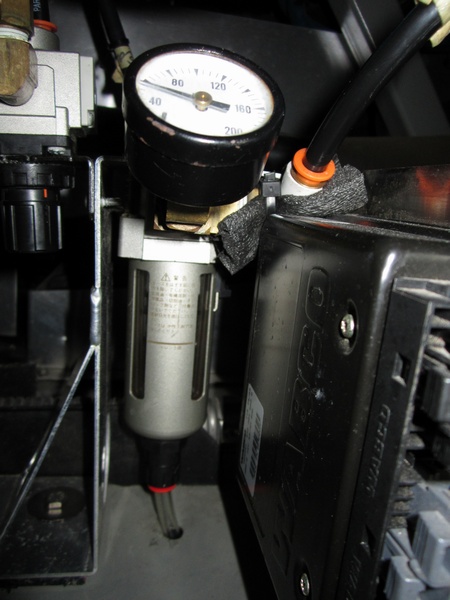
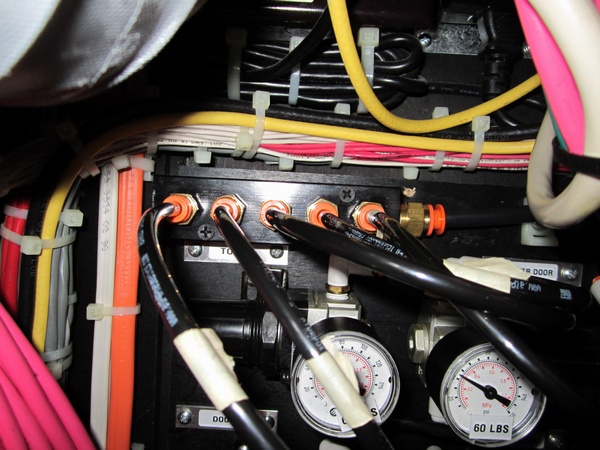
Regulators here are all pass through style. New manifold block nstalled.
-
Do check Valves make noise ?
All is good one day and the next….another air leak. Hearing a slight noise…..a little buzz,,,,coming from aux air tank At first believed the cut in/out pressure valve was making internal noise. Using the electronic leak/noise detector .. noise was coming from of all things the large silver SMC AK4000 check valve.
The strange sound makes no sense. Check with Marathon Tech service learning Leon, did’nt recall any problems with that SMC valve at that location. Long life trouble free, I’am told, good locaton, stays cool.
I had spent most of the morning checking all the areas where working on the Marathon Air system last month. Isolated systems from last repairs,
leak contiued.
Made a call to Eagle Fluid Air in KC learning any noise inside a check valve requires replacement. Another consideration is age of part and is on the high side.
Brian, at Eagle suggested that if I had any check valve in my spare parts to install it right behind the present valve. Test was a success and the air leak ended.
new valve $190.

-
The continued adventures of air leak repair.
After replacing the air check valve on the Aux green tank a very slight leak down was still happening. Isolating zones again this leak was on the toilet air system. Using my electronic sniffer no leaks show up on the valve below that has 6 colored air lines.
With the help of Microphor tech service in New Jersey I first isolated the feed air line, no leaks. The leak must be internal to some operation part of the Microflush toilet large grayvalve. Nearly an hour later the leak was found on the yellow air line which goes from valve pictured below to the contents hopper. The leak was air constant which was about 10 lbs + or – in 3-4 hours measured at storage tank.
John ( Microflush dealer) said he gets over 100 calls a month for tech service. Has only seen this malfunction maybe 3 times finding this leak when everything else works fine. Our toilet worked perfect.
This leak is only detectable when you disconnect the yellow line from the sealed hopper tank. It was a last resort check as all other tests were 100 %.
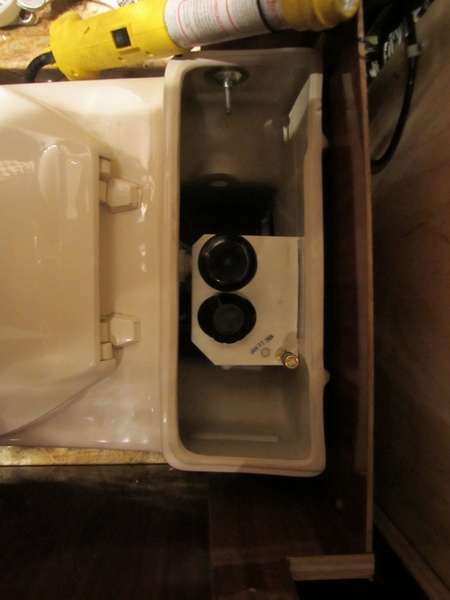
Second picture shows a metal wafer insert into a plastic bracket. I made this metal wafer-washer to stabilize mounting of two valves on this bracket. Problem is the 2 valves mounted on this bracket have different hole mount diameters, over 3/8 inch difference. Both valves must be mated secure as water under pressure transfers between valves when you flush. This plastic bracket was used in production for less then a year, I’am told.
This wafer insert corrects the excess factory hole play, provides secure mounting of both valves on a plastic bracket. Have 3/16 inch adjustment play, which was all that’s needed.
Our toilet is a Microflush LF-210 and no longer manufactured. Parts are still available but extremly expensive.

This is the internal air leaking Air/Water Sequence Valve, cost $3400. Brass part is old style bleed off assembly, new bleed off valve is $520. The bleed off valve is the operation adjustment. Now has external adjustment screw.
 required with new style A/W Seq valve.
Wall mounted (not pictured) flush handle internal valve part also leaked air , replaced sometime ago $710.
-
All parts in place…..it flushs, it doesn’t leak air,
 Mary Ellen is happy !
 -
Picture shows holding air pressure test for 14 hours.
Aux compressor cut out at 120 psi then power turned off at switched panel
Estimated cost ; one $400 electronic leak detector , 50 gallon drum soapy water, 3 trigger sprayers, new knee pads, probably around $1000 of parts, (toilet air parts alone over $500).
Thanks John and Sue at Microphor Tech/Parts New Jersey who stayed with me through many phone calls.
Mega thanks to Leon at Marathon Coach Tech service Coberg OR. for outstanding customer service.

When ever a leak was found I always let him know the result. Leon , remarked that rarely learns or gets feed back of what happens in finding or fixing the problem after the customer first calls.
-
Al………If you hadn’t taken a shot at us Liberty guys in the discussion of pumps VS city water I wouldn’t mention your Microphor cost of parts (ignoring the time spent, frustration, and the fact when you were messing with it you knew some smart aleck was going to say something). But I thought it was worth mentioning. So I did.
But I have to tell you I am impressed with the results of your efforts. You really did a good job.
Log in to reply.