
-

As long as you Liberty guys are getting the best stuff, consider a detector with an ultrasonic transmitter. The transmitter can be placed inside the coach and you can detect wind or water leaks around the outside of the coach with the detector.
-
The link I provided for the Amprobe did not include the transmitter, but the one I own has the transmitter and as John correctly points out the transmitter increases the versatility of the ultrasonic leak detector.
I had a pressurized cabin in my plane and I used the transmitter to help me identify bad cabin door seals which is the exact same application John references except you would be looking for bad seals that create wind noise.
-
As Jon says, push-in fittings are fine when new but……. Our bus is an early push-in fitting machine and we’re now paying the price of manufacturing convenience. As I discover them leaking, I am also replacing the push-in fittings with tried and true compression fittings.
With numerous leaks in both the aux and suspension systems, I started with the aux system, it seems a little less complicated and is easier to access. The original Prevost aux manifold was made up of standard pipe fittings. Installing a simple manifold simular to Als helped organize and put the various aux elements in some sort of order. I used all new compression fittings in the new manifold.
Having used both soap sprayers and electronic ears over the years with varying success, I recently bit the bullet and built Hectors’ bubbler. After using it, IMHO the bubbler is truly the only sure fire way of finding small leaks. In some ways, the bubbler is an instrument of torture. Building it is pretty simple. The process of adapting it to various tubing sizes from the bubbler into the system takes time and patience. Another advantage with starting the project on the aux system is that 3/8 and 1/4 inch DOT brake tubing accounts for most of the component hook-ups. For the suspension system you may also need 1/2″, 5/8″ and 3/4″ DOT adapters.
I am using a 12′ section of 3/8″ tubing to connect the bubbler to the components. This keeps you from having to drag the bubbler under the bus and it can pretty much stay in the same place when looking for leaks at each end of the rig. Hector cautioned me that when using the bubbler, to leave it hooked up to a component for a sufficient amount of time for the rubber seals and airbags to stretch and find their inflated comfort zone. Consequently I am leaving it hooked to each component for a minimum of 4 hours.
By the way don’t forget to check compressor to system supply lines. I found a small but constant leak from the aux compressor to the aux system. The check valve on the compressor discharge line was bad allowing aux pressure to leak back through the compressor. It would not have been detectable without Hectors’ bubbler. Thanks Hector.
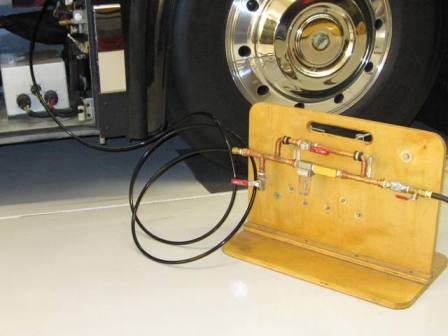
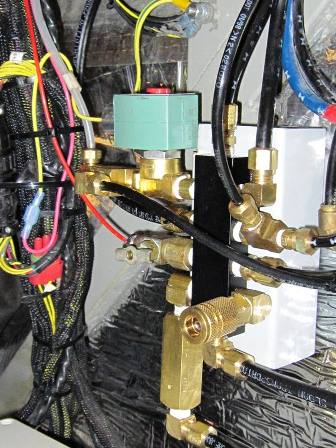
-
See!! I told you it would work……
From now on, your leaks finding success will be 100%. Looks good.
Hector
-
Hector,
Is there any way to create a drawing that can be put in the articles section? Brian is right in that it is an instrument of torture because of the scope of the work required to isolate a leak. Folks need to see how simple it is, plus have a short tutorial on how and why it works.
Push in fittings are going to be our worst nightmares and leak detection is going to create a need for countless hours of effort to locate them.
-
Hey Brian,
What is the green “box” with what looks like a red button on top of if for? What does that do?
-
Fred,
That is a solenoid valve. Asco makes a line of solenoid valves called Red Hats or Red Tops. I can’t remember the specific name. I don’t know what that one is for but it obviously controls something in Brian’s pneumatic system.
-
That
whole manifold set up by Brian is very impressive. -
The solenoid is another of Hector’s great ideas. About a year ago, just after Tom had torn up his floor to fix a leak in his step slide, Hector suggested installing an ignition key actuated solenoid that would isolate the step slide and driver’s seat. Since these devices are only used when underway it seemed like a heck of an idea to me.
-
I hear that push on fittings aren’t reliable. There are two types of push-on fittings, one that is DOT approved. Given the wide use of DOT type push-on connectors I’m wondering if the reliability issues are only with the non-DOT fittings?
I just replaced my aux air compressor motor and discovered something new. I adjusted the compressor’s output regulator to 100 psi. This worked great until I started the engine. With the engine compressor supplying air the aux compressor’s regulator was constantly discharging excess pressure. I assumed these regulators only regulated the output. This is another reason for a check valve on the output of the aux compressor tank after the regulator. I didn’t have time to pick one up before we continued our trip, so yet another item for the list when we return.
-
I seriously doubt if Prevost or the converters would use anything other than DOT fittings. If they have used non-DOT approved fittings I have not seen any. Conceptually the push on are great, but the enemy is time and since the seal is a rubber O ring that ages, hardens and eventually leaks we are destined to have problems.
We will not have aging issues with compression fittings. But when we get to the point where we have to replace leaky fittings we are also going to have to create new manifold blocks that use compression fittings. On my coach I have no less than 3 air manifold blocks that use swivel type 90 degree push on fittings. The leak potential is at the push in connection point or at the swivel. The block is too small to allow the use of conventional 90 degree compression fittings so a new larger manifold will be required or I will have to use new push on swivel 90 degree fittings.
I believe Hector said almost all his leaks were from push in fittings. When a compression fitting is leak free, age will not cause a leak.
-
Gil,
I also have a Country Coach, so our setup should be similar. Concerning the regulator on the aux compressor, I do not have this item. I would get rid of it and run straight from the compressor. The pressure switch installed on my CC has the ability to set the on/off pressure with a differential gap. Meaning, it comes on at 85 psi and goes off at 110 psi. With these settings, the aux air does not interfere with the Bendix engine compressor.Additionally, I have found that the check valves in most compressors are not as tight shutoff as we need for our aux air systems. I have mounted a double check valve in the aux air discharge line. A word of caution, do not mount the check valves close to the compressor, but as far away as possible on the discharge line. This will avoid any check valve damage due to hot air from a aux compressor that run alot.
The comment of Brian E concerning installing a air blocking solonoid on the air lines that supply the ISRI seat and the step slide is almost always assured to stop a few leaks. These two items have proven to be leakers.
Good Luck.
Hector
-
From Jon…
Is there any way to create a drawing that can be put in the articles section? Brian is right in that it is an instrument of torture because of the scope of the work required to isolate a leak. Folks need to see how simple it is, plus have a short tutorial on how and why it works.
………………………………………………………………………………………………If one checks out the current articles, an article titled “How Does the Prevost Suspension Work” can be found. This was one of the first articles you guys posted. Around 50 minutes into the presentation, a discussion of the bubbler is done. Concerning posting a drawing of the bubbler, well, I reserved the actual drawings for those that participated in one of the suspension presentations I gave over a one month period of time, twice a week, late in the evenings (was offered two years in a row). We all connected using the Internet (and our computers) and had a workshop concerning the suspension system. The posting in the article is a recording of the last session in the first series.
I would be worth while for any new coach owners to take the time to review this presentation. This time will be a good investment in you time. It will save you much time and anxiety in dealing with suspension system leaks. The suspension system is managable, but you will need basic knowledge of how the system operates at a minimum.
Hector
-
Jon I went to the tools and testers site. There is a uld 300 and tmuld 300. The pic of the tmuld 300 has an added item to the right that the uld 300 doesn’t. Is that a transmitter? Rick
Log in to reply.