


Archived
Forum Replies Created
-

We (well actually that should be “I”) ran out of fuel trying to stretch it into a Pilot truckstop in Alabama. We lost the prime and had a host of other problems because of it. Really un-good man.
Now we have a new traveling rule … “1/2 tank rule.” …. When it hits one-half tank we fuel it up, regardless. No worries, and no concerns.
“While parked on the Interstate actually had someone knock on the door asking if they could use my toilet.”
Now that one Al, it has to be the winner of the string. I loved that, it really conjoured up an image in my mind, let me tell you.
Kind of like those Orkin bug commercials … “Uh, could I use your telephone?”
hahahahaha
BCO
-
The wiring for AC circuits in all coaches is NOT
solid copper. That is absolutely inappropriate for the application for
the very reasons you state about the need to regularly retighten the
connections.Coaches should have tinned, stranded copper wiring for 120/240 circuits.
I believe thats what ANSI/RVIA specifys ..
-
Tom you are probably right I was going on memory from another discussion on this topic.
-
The wiring for AC circuits in all coaches is NOT solid copper. That is absolutely inappropriate for the application for the very reasons you state about the need to regularly retighten the connections.
Coaches should have tinned, stranded copper wiring for 120/240 circuits.
-
Dave,
I don’t think any of us can keep track of all the needed maintenance items without a specific plan, a method of tracking maintenance, and a way of recording the various tasks when completed.
Some of the things we have to do are obscure and hidden in the Prevost maintenance schdule or the generator maintenance schedule or are not even mentioned, but we learn of them either through need or by accident. For example, have your changed the power steering filter? How about differential grease? How often are your air tanks drained? The air dryer cartridge changed? etc. If I did not have a list that took a long time to create I would overlook some obvious and not so obvious needed tasks.
Your coach is “new” in the respect that its percentage of life used is probably still in single digits compared to its design life, especially if you do have a strong maintenance program.
-
If you have a 160 gal tank you are not going to get 160 gallons into it. I believe the filler is designed to only allow you to fill it to the 85% level. Therefore you are always going to be short 24 gallons unless you are creative in tipping and shifting the bus.
-
It was reading about a needle thickness away from empty.
I have let the fuel light go on once several years ago, and it took about 260 gallons but probably burned about 10 more gallons after the light went on before stopping to refuel.
-
Dan What did your fuel gauge read before fueling up? Rick
-
Peter,
The problem with shore power cords on boats is all too common. I have had the same happen on two boats in the past. In most cases, the failure is due to the power cable becoming loose over time. The other failure point is that the plug and connector don’t make enough contact to support the current draw. The corrosive environment doesn’t helped. In the marine environment there is better mousetrap. Check out this connector and plug: http://www.smartplug.com/marine.html .
It is never good to add unnecessary plugs. I don’t understand why any converter in the last 10 years or so would configure a coach that would require the use of an extension cord. The use of extension cords adds 4 additional failure points PER WIRE. Marinco retracable power reels have been around for a long time. Today there are others available, as well. If my coach used an extension cord, I’d look for a way to install a power reel.
To someone else’s point, electrical connections should checked periodically for good connections. BTW, the marine industry does not allow single or solid wire electrical wiring. Their rationale is that solid wire will break under vibration well before multistranded wire of equivalent gauge. If makes be wonder why coaches haven’t followed the same rationale.
-
To bring closure to this thread:
1) All light problems were corrected with new bulbs.
2) Cigarette lighter was fixed with a fuse.
3 Jake was fixed by resetting a popped breaker in the chassis electrical bay just above the steering compartment.
4) Pyrometer gauge on dash was NOT fixed by replacing the sensor. Gauge ground is next try, or whatever you guys think.
-
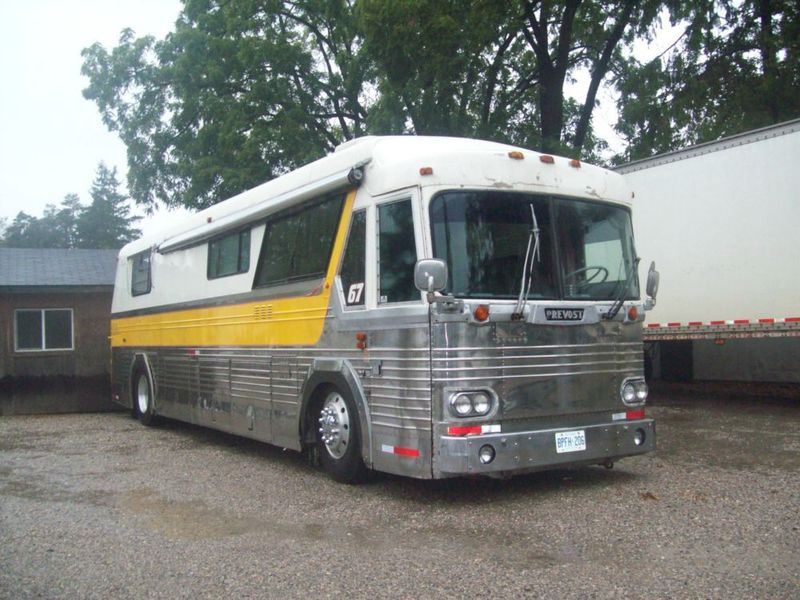
Okay Jon or Truk, if I can somehow locate one of these, would this qualify me for the “secret handshake society?” (I think it is a 77 model Champion wtih good air lines)
BCO
-
One more welcome here! You happened upon the right place. I will look forward to meeting you at some future event.
-
“But since the tires were six years old I bit the bullet and had them all replaced.“
Most tire compounds start to break down on the inside of the tire at about five years, replacing them at your age of six years was a good idea. They can have a huge amount of treadwear left on them, but the sidewalls are starting to weaken at that age.
Good move Sid,
BCO
-
Good to hear, another fine representative of the bus community has been located.
Welcome.
A lot of good information here Rocky, informal and technical, dive right in, the water is just fine.
BCO
(What secret hand-shake? This is my second reference to this …. Could this be bus parlance for greasing of the palms? Inquiring minds want to know)
-
It’s allowed……if you want to post pictures and sell your Harleys here go for it. The Flea Market might be the best place.