
-
Wheel Studs
Posted by Archived on May 6, 2012 at 8:33 amHello to All,
Lost a hub cover on the steer axle because I failed to properly tighten the wedge lock bracket. In ordering replacement hub covers from RealWheeis Corp., I find that the new wedge lock brackets are of a heavier gauge and require a minimum of 1/4″ projection of the stud beyond the wheel nut. At best, I have a 1/8 to 3/16″ projection which is not enough for the brackets to grip. Has anyone successfully dealt with the issue of extending a stud projection?
Thanks for your help.
Archived replied 14 years, 5 months ago 5 Members · 7 Replies -
7 Replies
-

I am not aware of anyone (Prevost, Alcoa, etc.) liking any type of hub cap whose brackets are captured behind the wheel lug nuts. Having said that however if I were in your position I would view the issue as having three possible solutions.
The first is to grind or sand the bracket part that rests under the lug nut so its thickness is approximately equal to what you had. Just make sure it is even after grinding or sanding so it doesn’t localize the forces or load on the wheel.
The second option is to grind the lug nut down to the thickness required to allow the stud to project through it a thread or two.
Since the first two are kid of band aids my preference would be to not grind or sand anything and just tighten up a lug nut and ignore the fact it is not completely threaded on the stud.
I can say all of the above because it is just an opinion and since it is free advice it is worth every cent you pay for it. You are not alone with hub caps that mount as you describe and others have dealt with it in the ways described above. I am not aware of anyone that has changed the length of the wheel studs although that is an option (as long as you understand that still will not make Prevost or Alcoa particularly happy about sticking anything between the wheels and lug nuts).
-
Jon,
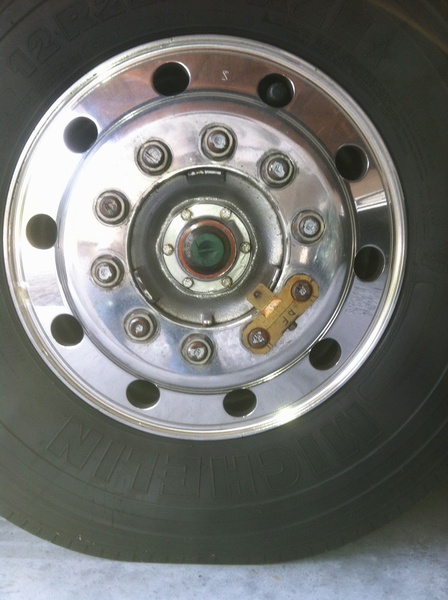
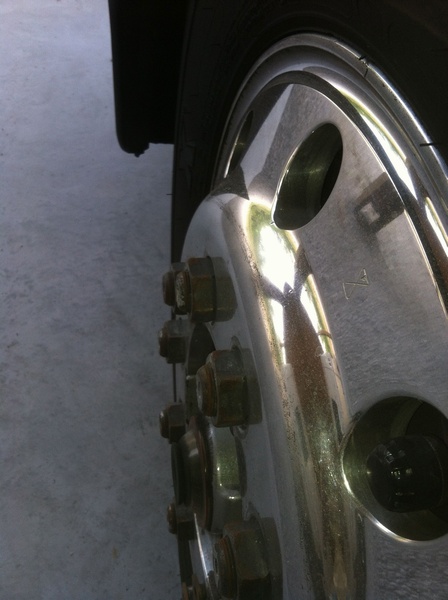
Thanks for your thoughts on this. The brackets do not mount behind the wheel lugs but in front of – see photos where one bracket remains. I have checked with various truck places such as Fleet Tires, in hopes of finding a stud longer than the ones on the bus but no luck. My solution was/is purchasing new lug nuts from Prevost and removing enough material from the exposed face of the nut so as to get the 1/4″ needed.
-
Tom,
Maybe I am looking at the photos wrong but it looks like the bracket goes under the lug nuts and on top of the wheel. That is the exact condition that Prevost and wheel manufacturers have stated they do not want to see. The stated reason is the proper torque on the lug nuts is intended to keep the wheel secure while having the tightening forces applied equally around the entire wheel. Placing anything between the nut and wheel disturbs those tightening forces which need to be equal.
Having said that and acknowledging you are going to capture the bracket as you describe, I question why bother to do anything to reduce the thickness of the nut? The number of threads captured by the nut remains the same whether you use an unaltered nut or you grind one down to a lesser thickness. It may not look as pretty as a nut that sits flush or nearly so, but at least you maximize the number of threads that are engaged and all the nuts are of a uniform size so you don’t have to worry if the tire guy placed the nuts in the proper place.
-
Tom,
I relaize your brackets are secured “ouside” of the nut on what threads are left and if you can’t find the thinner brackets, you may want to consider replacing with center mounts. Here is what I have and they use the bolts holding the oil cap on the steer and tag.
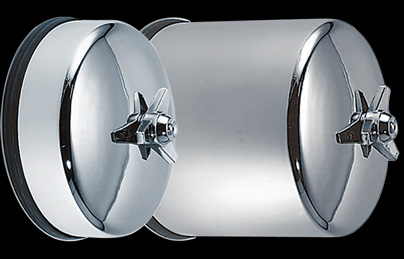
It may be cheaper going for new compared to changing out studs if that’s even an option.
-
Hi Tom,
I looked at that style of hub cap when I recently replaced mine. I believe that the “wedge lock” relies on the fact that it binds on the thread of the stud when you tighten the bolts on the cap. So if you do not have enough stud protruding it will not provide the required holding strength.Although cutting down the nut will provide the required protruding stud I would not personally recommend it. If I remember correctly from trade school the thickness of the nut must be the same as the diameter of the fastener to provide the same strength. So if the fastener is 1″ you must have 1″ of engaged thread to match the holding power of the stud or bolt.
-
Tom
I believe if you go to the Alcoa, etc. (whatever company made you wheels) website, it will tell you what to torque your wheels to and what amount of thread must show beyond the nut. The solutions presented so far, while solving your problem and given in good faith, I believe would be found to be unsafe by any manufacture that would surely be called in to testify at a court proceeding where your studs failed and the wheel flew across the road to injury someone or your coach manunvered after the studs failed in such as way as to cause a wreck with another vehicle. There is only one safe way to fix this, that is stud extension. Longer studs are available from many truck centers, I know because I just installed aluminum wheels on my coach which I am converting from an OTR bus to a MH. My coach orignally came with steel wheels. The thickness of the steel wheels compared to the aluminum is much less for the steel, necessitating a change of the studs by the local tire shop that installed my new tires and new aluminum wheels. The studs were not cheap at $60 per stud installed but when finished, it is done right with a torque of 550 ft/lbs and 4 threads showing, which is what my aluminum wheels call for from the manufacture.
Keep looking until you find a truck tire center that has access to longer studs. BTW, if you removed your wheels you would find the studs screw through the hub and then have nuts on the back that lock them (the studs) to the hub. The same amount of threads showing are necessary on the inside of the hub as the outside of the wheel.
HTH
Rob
91 LeMirage XL40
Missouri
Log in to reply.