
-
Whats the best way to drain the fuel tank?
Posted by Robert on November 14, 2013 at 12:20 pm94 Liberty 40′ XL not sure the size of the tank but its full of fuel thats been in it for 16 years. Should i pull from the engine supply line or put a garden hose in where the fill is?
Bob replied 12 years, 12 months ago 6 Members · 12 Replies -
12 Replies
-

what are you going to do with over 100 gals of old fuel, you might call a real truck stop or fuel distribute and find out if they can drain and desposes of the old fuel.
-
If you are near a place with yachts, there will be fuel polishing services that suck the fuel out, filter it and return it to the tank. If you’re in a cold area of the country you should be able to find someone with a multi-fuel heater that would gladly take it. Two trips with a 55 gallon drum and it’s gone.
Used fuel is hard to get rid of otherwise.
-
I have a heater that can use it How much will it hold with only one tank?
-
I would syphon as much out as possible first. Someone like Safety Kleen would pump it out, or other oil recyclers.
-
Rob, If I recall correctly, my 1990 XL Country Coach with single tank held 150 gallons. Not sure if a 94 Liberty would be the same, but likely if they kept the stock tank. There may be a plate listing the capacity inside the filler door.
I’m very interested in your project to wake up your sleeping beauty. I’m guessing these fuel questions mean you have not started it yet? My bus had only 10k miles when I bought it this summer so it had been sleeping way too much, but it sounds like yours has been in a coma. Despite very thorough testing and inspection of the engine and chassis and lots of maintenance, I’m still working on stuff that failed due to lack of use. Please post about what you do to get the engine running and how it goes.
-
Getting the fuel out is part of the problem. The second part is the fuel likely has algae in it if the bus sat in a high temp / high humidity location. Typically that algae is going to be on the sidewalls and bottom of the tank so part of the issue has to be getting rid of that as well. Even after draining, cleaning and refilling the tank it would be a good idea to rig up a pump to pick up fuel from the tank, run it through some coarse filters and return it to the tank.
I suspect the coach might have a Racor filter / separator and that would be ideal for use as the filter. Those pleated cartridges are easily replaced and the sediment bowl will show accumulations of water and algae. Far better to deal with that when at home than having a road trip interrupted numerous times to change plugged filters and reprime the engine.
It would be worthwhile to study a little about the various algaecide products to determine if there is a solution to ridding it from the tank as well as treating fuel to prevent further growth.
-
Rob probably has long range fuel and if so, then there are two tanks to empty clean, but only one fill tube. The two tanks will have a rubber hose connecting and filling is by gravity.
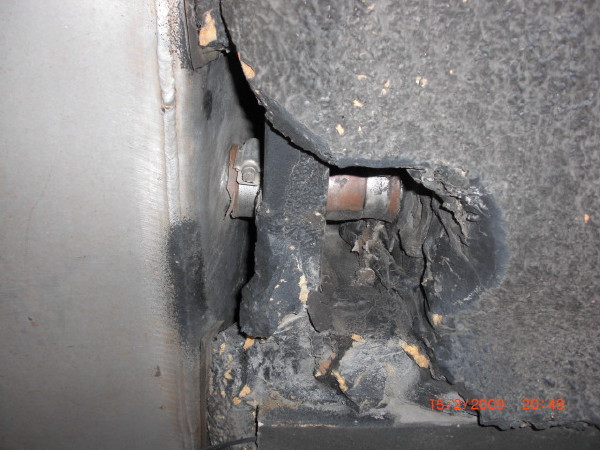
If you cut away the foam under the bus, you can access the cross over hose.
-
The engine fired after only half a turn,i did air up the system first coz the belts. I ran it for about 5 minutes to move it about fifty feet so i could drain the holding tank, and then back in the barn. It ran fine. I am going to disconnect the line comming from the racor filter and connect a pump there and pump the tank or tanks out. If there is alge its my concern i think maybe to try to kill it before i drain so the residue might drain out with the fuel. When i refuel i will fill with new fuel and road test about 50 miles stopping every 10 miles to ckeck the racor filter. Later when i take the first trip i will add Lucus just before leaving so it wont settle in the tanks. Iam working on several things right now, I will add some cutoff valves on the air supply just for leaks that will popup later. All the lines feeding the driver air seat and on the seat itself were bad. One gas strut on every bay door were bad so i changed them all. I am still trying to learn more about the systems I will change the coolant and the transmission fluid next . Then the 3- D8 house batteries i am getting from Tom . My goal is to have the coach ready before the spring rally near Tampa. I would like to meet some of the people in this site.
-
If you are going to pump thru the racor why not run it back in to the tank and do that for several cycles depending on the volume in the tank and the flow rate of the pump. add a few more filters and change them as needed.
-
Rob,
Here’s
a pretty good article on fuel
algae. http://www.diesel-fuels.com/index.phpThere
is no mistaking if you have algae, the fuel filter will be completely
black and slimy I had it happen years ago in my Marathon, but it
was run almost every month. I don’t remember what I added to the
fuel, but it only happened one time and I never saw it again. The
Racor looked fine when looking at the site glass, but as soon as I
pulled the filler, it was nasty black and slimy. -
Thanks Tom, the new filter is still clean but only a few short run times. and the old filter was not black
-
You may not even have a problem Rob, but maybe the best bet initially is treat the fuel as if you do, and then do nothing other than run it close to home and keep checking the filter(s). Not only will the pleated filter look nasty, but you will see crud in the bowl beneath the Racor. Your engine is well protected because even if it get’s past the Racor you still have the primary and secondary filters to catch it.
I would suggest you get a small inventory of the filters on your coach and for the Racor get the 30 micron because that is the first in line and it will certainly catch the big stuff. The 5, 10 and 20 micron elements will catch it too, but they will plug a lot faster.
Log in to reply.