
-

This is the PR-2 valve taken apart. Look at the spring, it is rusted and no longer moves. The plastic plunger was stuck in the bore of the metal housing and would not move. I had to use a punch to knock it out. The inside of the bore is very cruddy and is the root of the problem. This is the second issue I have found due to poor air system maintainence by the previous owner(s).


-
Very profound and educational thread.
Many of us on the forum would not have been able to figure this out and apparently solve the problem as Andre has. (We’ll see in the morning!)
Two of us who have posted to this thread mentioned that our coaches take a while to go to full height. Ours will sometimes go to “almost full height” in what I think is a timely basis, but not “full height”. Then after moving a 100 or so feet its “full up”. I wonder if I should look at the valve that Andre had trouble with. I’ll have to look at it and see if Jeff Rowe replaced yet or not (he has replaced lots of valves and stuff so far).
Moral to the story … nothing lasts forever!
-
Nothing in the air system lasts once it gets filled with moisture.
And chasing issues is a challenge until information needed gets sorted out. In last nights conversation with Andre we were looking at the front ride height issue only because he was under the impression the rear was going to ride height. Sorting out issues is a step by step process and as information is gathered it eventually leads to the isolation of a cause, but until all the facts are in there remains a lot of guessing.
-
Just a note about road height! Many times the vehicle will not get to true road height until it is exercised a bit. This is many times due to the weight of the vehicle. This can make the coach slow to rise but once it gets to road height it stays there fairly well. As Jon and Andre have noted the pneumatic system is many times overlooked in the maintenance cycle and moisture gets into vlaves . Plus the fact that most motor homes sit for extended periods can let internal parts begin to corrode.
At least once a year you should have all the air tanks completely drained to see if your air dryer is still functioning well. Then every two years the air dryer cartridge should be changed. That way you are pro-active with the system and you will not get into issues such as this one. If you are purchasing a vehicle and are not sure of the history of the pneumatic system, have the air dryer serviced. It is not expensive and generally done easily.
As a note also on the pneumatic system on the coaches! the converters have always installed some form of air compressor to make up lost air for toilets , pocket doors, etc, For many of the early models the output of the compressor was simply “t”ed into the auxilary air system of the coach. Thus they introduced non-filtered air into the coach system after the coach air dryer. Moisture was put directly into the system. As years went by the converters began to install a water and oil separator to the output of thier compressor before it dumped into the coach system. This is one of those things that is not readily apparent when you look at the air system. Just check the system with draining the air tanks and service the air dryer regularly. It will help greatly with sticky and sluggish air valves and prevent freezing in the valves if yoiu get caught in that dreaded cold weather.
-
Just the opposite problem from Andre. Had extensive front end work at Nashville prevost drove home now ride height is 14 inches. Had oil changed at local place and the adjusted it down to 11 inches. took a 70 mile round trip now ride height is back up to 14 inches. Any ideas? POS
-
I would not hesitate to get it back to Prevost. It is not safe to drive it that way. Something was changed during the work they did and it has to be restored to the way it was.
-
Dan – What was done at Prevost? Did the high ride height happen when you left Prevost or was it OK?Good advice from Prevost on the aux air and compressors, they make a ton of water. Kudo’s to Marathon for isolating the Marathon aux air and keeping it separate from the Prevost aux.
-
Here is how the front leveling valve is attahced to the frame and the front sway bar.
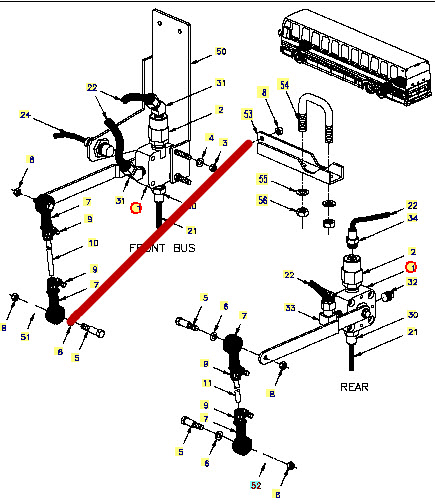
The leveling valve is attached to the frame of the coach. The rod with the two rubber ends attaches to the bracket above in the picture. That bracket is attached to the front sway bar. So to adjust the road height we normally slide the rubber ends more open on the rod or move them closer. Then you have to retighten the small clamps on the rubber ends to hold the rod position. That is one place to check. Secondly check that the bracket that is on the sway bar is good and tight. If not, it can rotate on the sway bar and the road height is thrown off.
These are the two most likely places to check.
-
Had slack in steering and I believe most everything that effects steering an alignment was replaced and bus was aligned. Did not notice height until I was home later that day. Maybe has something to do with HWH system and I will check that today. Just one of the many mysteries of a Prevost bus! POS
-
The PR-2 pressure Protection valve that is under the drivers seat next to the Norgren filter, has been replaced and everthing is working again. We should be on the road in next hour.
Thanks to everyone who helped be out with this issue. The combined knowledge of the this group is amazing!
-
Followed your problem from start to finish. This is an amazing group of Prevost Owners. With out this web site we would be lost in the sea of “OMG…now what”
This repair is an example of how tight this group is. Many go out of their way to help other Prevost owners they have never met.
One post by Terry and Andre was seeing the light at the end of the tunnel………..Yes, Terry you nailed it
As of right now, it looks like Terry hit the nail on the head. Andre posted
AL
-
I am having the same problem – can control height with Level Low but am not able to go up in ROAD mode from lower than that point, nor does it purge back to driving height if put back into ROAD.
Assume it’s the same problem, will give it a try.
-
Chip, if you have issues with ride height switch the center solenoid with any of the others in the five solenoid valve manifold. Just the solenoid is all that is required. Don’t lose the “C” ring.
I am assuming all your solenoids in that stack are 24V. Replace the bad one when you get a chance.
-
Jon, I hear it click so I bet my problem is the same as Andre’s. Going to try that first.
-
If you hear the click, then crack the air line coming from the valve and make sure you hear air flow before going any further.
And to be honest I keep forgetting there are other issues caused by poorly maintained air systems such as water in the system or sludge due to moisture preventing valves from shifting as required.
When I have a system malfunct ( a highly technical term) I start at the beginning and follow air flow or current flow until I find the issue so rather than go beyond the manifold I first would verify it is infact allowing air to flow in the road position.
Log in to reply.