
-
Towing a Trailer
Posted by Roy on June 15, 2018 at 11:28 pmSeveral months ago, I posted about loosing a rear wheel bearing on my Jeep while towing 4-down. It did over $7,000 damage and at one point was smoking, which could have resulted in a fire, possibly endangering my coach. I posted that I was thinking about a car hauler. I read all the posts, talked to my friends that do tow a trailer, and decided to buy a trailer. We are 7 days into a three week trip to the Badlands, Mt. Rushmore, Yellowstone, Jackson Hole, Moab Ut, and into Breckenridge where we will spend the summer at Tiger Run. So here are my initial feelings on towing a trailer.
Yes, it is more work. Not a surprise, knew that going in. The trailer seems to roll easier than 4-down, less resistance. The trailer is total 25ft long. I am making wider turns, getting a feel of how it follows. No problem being 70 ft long with campgrounds, all our reservations were made in advance, with the length information.
So, here is what we did . First, I installed a Tekonsha 90250 Prodigy RF Electronic Brake Control. This is a wireless controller. The main unit bolts to the trailer tongue and you plug the trailer plug into the unit and the unit plug into the coach. Then there is a small control unit the plugs into any 12v receptacle. This was important to me, because I can simply move this unit to another vehicle and have tow brakes. I use the Jeep to take the trailer to and from storage. I bought a Weight Safe WS6-2 adjustable ball hitch. This unit has a built in tongue scale. Tongue weight should be 10-15% of total trailer weight . I am using MAC Straps. They are American made and each has a 10,000 pound rating.
A car is really not designed or intended to be towed. A trailer is. And if there is a problem, you most likely have minimal damage to the trailer and no fire. Also, trailer tires are much less expensive to replace than 35 inch off-road tires.
So far I’m pleased. We’ll see how it goes.
Roy
Brady replied 8 years, 3 months ago 12 Members · 30 Replies -
30 Replies
-

Nice looking trailer Roy, now when it gets dirty you can keep Martha busy polishing it.
-
Roy, I am not trying to offend you, and I understand you are doing what you feel is correct, however be aware of my concerns.
Trailers will never possess the quality level of the average car. The axles and rolling components are mass produced to the lowest possible cost level and rarely will any trailer, whether it is a camper or a small utility trailer or even a trailer intended to haul cars have axles, bearings or tires as good as what is on our cars.
Pay very close attention to the trailer tires and wheel bearings. If you replace the trailer tires get the best possible. Keep the wheel bearings lubricated and plan on “packing” those trailer wheel bearings often using very high quality high temperature grease.
The good news with your decision is the offset to the disadvantages of a trailer is now you can back up. When towing 4 down any backing, even a short distance can damage the tow bar, car tires or even the steering linkage, but a trailer can be backed up all day long with no damage.
-
Roy,
Very nice looking car hauler! The stainless storage box compliments the stainless on your coach!
Safe travels, hi to Martha!
Mark
-
Years ago I owned and drove one of two 18 wheel car haulers. I have some experience in tie down, weight shift.
Vehicles carried must be secured pulling the top spring weight down. If it is not tied down correctly you will have a shifting of the vehicle on trailer bed.
Carried vehicle must be made part of the trailer and firmly tied down in all directions.
I’am not trying to offend you…But offering a free opinion as Jon did should be posted.
There is no way I would switch from towing four down to tie-down with 4 straps a 5000 LB Jeep.
Speaking of straps… which are not load attached correctly. Also missing a safety strap on the handle gear lever.
It’s what I see in your picture . Maybe you have changed this by now along with using chains …weight rated.
Correct “X” tie down will hold your jeep more secure as things change , move, vibrate, shake, when you travel. That might be in place on front but I’am unable to see.
I’am affirming Jon’s post, yes it does happen….. hope you re-think the danger we both see.
AL
-
Roy,
Great looking rig, what kind of trailer is it? Is it a tilt or ramps?
-
Jon, Al,
No offense taken, thank you both for your thoughts and information.
Jon, here are the safety measures I took to minimize risk. First, I am not loaded to capacity, I have a safety margin. I ordered 16 inch tires with a higher load rating (E). I will not run the tires past 4 years and maintain the axles, bearing etc. I am using a Pressure Pro System. I am also using a TATTLE-TRAIL Towing Monitor System. This unit monitors for abnormal vibration. This will signal a bearing going out. And yes, if I had been using it when I had my bear failure on the Jeep I would have caught the problem early.
Al,
I am X strapped around the axles, (Was not in the first photo). Please clarify what you mean by “vehicles carried must be secured pulling the top spring weight down”.
How should the straps be load attached correctly? What is a safety strap on the handle gear lever? How is attached?
-
Greg,
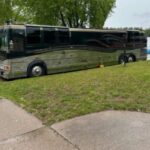
The trailer is a Sundowner made in Okahoma. It has 8ft ramps stored under the back of the trailer. I liked the V nose, which is less likely to hit the back of the coach, and the storage compartment that doubles as a wind damn. They make a lot of horse and cargo trailers.
Roy
-
Thank you, being open minded after reading post.
Some would have taken offense to Jon/Al post. We both took a risk.
What I’am suggesting is to re-think your tie down. Jeep must be secured to your trailer using the holes in the structural frame. This pulls the Jeep firmly down being part of the trailer, thus making trailer and Jeep a single unit. Now we have a firmly mounted Jeep that will use the suspension and ride of the trailer. Doing this has assured your Jeep will remain with and on top of the trailer in all road / travel conditions.
Actually your rear “Y” strap is holding your 3ad member. Your passenger compartment is not firmly held down.
After some changes your “Y” strap can now add the extra bit of safety to keep Jeep on trailer firmly in place .
You might think about returning to the trailer manufacture for some eyes to be located in or near frame points.
Strap handle needs to be wrapped so it is firmly secure at the locking point of tightness. It must be locked in place so to render the handle unable to break loose.
AL
-
Example of frame chain with 3 options . Cost $29.95
Northern Tool inventory

-
My concern is your solution not only did not resolve the stated problem but added more potential issues. Our cars are deigned to roll and literally roll for 100,000’s of thousands of miles. Our wheel bearings and their lube are light years better than any trailer.
The fact you had a problem on a toad was a very rare event especially when we consider the thousands of vehicles being used a toads, four wheels down.
Your safety devices if applied originally would have offered protection and early warning for the toad and especially the Tattle Trail would have signaled an alert about potential bearing failure long before it got the level it reached.
But except for the inconvenience of a trailer and the pain in the ass it is to tow one with a car on board, I really like the fact that if using one we can back up. That alone is a huge advantage, but it does not offset my concerns. BTW, it does not matter if the trailer is a $5,000 trailer built for hauling lawn mowers or a six figure stacker, I think the concerns expressed by Al and myself are equally valid.
-
I agree with Tom and Al. I’ve bought two enclosed trailers from Tom and Jerry Mueller of Random Lake, WI who were a top five Pace Trailer dealer for decades, are now #1 or #2 nationwide for Bravo, sell more than 200 trailers a year (from light to utility trailers to 32′ stackers, and have hauled race cars all over the country in 24′ to 32′ enclosed trailers when they raced USAC, ARCA, and NASCAR Cup and Trucks.
The Muellers and my experiences have taught me a few things about trailering vehicles I wouldn’t have figured out on my own.
1. X the tie down straps on something close to a 45 degree angle. That puts the D-rings in the trailer far out and the fastening point on the frame as far out as possible. All of my race cars have had hooks for tie down welded into the frame. If the X is too flat (or you have the straps in line with the vehicle), its possible for the vehicle to move from side to side as it goes down the road, especially if you fasten the straps to the axles versus the frame.
2. Check how the D-rings are attached to the trailer frame. Expect the D-Rings to bolts to a gusset (large 1/4″ to 3/8″ plate would be best) that is welded to frame. They should be fastened more securely than just bolted to bed of the trailer.
3. Do you tow with the Jeep in gear (manual) or in park (automatic)? You’ll notice that as you travel, the web straps will have a tendency to stretch. Everytime you stop see if you can put another click in them. Before you get that click in them, the Jeep will move just a little bit … enough to not be good for the manual trans or the parking brake pahl. I ALWAYS tow with the race car in neutral.
4. I tow enclosed, you tow open. The straps will be subject to lots of sun, rain, and road dirt and debris. When you put new tires on the trailer, consider getting new straps. The material the straps are made of probably get better every decade, but I wouldn’t trust them being outside often over a long period of time.
5. I’ve only had two tire problems in all the trailer towing I’ve done. First was a left rear tire on an open tandem axle trailer. Front tire picked up a small piece of steel (like flat clip) and propelled it neatly into the face of the back tire creating an 1″ wide slit across the face of the tire. Second time I was coming back to Grafton from Blackhawk Farms Raceway (2:15 trip), it was late, stopped for gas, fortunately it was really quiet, and I could hear an air leak. Had nail in the face of the back tire. Pumped it up to 60# at the station and limped that last 30 minutes home. In both of these situations, I think the thing in the tire was caused by the tandem axle. With Pressure Pro, you should know within a minute or so when you have a tire problem.
I find your draw bar very interesting. I like the tongue weight scale, I have a small tongue scale I bought from Joe Martin’s Sherline Industries before he passed away. Knowing the weight of the tongue is important for a SUV or pickup, but probably less for our coaches. I’ve considered similar drawbars to what you have, but have been concerned about how close the down piece might get to the road, especially when crossing a high railroad track, or going in and out of driveway with a deep gutter.
I’ve never thought about trailer components (axles, bearings, etc.) in the same negative vein that Jon does. Trailers are build to haul stuff, whether it be yard waste, lawn mowers, race cars and huge amount of support equipment, or Jeeps with 35″ off road tires. If the word got out that a particular trailer manufacturer’s axles and bearing couldn’t handle the rated load, that would be the KISS OF DEATH to the trailer manufacturer in the racing community, especially with social media. I try to buy quality stuff (and pay for it) when I think its warranted … like the Jamestown Industries shore power box the coach is plugged into on the side of the race shop. I paid more than competing products, but it has NOT let me down and there has been NO corrosion on it in four years. But maybe Jon has more insight into what goes into stuff since he was in the manufacturing business.
I’m still trying to figure out what Al is referring.
-
Roy,
As a person who has towed a trailer with the Corvette inside, I recommend that the back straps be cris-crossed and I would attach them equally as far to each side as possible. You are looking for side to side stability as well as holding/stopping power. The set-up you have in the picture is not secure from my view. That Jeep can potentially move to either side. It can literally bounce off of the trailer potentially. If you look closely, the movement does not appear to have to be much before the tire is on the rail. I used three foot straps under the car on each strap to wrap around supports.
Our mantra when towing the Eliminator Vette was pull the straps straight in front and cris-cross the back. In retrospect, I should have cris-crossed both the front and back.
My thoughts. Look at it closely. There is a lot more movement than you potentially realize and the momentum is great.
Pres
Log in to reply.