Prevost Community Forums

Find answers, ask questions, and connect with our
Prevost Community around the world.

  • Tires and Tire Pressures and Failures

    Posted by Archived on July 9, 2013 at 1:07 pm

    For roadside service I’d say that’s a fair price. Shouldn’t Michelin cover this? Their RV tire warranty is either 5 or 6 years. In either case it was in the warranty period.

    I have a TPMS that I never used. As much as I’d like to have a TPMS I read too many negatives, like what happened here. I’m sure they have be beneficial to many they just don’t pass my risk vs reward test. An affordable and reliable in-wheel system like those factory installed would be great.

    I’m glad no one was hurt and that coach wasn’t damaged.”

    Gil J posted the above on another thread and he made some good points worth discussing.

    First, in regards to a TPMS I suspect any one, no matter how good or bad is better than a poke in the eye with a sharp stick. Where false readings come into play are those that lie indicating tire pressure when none exists. That puts the burden on the owner to sample tire pressures periodically to verify those the system is reading are accurate, or if not are known to be ignored.

    What propted Gil’s post was Roger had a tire failure and after the tire had blown the TPMS still showed the tire pressure at 111 PSI.

    One thing we all have to realize is if we did not install the tires such as buying a coach with tires that have good date codes, we still cannot be fully comfortable they are OK. Gil mentions Michelin should stand behind Roger’s tire failure, however one thing those of us driving on tires with an unknown history can be driving on tires that have been driven with low pressure. According to the tire manufactuers driving with 20% less than the recommended inflation pressure renders a tire as junk. A tire driven at low pressure will likely have a “zipper” failure. That type of failure is a sudden blowout, but one in which the tread “unzips” from the sidewall around the perimeter of the tire just past the tread. No tire manufacturer will stand behind the warranty when that is the failure mode.

    Sorry for the size of the photo. Do a google search for “tire zipper failure” and you can see numerous images.

    Kenneth replied 13 years, 1 month ago 8 Members · 10 Replies
  • 10 Replies
  • Fred

    Member
    July 9, 2013 at 2:43 pm

    Glad
    it didn’t turn out worse for Roger….

    I don’t know what TPMS Roger has, but I’m a Pressure Pro fan, also
    a dealer and for the price of the entire system, it’s cheaper than
    one tire. A catastrophic failure (Blowout) may not give you any
    sensor indication if the cause isn’t excess heat or low pressure
    leading up to the failure. A road hazard is a road hazard and happens
    usually instantly.

    They are not bullet proof, but gives you piece of mind knowing you
    will get a warning of low pressure or high heat in time to get off
    the road before a failure. If you are not diligent in checking tire
    pressures, at least with the Pressure Pro you can push a button as
    often as you like to get pressures.

    My problem with the 365’s is the stem hole is not big enough to
    accept a sensor, necessitating a short extension that just goes
    against the grain, but I’m going to do it anyway. I think the
    benefits out-way the short extension concerns.

  • Jack

    Member
    July 9, 2013 at 4:33 pm

    OK Truk,

    You have just become the test bed for whatever combination of valve stem lengths or extensions work on 365 tires so I can get back to giving consideration to Pressure Pro

    You just have to convince me I can check tire pressures on my duals easily.

  • Gerald

    Member
    July 9, 2013 at 4:55 pm

    Don’t want to misinform anyone anyone about TPMS. I have had two previous experiences on other coachs with TPMS that saved me big $$$$ by warning me of loss of air pressure. Once I was able to remove the bolt from the tire tread and plug the hole and continue the trip home without further interruption and in another case was a ble to limp into a nearby truckstop and overnight while a new tire got delivered. In both cases running with a flat could have been a disaster.

    I will continue to run TPMS in the future. A blowout due to zipper or whatever issue is probably not going to give an advance warning thru the TPMS – How could it? A sudden puncture causing air loss is definitely a hazard to be avoided.

    The tire fortunately exited the wheel well opening to the street side reminding me of a potato peeler in the Army. It shot right out of the side of the vehicle, I heard the boom and looked in the mirror and it shucked the tire tread right off. There was about a 3″ band of tire left at the bead when it was over. – Lots of steel wire wrapped around the wheel.

    Like Gil said it was great no one was hurt!

  • Archived

    Member
    July 9, 2013 at 10:00 pm

    If anyone is concerned with using valve stem extensions, why not just have valve stems of the right length for your application installed? Besides the issue raised with 365s, which I have no experience with, you must have extensions on your inner duals or installing your TPMS sensors must have been a real PITA.

  • Archived

    Member
    July 10, 2013 at 6:56 am

    Anybody reading my posts knows there is not a snowball’s chance in hell that I am using extensions on my inner duals.

    With or without the rubber grommet in the outer wheel I have seen several extensions that were almost worn through to the point of failure and in the early 90’s at seminars Prevost condicted they were adamant about the use of extensions. They were 100% against them and warned owners their use could also contribute to a fatigue failure of the valve stem due to centrifugal force.

    If you use extensions just be aware you are at risk. Alcoa can sell you all the rubber grommets they want, but if the grommets don’t wear a hole in the extensions the valve stem can crack at the bend due to the weight of the extension and flexing from centrifugal force due to tire rotation.

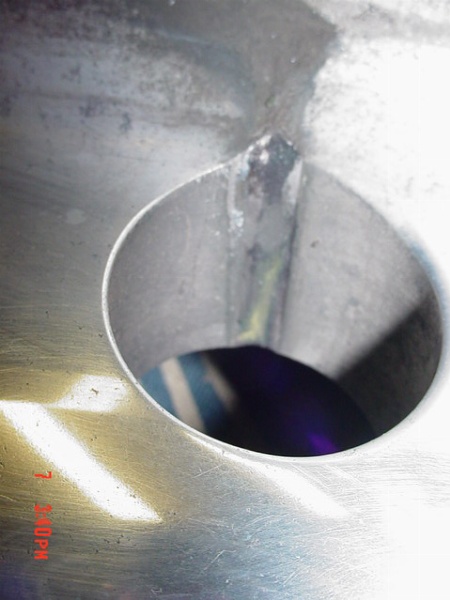
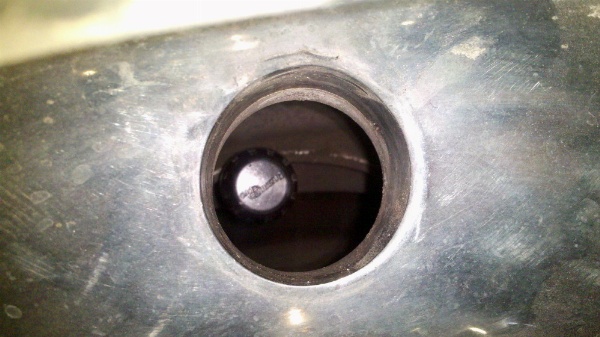
    The flat spot on the extension was where it went through the grommet in the outside wheel.

    That’s a wheel through which an extension extended. At some point the grommet was lost and the owner was unaware that when he was driving the extension that was centered in the wheel when the bus was stopped flexed outward so much at highway speeds that both the wheel and the extension were wearing each other out. It was only a question of if the extension would get a hole worn in it, or if the valve stem would fail first.

  • Paul

    Member
    July 10, 2013 at 7:46 am

    Gill, not correct.

    You can easily put a sensor on the inner tire without an extension, that’s what I do with the Pressure Pro. You can buy the tool from Pressure Pro, or go to Home Depot and buy a 3/4 PVC coupler and a piece of pipe and you now have your tool.

  • AL

    Member
    July 10, 2013 at 8:01 am

    I forgot to mention the Pressure Pro will alert at high pressure as well as low.

    Low Pressure – 12.5 – 25% of baseline

    High Pressure – 10 – 45% of baseline – adjustable

    High Temp – 200

  • Lee

    Member
    July 10, 2013 at 8:51 am

    Jon, yet another thing to keep an eye on for those using extensions. I saw a similiar risk an owner wasn’t aware of. He was using the steel braided extensions on his duals and the hose mount broke.

    Tom, Pressure Pro has smaller in diameter sensors than the ones I never installed. Also, the ones I have have small set screws to lock them to the valve stems that seems smart.

    A well respected coach conversion expert told me had seen more than one valve stem failure attributed to sensors on the steer and tag axles that must have contacted curbs or something else. To me that seemed remote, but it did happen.

    Maybe there’s been enough advancements in sensors to give them another look.

  • Kenneth

    Member
    July 10, 2013 at 7:47 pm

    Pressure Pro’s come with the locks.

  • Archived

    Member
    July 10, 2013 at 8:00 pm

    Which cannot be used on the inner dual which makes the valve stem extension a part of the equation.

    Why cannot life be simple?

Log in to reply.