
-
Tire Temperature
Posted by Archived on August 13, 2015 at 9:47 pmDriving home from the donut shop, I mean ETLC, I noticed the tire temps with my new Pressure Pro system.
All tires were running within a few pounds of expected pressure but I noticed the inside duals and the curbside tag tire running 40 degrees more than all the other tires. All tires except those two were showing 110 pounds and the two in question were at 150 degrees.
Can anyone offer an explanation for this.
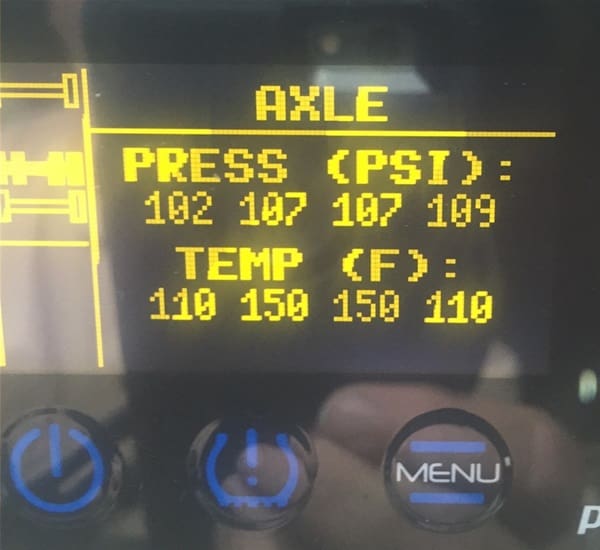
Finally got the upload to work.
Peter replied 11 years, 1 month ago 5 Members · 9 Replies -
9 Replies
-

Buddy
Your inside duels have less air flow and they can possibly be getting motor and trans heat to raise temps. Mine do the same.
My tag tire that is on the sunny side of the bus will also run hotter.By the way 150 degree tire temp is optimum.
Later
bv -

If you get hotter than 180 degress than you have an issue. I don’t know exactly what your warning sensor is set at but 185 or more and I’m sure it will go off.
If anyone is concerned about tire heat, read up on Tire Thermal Equilibrium. I put that in here for the Cowcatcher.
Later
bv -
I am not as comfortable as Bernie with the temps, but they are affected by the initial tire pressures.
First, all tire pressures have to start out consistent with the Michelin tire pressure chart based on your weights. When they are set like that the tire temps are very close to one another.
You have a 40 foot coach so there is going to be a difference between your inner dual and tag tires than a 45 foot coach because of the proximity to the engine and transmission. Those would be expected to be a little higher than the others. I cannot remember what my 40 foot coach temperatures were because that is too long ago, but the difference between the inner and outer drives and the tags on my last 2 coaches was in the 5 or 10 degree range.
I do know the sunny side of the coach is warmer, but if I jump from the coach as soon as it stops and shoot the temps at the center of the tread all around my temperature differential is always within a 10 degree range. The same goes for temps as close to the hub as I can get them also.
-
I kept re-reading his post and thought he was confusing pressure with heat readings.
If in fact that 40 number is a heat difference reading, that’s no good.
Later
bv -
Don’t panic Buddy. If you have a heat gun, check the temps then compare to the Pulse readings to verify the temps are correct. It’s possible the sensor is off.
-
I will check it with my heat gun to verify. I think I did this on the way to Jeff’s back in July when I had the old system and the temps were closet than what the sensors are reading now.
I am headed to Yellowstone next week and will check before I pass Fort Worth Prevost.
Thanks
-
Buddy,
We have just completed a 2,500 mile trip from California to Florida. Driving across the desert it was 114 outside all the way from Southern California to Phoenix. It was in the low 100’s all of the way through New Mexico and Texas and along the southern route until Alabama, Mississippi and Florida (upper 90’s).
My tire pressure monitor showed a range from 145-154 with the rears being in the higher range. But, it did take a long time to reach that temp. Generally, they stayed in the 135-140 range and mid-day and then climbing slowly towards days end.
Safe travels,
Mark
-
I hope everyone who monitors both tire pressures and temperature understands that how the system is set up can impact the accuracy.
For example, if the tire pressures are not set to the pressures listed in the Prevost or Michelin tire pressure charts that will create variations between temperatures. The initial tire pressure settings have to be correct and the weight on the tires determines those pressures. If you want to use the recommended pressures as the initial setting and then add 5 PSI at least you are being somewhat consistent and it will keep readings more uniform.
Once you have consistency in your tire pressures relative to the charts, then to get consistency in the temperature readings you must be consistent with the sensor location. I know a lot of folks prefer to use extensions on the inner drive axle valve stems. But if the sensor for the TPMS is located on the end of a valve stem extension it will never report the temperature accurately. First you cannot remotely monitor the temperature of the air in or the tires themselves. It is no doubt better than having no information, but still will have an error so large as to be useless.
If you intend to rely to an extent on the sensor reading tire temps, at least get the sensors as close to the tire or wheel as possible, and make sure it is in a location consistent with other sensor locations.

Log in to reply.