
-
Time to Change House Batteries – AGM/Wet cell – $
Posted by Davy on June 5, 2012 at 3:19 pmI have eight 4D Lifeline AGM sealed batteries in my coach that are way overdue for changing.
I have a price of $482 each from Batteries Plus and $250 total shipping.
I have an RV guy that’s a friend who says his cost on Interstate AGM 4Ds is $502 each.
An Interstate dealer that also sells Interstate under his own badge said his cost is $306 each. He has helped me before on chassis batteries and he offered to sell me these at his cost if I bring him the old ones.
My RV friend suggested changing to wet cells at about $140 each and adjusting my inverters accordingly. I am reluctant to do that.
Questions…1. Would you buy the Interstate under another brand and save $200 each?? Any problems with that? It seems right to me but I really want your input.
2. Is the wet cell battery idea viable? Should I consider that at all?
3. When I do the change are there any suggestions?-I will take pictures, draw diagrams, number and label everything and use dielectric grease. -I ask have an inverter bypass switch for each inverter as well. I know that when it is switched to Utility is does Not charge the batteries.
Anything Else?
Thanks DKOElliott replied 14 years, 4 months ago 7 Members · 13 Replies -
13 Replies
-

Sorry, I do know about paragraphs but posting from my iPhone and everything ran together. DKO
-
DKO. If I am wrong I hope someone corrects me. I think on your coach the way Vantare sets up its electrical system everything goes through the inverters, meaning batteries are likely a little more important in your coach than others. If I were in your shoes I would stick with what appears to have worked well for you. Assume a five year life on batteries that are properly maintained and then do the risk versus reward calculation. If my math is close you might save $10 per month, but end up with batteries that are not of the quality level that your coach was designed to use. And battery issues drive us nuts because just one bad battery can present unexplainable problems until you finally realize that is what is messing you up.
I have used Lifeline for quite a few years now and none have tested bad at the end of my self imposed five year replacement. They have lost some capacity but that is anticipated. None have failed. I know from posts I have read that Lifeline is excellent about standing behind their product, something especially important because if one fails after a year or two you have to replace the entire set, which they have done in some instances.
Color me conservative or cautious, but I view our buses as recreation vehicles and I just never want to have to deal with issues. For what it is worth, assuming you intend to keep your coach for a while, your drpeciation is going to cost you much more than your batteries. Treat yourself to the best.
-
Suggest you give one of the PC advertisers on this site a call, Trans-Specialist. Price, shipping, national warranty,matching mfg dates on all batteries, factory help, all this with Lifeline.
I have been on Prevost sites for over 2 years and can only remember one incident involving Lifeline. A repair shop had the chance to get rid of 6 Lifeline batteries which were later found date coded all over the map. Bus owner posting more electrial problems after battery replacement finding the root cause was old batteries. Trans Specialist was able get in touch with the Lifeline factory with the Lifeline CEO stepping up to the plate. Shipped the bus owner 6 brand new batteries, no charge including shipping.
Great product, great service…give Trans Specialist a call they stand behind the Lifeline product.
.AL
-
DKO,
Contact me, I’ll save you money! I wouldn’t under any circumstance put wet cell batteries in your bus. I sent you an e-mail.
PS – Notice my Avatar…
-
I just went through a very similiar situation. My coach had 6 8D wet cells. I’m not a fan of wet cells in a confined space, so I changed to AGMs. I also had the wiring changed so that each battery is directly connected to a buss bar that is connected to the two inverter/chargers.
Best of luck,
Gil
-
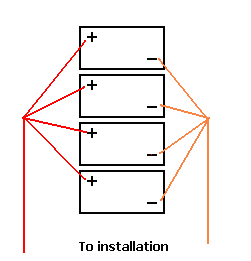
The buss bar method provides two benefits. The first being it provides a more effective method of equally using and charging ALL batteries. Typically the connections between the charger/inverter and the battery bank are on the same battery of many in a battery bank. If this is done, the battery directly connected to the inverter/charger is used more and charged more than all other batteries. The battery the furthest down the ladder of connections is is used the least. To overcome this and still save costs, the positive connection to the battery bank from the inverter/charger is made to the battery at one end of the bank and the negative connection from the inverter/charger to the battery at the other end of the bank. This forces all batteries to participate equally in the charge and discharge process. The problem with this method is that a single weak battery or cell compromises the entire bank.
The other reason for using the buss bar approach is that it makes it simple to isolate a single weak or otherwise defective battery. Besides the one battery terminal with a temperature sensor, there is just a single cable connection to each battery, just another plus.
One note. The battery cables used between the batteries and the buss bar should be approximately equal length to ensure each battery discharges and charges equal to the other batteries.
Gil
-
O.K. You did not use a buss bar directly connected to battery posts. You used common length cable segments to tie from the post to the buss.
Did you also equalize the the length of the cable from the buss to the inverter (i.e., load and charger)?
———————————————————————————–
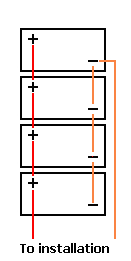
I think this is indicative what we have in most of our coaches. and cables are of random, or convenient length

This is what you described as somewhat better………….
This is what you end up with if you bus with cable…………………….
Here is a more economical way to accomplish this with cables as well
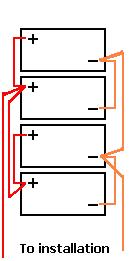
Now, all of this does nothing to overcome the inherent differences in the batteries themselves and the batteries themseleves prevent addressing any difference between the cells. The only thing that this (installation of a buss) accomplishes is to equalized the opportunity for charge/discharge events to be equal down to thre level of the battery post. An important aspect of this is that the leads form the charger and load points to the taps for the strings in the bank must also be of equal length.
What we fail to do is to manage at the level of the individual battery. For this, we need a Battery Management System (BMS). Such a system would supply charge regulation at he level of the individual battery and load balancing across all batteries and all strings in a bank. Additionally, it would be able to monitor for dead cells and actively isolate any given battery based on failure of an individual cell (and a monitor or alarm might be nice as well). Something like Powecheq? – might be usefull
Sorry for the rambling. You touched on something that has had my attention for a while. After months I finally know enough of this battery language to start over with some hope of success.
Also, the images are from a great web page owned and operated by SmartGuage Electronics. I think they are British.
-
Although this is interesting stuff, over the long haul of 5 or 6
years with Lifelines, I doubt it will have any impact on battery
longevity or condition. I spoke to my contact at Lifeline regarding
the use of a BMS system and they neither recommend or endorse the
need, providing your inverter/charger is properly setup and the
batteries are charged/discharged correctly. Same goes for the battery
optimizers with Lifeline, there is no benefit with AGM’s.Lifeline deals in a gazillion batteries for the Military, Marine
and Aviation industry and if these systems were of benefit, they
would probably be selling them. There are of course needs for a BMS,
such as a boat that is monitored from long distance when not in use
for a long period of time. Same could apply to a bus, but we normally
aren’t too far away for extended periods of time.Just my two cents and I’ll be glad to help you start out with new
batteries:) -
Tom, what do your mean by “correctly” when you state that the assumption is that the inverter is charging discharging your battery “correctly”.
It is my understanding that the inverter operates on the string of 4D or 8D batteries as a single “battery”.
You might want to check the reference I supplied. It clearly calculates that in the first presented example, the bottom battery in the string is supplying twice the current as the top battery and that none of them are being drawn down equally. The author claims he did not believe the math and verified the computation experimentally. I don’t think that his results would fall into any definition of “correct”. Fact of the matter is that we may well have a cabling “rat” in the battery bay.
Now maybe you are correct that this is not a matter for concern by Lifeline and I completely appreciate your offer to refresh my battery inventory. However, I have observed over the last few years many instances where one cell in one battery went south and took the whole string and then the entire bank with it. I can not for the life of me remember any one incident where it happened at a good/convenient time. Also, I wonder how many of the batteries with the bad cell were the “bottom” battery? I wonder about the options which would be available if we had better resolution into the health and condition of the individual batteries in the strings in our coaches. How about how many owners where present when the failure of a cell occurred and were able to do something about it? I am also questioning many of the “but-that’s-the-way-it-has-always-been-done” approaches to coach battery management, which seems to be hit the problem with a $40000 “new battery” hammer.
Also, as has been stated previously in this thread, A Vantare is a little bit different in the design of the power system and the loss of house battery power is so significant, it makes one think about such things.
-
I hope everyone recognizes an excellent point made by Ed.
When one cell in a battery fails it typically is the first domino to fall and it ultimately takes out all the battery set. While the discussion and focus is on how the batteries are cabled to insure equal loading, discharging, and charging everyone needs to recognize our batteries are the heart of our coaches and they need to be properly connected together and charged. Failure to do either can result in a premature battery failure.
Our batteries have a finite life. And it has been my experience as they begin to fail at the end of life the first thing that happens is we experience what appears to be unusual problems that could be inverter problems, alternator problems, battery problems or wiring problems. And those problems tend to drive us crazy until we bite the bullet and separate the batteries and load test them individually. Waiting until the batteries fail or begin to fail may allow an owner to save a few bucks, but can provide some tense moments until the weird problems are found to be failing batteries.
My tolerance level for surprises is very low so I throw away perfectly good batteries every five years. I make absolutely certain the inverter charging cycle is correct for the type battery, and that all posts clamps and cables are in good shape. I have lived through how a single cell as Ed describes can play havoc with batteries and have insured I never discharge below a 50% of capacity. The worst thing to pinch pennies on is your batteries by trying to nurse every last volt from them. And I urge you look at how your batteries are connected compared to Ed’s diagrams and try to insure they do charge and discharge properly.
-
The bottom line, in my opinion, is that we should do what we can that likely will result in longer battery life and aid us in troubleshooting and battery isolation. The first illustration is indeed common and ill advised. It will work the first battery harder (chaging and discharging). On another site a there’s a great termal image of multiple batteies in a bank being charged. Although I don’t believe the author stated the batteries were wired like the first illustration, I suspect they were.
Having spend some time out on the water, the last thing a yachtsmen wants is to be dead in the water with no help or land in site. Some of that mentality has carried over to the bus. I’ll suck up the few extra bucks the buss bars and additional battery cable cost me and know I’ve made a major improvement in the effective use of ALL the batteries in the bank and provided a great troubleshooting and battery isolation aid.
The only thing about my set-up is that the charge curve of my two Freedom 25s will not support lifeline batteries if the temperature compensation circuits are used. Once the batteries reach 90 degrees, which is common in Florida and when the batteries are being charged, the float voltage drops just below Lifelines 13.1 volt minimum float voltage. Because of this the charges toggle between float and absorbtion modes. If the chargers can maintain the batteries and support the house load a battery bank should not come out of float charge once it enters float. So, I had to turn off temperature sensor support. With the temperature curve manually set to 70 degrees the bank stays in float, as it should, with a constant 13.3 volts being supplied by the charger.
Gil
Log in to reply.