Prevost Community Forums

Find answers, ask questions, and connect with our
Prevost Community around the world.

  • Someone kept Lifeline batteries in service 9 years

    Posted by AL on October 26, 2016 at 10:24 pm

    The new owner of any bus will wonder about what a previous owners did or did not do in caring for his bus. With a nagging inverter problem my cooling fan runs sometimes constant for days. When all expert opinions are aired about how long cooling fans should run it gets somewhat frustrating.

    Marathon would work on this problem suggesting it be done in Coberg just in case the inverter is faulty. Not very excited about a 1900 mile trip back to the factory.

    Google shows that there are 2 authorized service centers in the USA for Marathons Xrantrex inverters. One in Nashville and a advertiser on PC and another in Hutchinson, KS. WHAT ! OMG ….3 1/2 hours from my home in KC.

    Getting an appointment for the next day tech tells me to park inside the Hutchinson KS. State fair grounds as full hook ups there is $20.00 a day. If the inverter must be pulled, I’ll be able to stay in the bus.

    I meet Terry the next morning and he tests the entire system…here is his report , nuts and bolts of the entire testing and repair .

    The short version is ….If you think you’re saving money by getting an extra couple of years out of house batteries , think again. Inverters will charge to the max limits trying to bring junk batteries to full charge and will develop so much heat that they will cook transformers as-is my case.

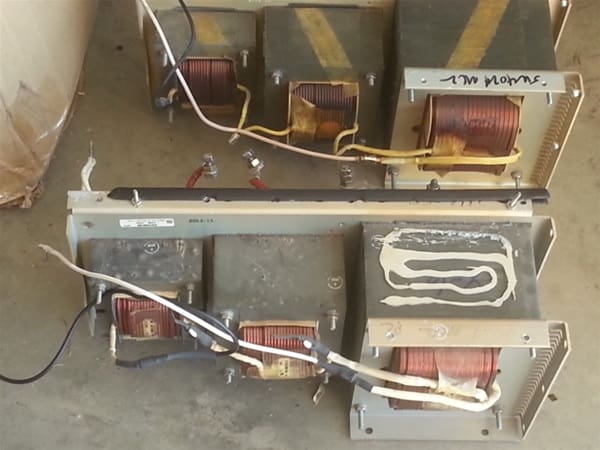
    Tech Terry’s report……with pictures of transformer packs

    I arrived on site and the customer and I begin to look
    things over.

    Nothing appeared to be an obvious problem so the Inverter
    that had fans running more often than not was removed from the coach and taken
    in to the shop for testing. 4hrs.

    Benched tested unit and could not identify any problems (no
    fans running).

    Assumed the problem to be in the coach so I took the unit
    back and reinstalled it.

    At this point the customer and I went over the battery bank
    wiring and the two battery equalizers in the battery bay. We found three batteries where the
    connections needed ½ turn to be tight.
    We also found a loose connection on the back for the battery disconnect
    for Inverter 2 (which was the unit in question).

    We ran tests on the AC circuits inside the coach and found a
    loose connection and faulty breaker. The
    customer replaced faulty 30 Amp breaker.
    We assumed we had found the problem so we turned the inverter on and
    activated shore power and shortly after the fans came on again.

    I pulled the Inverter again and took it back to the shop and
    called Steve at Xantrex to ask for advice.
    He suggested transformers and said they may be hard to find.

    He suggested that when I get this unit fixed that I should over-ride
    the (pre-recorded settings for Monarch) on Inverter 2 because the battery bank
    does not need both chargers running.

    Here are the changes:

    Set Absorption Charge to 10 minutes or 0 minutes if it would accept 0 as a
    setting.

    Set Max Charge Amps to 01


    I got on the Internet and searched for anyone who may have the parts I needed, and
    emailed several people who said they had an SW4024MC2, some were working, and
    some did not. I was only looking for the
    transformer stack so all units were viable options at this point.

    A set was found in Indiana and shipped overnight to me and I
    installed them in the inverter the next day.

    A full and very rigorous test was run on the Inverter and
    charging system.

    The unit ran fine with normal on and off fan operation. 8hrs.

    I took the unit in that evening and reinstalled it and we
    ran tests on the system and everything was working fine.

    The customer even said “now that is how they are supposed to work” 3hrs.

    The Customer returned home.

    The new-used transformer pack where you can see the normal copper color windings. Note the paint in the rear old pack has changed color due to heat.

    Parts, overnite shipping, tax, labor $2042. Lots of money …cheaper then a new inverter at $8-10 K. This electric repair was completely system tested where items were eliminated on a step by step process. Bench load test confirmed success before rebuilt inverter was re-installed in bus. It works as designed now.

    In Xrantrex world our inverters are known as MC-2’s with a near bullet proof reputation. I00’s have been manufactured. Parts pipeline slowly will dry up …..Owners will spend big bucks on inverter repairs all related back to stretching service on Lifeline batteries, just not worth it.

    Thanks, Terry and the other pro’s at Xrantrex

    Archived replied 9 years, 10 months ago 8 Members · 13 Replies
  • 13 Replies
  • Raymond

    Member
    October 27, 2016 at 6:33 am

    Al, we have harped on changing batteries out after five years (sooner if they have been abused) just because a bad battery or bad set will drive a person crazy.

    If every owner considers that chasing what appears to be an inverter gets very expensive very fast it becomes clear that removing good batteries at the end of 5 years is ultimately pretty cheap preventive maintenance. When you consider your time, miles and out of pocket expense would you agree?

    Tom doesn’t push this as much as i have over the years because I think he doesn’t want people to think he is trying to sell batteries. I know he shares the same opinion I do. I know he also (like me) is not in favor of deep discharges which shorten a battery life and may change the replacement interval to a shorter time than the five years we usually discuss.

  • Archived

    Member
    October 27, 2016 at 7:05 am

    Jon is correct, in an attempt not to spend people’s money, I don’t push the 5 year battery replacement, but I can say that in selling Lifelines for 7 plus years, I see folks all the time battling electrical issues with battery/inverter problems that surfaced by trying to delay the cost of battery replacement. Most will not take chances with tires as they age, but seems like it’s the norm to stretch battery replacement to the point of causing all kinds of electrical problems and in some cases potential fire risk. I agree with Jon, 5 years is the magic number.

    A good example is what Al just posted. His new to him Marathon had original batteries 8 years old and his inverter would not come off bulk charge in an attempt to bring bad batteries up to full charge, a potential dangerous situation. Al caught the problem, but for many folks, if they never look at their inverters (usually behind a cabinet door) or open the bay door and hear the fans running 24/7, the problem will not surface until bad things start to happen.

    Change out your aged batteries folks, it’s piece of mind and your inverters will love you.:)

  • Tim

    Member
    October 27, 2016 at 10:59 am

    Of course with 6 new Lifeline Batteries all the experts say one of your new batteries is causing the problem. The only way to put this to rest is disconnect each one testing it alone. All were within specs.

    I’ve talked to Truk about this and his comment in the 5 plus years selling Lifeline he can recall only one defective battery after installation.

    I know with some experience in my NAPA days, having sold 1000’s of batteries …if you are unlucky to get a NEW defective battery it will fail, usually with-in days of going in service.

    2-3 hours labor to shut down system , mark-tape everything to test each battery by itself.,

  • Chuck

    Member
    October 27, 2016 at 12:41 pm

    I don’t believe batteries get all the attention or credit they deserve in our coaches. We tend to take them for granted. Our coaches are as capable and enjoyable because of batteries. Without them, or with aged batteries our option to enjoy the coach would be to always run the generator or engine.

    Some coaches are set up so if one of the sets of batteries is weak the chassis and the house can be merged. Doing something like that is a huge assist in by-passing an issue, but as soon as that is done the first time, the immediate concern should be about getting replacements.

    In Al’s case, with a new coach he has not yet had the opportunity to get to know his coach. So what may have been a signal he had an issue was not apparent. Had he been a long time owner of that coach his first clue would have been a house set of batteries that would lose their charge quickly when dry camping. Then the fact it would not go out of bulk would be the second signal. But more likely Al would have never gotten to see those clues because he would have changed batteries to a schedule.

    The odds of a bad set doing damage to your wallet is fairly high. Over the years a lot of posts have described some off the wall problems that ultimately turned out to be a bad set or a bad battery. Just diagnosing those problems gets expensive so as has been pointed, out old batteries should not be in a bus.

  • Dick

    Member
    October 27, 2016 at 12:43 pm

    According to Leon, Marathon sets the inverter’s fan’s bimetal thermostat @ about 96*F just to keep air flowing through the inverter compartment. The inverters throw off radiant heat even while running on float stage. Consequently, Summer weather with ambient temperature over 80*F or so will trigger the fan on. This is normal and the fan is working as designed. Abnormal issues such as Al had will trigger the fan on when the inverters work so hard that they throw off excessively high heat.

    Here in Arizona, Summer temperatures can exceed 120*F. My coach sits in an air conditioned garage where the thermostat is set @ 86*F, the inverters are on float, the batteries are 2years old and the fan runs much of the time throughout the Summer months.

  • Darrell

    Member
    October 27, 2016 at 8:26 pm

    Chuck,

    I want to be sure we’re talking apples to apples. Are you saying Marathon set the internal inverter fans to come on at 96 degree’s? My inverter fans do not come on at 96, I’ve shot them with my IR gun at 105 and they were just coming on. Maybe they changed that in the later models.

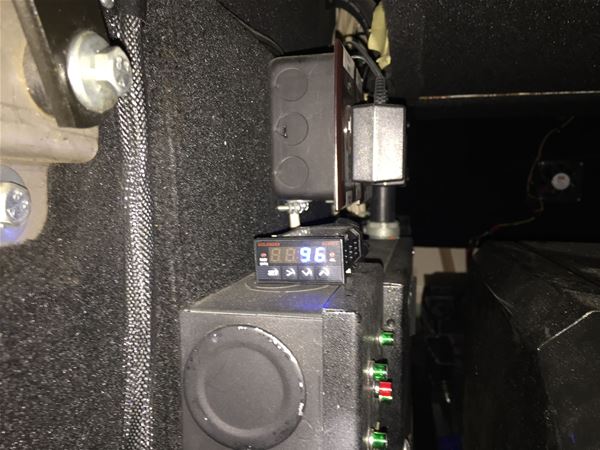
    The inverter compartment is another matter, those fans are controlled with an adjustable snap disc from Marathon set at 115. I removed the snap disc and put a digital controller in set at 100. I figure if I can stay ahead of the heat for the inverters, that’s a good thing.

    I just replaced the rear inverter compartment fan, mounted at the ceiling up high behind the inverters and it was a bitch to get at. Those fans are hard wired to the inverters, so you can’t turn them off with a switch or circuit breaker. Mine started squealing in the garage and I was able to shut it off using my digital controller by just dialing down the temp setting. Otherwise, it would have required removing the inverter bay panels and unplugging the fan at the snap disc.

  • Archived

    Member
    October 27, 2016 at 8:49 pm

    Not looking forward to replacing that fan if it fails…

  • Archived

    Member
    October 27, 2016 at 9:17 pm

    Hi Tom, I was refering to the inverter compartment fan that moves air through the hole in the compartment floor. I was concerned that fan ran much of the time while my bus was parked in the garage. So I asked Leon at what temperature the fan should go on. He told me that Marathon sets that fan’s thermostat at 96*F.So, if Leon is correct, you may want to lower the thermostat a little more on yours. He did mention that the original thermostat was of the bimetal type. So it is not extremely precise. I was just mentioning it to everyone, that in warm to hot climates, they shouldn’t be surprised to hear that fan come on and run a lot.

    While my bus is parked in the garage and hooked to shore power, the inverter fans very seldom or never run. It’s easy to be confused when you hear fans running by the inverters and think the inverters are running hot enough to run their fans but more likely, it’s the compartment fan running. That fan is very difficult to reach on a XL chassis also. I sure hope it don’t wear itself out.

    BTW, there is another fan in the Techlink box on my Marathon that runs all the time. It is straight wired without a thermostat control. I had to replace that fan with a very low decible one when it got so noisy that it kept us awake at night.

    Sorry for getting off subject of battery life.

  • Archived

    Member
    October 28, 2016 at 6:28 am

    Inverters are so important to the use of the coach I have a continuous running bay fan. The fan itself is cheap and quiet so having it run constantly actually makes me feel more comfortable knowing it is working. If I were to add a thermostat, entered my garage and did not hear the fan running, I would always be wondering if it had cycled off, or if the thermostat failed open, or if the fan quit working.

    That’s the great thing about our coaches. We can do anything we want with them.

  • Bill

    Member
    October 28, 2016 at 12:03 pm

    Yes Jon, we probably have that same continuous running bay fan. Few years ago when the original one quit, I researched it and bot 3 of them (couple spares) at $12 each = cheap.

    In July running in heat Chicago – Denver, one of our 22 year old inverters shut down. Their two fans were mounted on the back of the inverter outside the case, so I could see that they were not running. Was able to “reboot” the inverters to let the diodes bleed down, and that fixed the failed one for the rest of the trip. But at home I pitched the old ones and put in the Magnum 2824’s. Their two fans each are mounted inside the case. Since learning that heat dissipation is so important, I added another fan mounted on the floor in front of both inverters, consistent with the air flow of the other fans, and with a manual switch. Since it is 12 volts, it was convenient to power it off the generator start battery located next to it. I’ll probably turn it on only when traveling in heat, and as long as the inverter built in fans work, may never really need it. That’s ok.

  • Archived

    Member
    October 30, 2016 at 2:00 pm

    Tom,

    My house batteries have the date code BK. Can you tell me when they were built?

    Much appreciated, thank you.

  • Archived

    Member
    October 30, 2016 at 2:20 pm

    Feb 2011 Doug..

  • Archived

    Member
    October 30, 2016 at 2:46 pm

    Thanks Tom!

Log in to reply.