
Prevost Community Forums

Find answers, ask questions, and connect with our
Prevost Community around the world.

  • Slide Seals. A Little Trivia

    Posted by Archived on August 26, 2015 at 4:13 pm

    When Prevost slides were first introduced we all had questions about slide seals, their life span, how to protect them, what it takes to replace one, and how they work.

    The easiest way to talk about them is to start with a picture few of us get to see. The photo below shows what the cross section of a slide seal looks like.
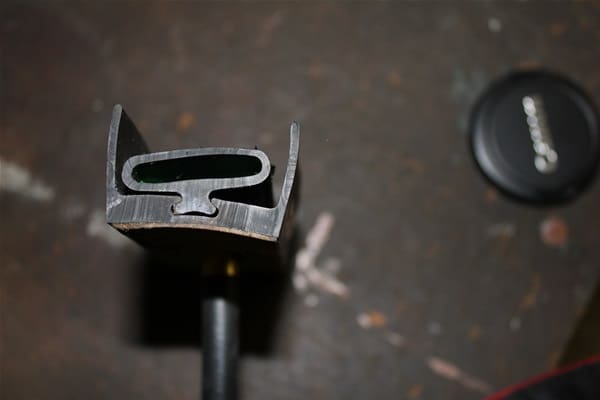
    The section shown above is what we don’t see. We have a limited view of the seal and that is the outer leg. The seal is an inflatable bellows seen as a flattened oval, inserted in a channel that serves as the mounting surface and as a wiper.

    The base between the two legs of the channel is bonded to the frame on the coach that surrounds the slide. The actual seal is a complete “frame” with rounded corners to match the contour of the slide room exactly. The base of the channel is the outer part of the frame and uses a very strong double faced tape to adhere the channel to the stainless steel chassis opening frame. The tube you see (out of focus) is the air supply line that goes through a hole in the chassis frame and connects to the slide seal air supply.

    The bellows under all conditions except when the slide room is moving in and out is inflated and it makes contact with the slide itself. That contact seals against the entry of water or wind or anything we don’t want to get into the coach. The bellows operates at a low pressure of 10 PSI, but that is sufficient to maintain contact with the slide around its entire perimeter.

    The legs of the slide are always in contact with the slide. They serve to keep debris such as leaves and twigs from getting between the slide and the seal by wiping the slide as it moves in our out. The legs also assist in keeping the opening between the slide and the coach closed to keep out moisture such as rain.

    There is no lubrication required for the seal, in fact any lubricant might attract dust and dirt and serve to damage the finish on the slide. So except for insuring there is nothing stuck under the leg of the channel there is no maintenance required of the slide seals. If you have spent time beneath trees with the slide(s) extended you should check to make sure any debris that might be on top of the slide is removed. Even with awnings that extend over the slide room it is possible for debris to blow on top.

    It is important to note that if you have accumulated any snow or ice on the slide room it must be cleared before the slide can be retracted.

    Archived replied 11 years, 2 months ago 5 Members · 8 Replies
  • 8 Replies
  • Archived

    Member
    August 26, 2015 at 6:31 pm

    Interesting Trivia …. Thanks Jon .

  • Davy

    Member
    August 26, 2015 at 6:39 pm

    Hmm…so that’s what a air-bladder looks like.

    I should have taken a pic of the Feathelite friction system since they use the Prevost slide, but install their own rubber seal. I think the bladder is certainly more air tight, just more expensive to replace. I think they also said something about you didn’t have to worry about the “pins” lining-up with their seal.

  • Kevin

    Member
    August 26, 2015 at 8:19 pm

    Jon, is that what Tom’s look like :-))

  • Archived

    Member
    August 26, 2015 at 8:21 pm

    I would have thought that all Prevost installed slides would have inflatable seals only… can’t imagine them doing any any differently.

    Vantare and possibly Featherlite used HWH slides in all their H3-45s for years… we had a ’98 model H from Vantare one of the very first if not the first H to ever have slides and Prevost didn’t put a slide in an H until around 2004 I think it was…they did in the XLs years before that however. I also believe other brands like Valid were used by some converters too…. Prevost is the only one I know of that has the air seals….. but I will leave that up to the experts to say.

    Cheers, Diane

  • Archived

    Member
    August 26, 2015 at 9:17 pm

    Tim,

    I think you may have been fed some misinformation. Prevost slides all have an inflatible seal and the entire control of the system is dependent upon the seal deflating and inflating. It’s built into the controller.

    And as Diane will attest, the pins have to line up or they will not engage or release properly on a Prevost. She watched me adjust one from the comfort of her coach when I had a stubborn one that was misadjusted.

  • Jim/Chris

    Member
    August 27, 2015 at 7:38 am

    Maybe I misundertood them; however, while I was there, they had taken out all the slides that the Prevost comes with. They told me they do this to install their own flat-floor system and to install the “friction” gaskets instead of the air-bladder. Shannon showed me specially what the friction gasket looked like in one of the their re-installed slides.

    Is there anyone with a later model Featherlite who could opin?

  • Corey

    Member
    August 27, 2015 at 8:03 am

    Current Prevost slides are called “pinless” slides but in reality they have a single pin in the center of the floor.

    Vantare has made its own slides and has used HWH slides. I would not be surprised if the slides were not Prevost slides. Prevost slides do not have a flat floor.

  • Corey

    Member
    August 27, 2015 at 9:31 am

    I believe Vantare builds its own slides using HWH mechanism. Geo.

Log in to reply.