
-

Just curious about the Vantare setup, could someone explain the
primary/secondary system and how it works? Is the RVAC zoned or is
there two seperate units? If they’re separate units, are they stand
alone with duct work and separate thermostats? -
Terry Glad you got fixed. Nothing worst than having issues when your on vacation. Keep my number
for future refence when traveling in Vacation Land. My door is always open to help. Safe travels home.
Rick -
I’m posting this for Seabyrd…
Here is the picture I was trying to upload … it is the RVAC
unit before being redone… 2 compressors and one fan… the Primary on ours has
to be running for the secondary to work…. they are on separate legs of the
inverter power and controlled by one thermostat… the Secondary seems just like
a booster to me. This system is vented throughout the whole coach where the
Cruisairs are specific to certain areas.When working well the system is awesome and very quiet. Most
Vantare’s have this system I think along with two Cruisairs behind the front
bumper. Newells also used this unit.This unit sits right behind the generator mid coach, and is a
bitch to get to !!
You can post this if you want to…. don’t know what I am
doing wrong with the pictures… I have full authority over this computer and
its telling me the file is not authorized. I have posted pics long time ago
without a problem. Don’t know what I am doing wrong.Have a Happy 4th of July.Diane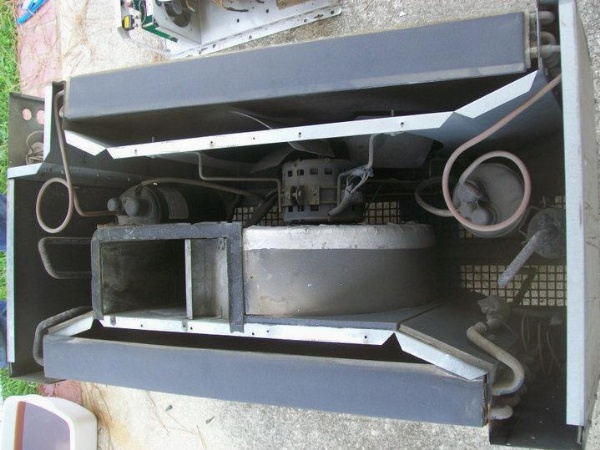
-
The Vantare’ system leaves the SCS RVAC pretty much unchanged. What most people do not understand is that the SCS RVAC is designed to accomodate low shore power conditions. It has capacity to be wired and operated with one leg CIRCUIT 1, {Compressor #1 or however else you might refer to it,} powered by shore power. The secondary, {CIRCUIT 2, Compressor #2 or whatever,} can be wired to be powered by our generators or some other suitable power supply.
[SIDE BAR—These SCS RVAC systems also have an inverter mode on them for over-the-road operation. I have not figured that out and I can find nothing that talks to enabling it. No, it is not enabled, at least not on the Vantre’ install. But, I believe that this is why Vantare sourced AC power through the inverters, viola inverter power and over the road operation with no fuss and no muss. However, there are “OPTIONAL” connection terminals and jumpers related to this INVERTER set up. ]
Apparently this was a design characteristic of the system so it could be used below deck on off shore boats where when at mooring, the connection to shore might not be within reach or was just really poor.
The compressors are started with time delays between #1 and #2 as the surge from a simultaneous start would pop breakers for questionable shore power.
The secondary is designed to operate as a supplement to the Primary. If the Primary cannot keep the temp at or a nn = degrees above set point for time = nn minutes, then the secondary kicks in.
I was recently reading another thread and they described a replacement of the RVAC control board with several 2-stage system thermostats. Cheap and easy sidestep for the absence of Specific Climate Systems.
Also, a common failure of early versions of these is the control board relays. They just weren’t sufficient to handle the currents being delivered.
That’s my story and I’m sticking to it.
P.S. If you have your Vantare’ wiring diagram books, or the SCS RVAC install manual, the circuit diagrams are there.
-
You answers one question SCS, so what does RVAC mean? Pardon my ignorance on this. Greg
-
It is actually cited as “R-VAC”
I believe I saw it referenced as RV – Ventilation and Air Conditioning.
It is not used as a heat pump for heating.
But, I have forgotten a lot more important stuff than that.
Here is a useful link to the installation guide if you need it.
-
I meant to reply to this earlier and got side-tracked.
“It’s as if the secondary unit is just a booster? but it has its own compressor… never figured that out !!!”
The secondary is exactly as you describe, a booster (on the SCS R-VAC model 2702). The primary (Circuit #1) and Secondary (Circuit #2) ARE NOT identical.
The primary drives a 1/3HP blower and the secondary drives a 1/4HP blower.
The Secondary has a lower circuit ampacity requirement than the Primary. 20 amp required for the Primary and 17.4 amp for the secondary. This was an intentional difference as the Secondary can be wired to a “Secondary” (i.e., read as “inferior”) power source. The thermostat is where the magic happens that makes these look like a single system.
I know that these seem like trivial differences, but if I have a problem and end up considering a replacement, I want not only comparable capacities, but comparable functionality. Currently, I have not figured out the pros and cons of having this secondary power source capability when Vantare’ implemented the R-VAC entirely through the inverters. If I spent more time at campgrounds with only 30AMP services (and it has happened). I might find this useful and end up wiring up a transfer switch.
Log in to reply.