
-
Roadside Assistance. Recommendations…
Archived replied 11 years, 4 months ago 16 Members · 34 Replies
-

Peter has the correct answer to that age old question of maintenance:
“How come you never have time to do it right, but you always have time to do it over?”
Or as FRAM says in their commercials: “Pay me now, or Pay me later.”
-
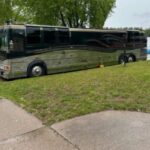
Maybe John Hawkins will see this and chime in. Any of our busses with IFS need a specific type of tow equipment as the bus must be picked up by the front wheels. If a tow operator tells you otherwise, send him packing. They must also have the proper tools and knowledge to disconnect the drive axles or drive shaft. We have been towed once while we had Good Sam and knew ahead of time that the dispatcher would be of little help. You may contract on your own and then call Good Sam and tell them why. They will then reimburse you direct(they said 4-6wks…it came in 3). Geo.
-
When I owned a Country Coach Affinity I had this adventure. Durand, OK. on two lane paved highway, light traffic , about 4:00 PM. Sunday afternoon.
Returning home from a “holiday weekend” … at 65 mph I hear a loud bang and as I recall like a gun shot. In an instant the right rear bottoms out. I realize that I have control so not a tire issue. I hear the tire spinning in wheel well, I think I have a blown air bag. Traveling on level ground I spot an area right ahead to pull over as fast as possible.
On inspection I have a blown ride control height valve. Calling Coach Net ….2 hours later a medium duty tow truck with 2 guys shows up.. After a brief conversation about what happened one ask me to put the jack stands down. I don’t have them ….his attitude changes saying ” all RV’s have jack stands they are underneath, you must have a button inside ” no this RV is all air suspension. Let me crawl underneath so I can find them their must be a button inside on the dash, you go look. Tow guy puts on a pair of coveralls and slides under rear of RV on other side
I ask, did you find what you’re looking for ? No, but your problem is a small box with an air lines that has come apart.
I listen to that little voice in my head a decide to send these two clowns on there way.. Don’t want either of them doing anything on my RV.
Calling Coach Net back, I’am told there busy and will get back ASAP. They called back late that night.
Sent the wife, son and dog home in tow car. I”ll wait till Monday morning call Buddy Gregg in Lewisville TX which is about 75 miles from my location, first thing knowing they open at 7:00 am
I get the help I need and was back on road late Monday after noon.
There were other CC Magna / Affinity owners who experienced same sudden failure of rear ride height valve in early 2000. Defective valves made with weak internal parts.
-
To answer the question about what are the clues that make me want to send the driver home they involve his knowledge of my coach, and his equipment.
Al spoke of two that were clueless. If you think the guy is looking at your Prevost as if it were a conventional motor home he is a candidate for being asked to leave. If he doesn’t know how to pick up your coach as Geo points out, send him packing. A solid axle coach can be picked up with the lift under the front axle and it needs to be well secured. An IFS coach needs a wheel lift. Both types of trucks must have a long enough reach so when the truck makes a turn it does not damage the left or right side of the front of the coach.
If the lift will not slide beneath the coach without hitting metal, or will not lift the coach without hitting metal it is time to stop. Make the driver go away.
The easiest way to prevent transmission damage is to pull the axles, or as an alternative pull the driveshaft. Don’t let the tow truck move unless the axles or driveshaft are secure in the tow truck and make sure they are replaced before he leaves.
If the bus has to be put on a trailer the slope up to the trailer deck has to be shallow enough so there is no front end damage. You can help by raising the coach it needed or possible. Ditto for protecting the belly as the coach starts getting onto the trailer. If you cannot raise or lower the coach you might be in trouble.
I do not have any type of towing service because I have yet to hear of one that knows what you are talking about when you say bus conversion or Prevost. If I have to get towed I have enough problems without trying to deal with a middleman who does not know I don’t have a Winnebago.
-
Guys,
Here was what caused me to wave off the two I got. I had prevost send me Tow Instructions. I read them a couple of times in the 9 hours i was waiting. I can try and post them here it’s a PDF if that would be helpful too others… everyone should have it.
Prevost suggests lifting the coach with axel forks not by underneath the wheels like a typical wrecker. My tow guys had the forks but were not set up to use them. Red Flag number #1
They started to boom out the lift and there was no way it was going to clear all the stuff under the front.. Geny raditor lines etc.. They asked what all that “stuff” was and I said… its important and it’s not broken… Red Flag #2
The final thing for me was both these guys were super nice but they were both really big guys… it was going to be a major ordeal to get them under the bus to disconnect the drive axel and secure it.
The final straw was it was raining like a mother…. so I opted to run the risk of getting killed by a truck rather than damaging the bus further… had it not worked out the way it did…. it might have been a bad call.
I Hope to never have to go thru something like this again but….But stuff happens…
Bill
-
Jon, Tom,
I uploaded the towing instrucitons that Prevost sent me to the articles section. Hope I did it correctly. Let me know if I didn’t and I can email the file directly to you.
Bill
-
Dick,
The problem turned out to be a weak/shorted cell in one of the chassis batteries on the 24V side that powers the starter as well as the DDEC “brain”. All was well as long as we were running, but when we shut down, the 24V side shorted under load & didn’t have enough umph to engage the starter / DDEC. Tried to jump via the 24V jump posts from another 24V system & it started to let some smoke out of the jumper cables as soon as they were hooked up. Not a good thing – especially for someone who at that point was still trying to learn which key opened the darned door. The batteries had all tested good on a stress test less than a month earlier, when we picked up the coach, but they were about 4 1/2 years old. After the tow, we replaced all 4 chassis batteries & that solved the problem. Except that the shop installing the batteries didn’t connect one of the Vanner equalizer cables to the battery terminal. I use VMSpc, and noticed that I was getting heavy draw on the 12V side and low /no charge rate when using the Jake in the mountains. Went into Mira Loma for dash a/c problems & asked them to check it out. I was concerned about a bad alternator. They found the Vanner cable loose in the battery box. Fortunately, it hadn’t short against anything. Could have been the source of some real fireworks and an engine bay fire. We counted ourselves very blessed that evening…we had run about 800 miles in that configuration over some pretty rough roads.
Bottom line for me is: if it’s running going into the fuel stop, don’t shut it down. I would have rather have dealt with the problem at a campground, or even a rest area, at my own speed, without the added presure of holding up commerce in that litle corner of the world. I can tell you first hand that busy fuel stops do NOT appreciate having one of their islands blocked for an extended time.
-
Mike,
I had a 2000 CC Prevost and when I changed out the chassis batteries I discovered some nimrod had hooked the wrong battery cable (positive) to the – jump lug. Any boost attempt would have been a bad day. Hope your’s isn’t that way.
-

If I lack the confidence in shutting down my coach while I fuel I shouldn’t be on the road.
Kind of tough checking fluid levels with the engine running.
-
Jon said “If I lack the confidence in shutting down my coach while I fuel I shouldn’t be on the road. Kind of tough checking fluid levels with the engine running.”
I don’t look at it as a lack of confidence in the coach. More kinda like the old “a body in motion tends to stay in motion” thing. Unless someone can teach me how to determine with absolute certainty when a battery cell is gonna decide to short out, I think I’ll try to minimize my exposure to those times when I can best deal with a potential “no start” situation without causing myself undue stress, and on my terms as much as possible.
I make the fluid checks part of the usual morning pre-trip check list, along with tire pressures on bus and toad, and add all to the full mark as needed. My en-route fluid checks are limited to checking for visable leaks in the engine compartment or puddling under the coach. Normally now I don’t shutdown once I crank until we reach our destination that evening. My DD manual says to wait 20 min to stick the oil on a hot engine. I suppose I could pull into a fuel island off the interstate, let the engine idle & turbo cool for 5+ minutes, shutdown, fuel, check to insure that it’s been at least 20 min since shutdown, then stick the oil or other fluid levels while still at the pump, but up to this point, I’ve not gone this route. But – if it is proven absolutely to be a better way, I would adapt in a New York instant. Much of what my coach routines consist of are the result of learning from personal past experience. Some good, some bad. The bad seems to cost a bit more. But then again…that’s just me.
-
We will have to agree to disagree. If I was afraid to turn it off for fear of a battery short or a bad relay or any of the myriad of reasons why one will not start I am not going to use my bus. While some may be able to cope with on road failures my wife gets very upset and she loses confidence. Because I have no confidence we aren’t going anywhere in the bus.
You can rationalize why you don’t want to check fluids, but I’m old school and just want to see for myselt. I know all oil has not run back into the oil pan by the time I get the pump going and the nozzle filling the tank, but I know from experience I am going to show fuel well above the empty mark on the stick. But that is just one reason to open the doors. I can take a quick look at the belts, the coolant sight glass and any signs something isn’t obviously right. That’s more important to me than leaning against the bus waiting for the nozzle to click off.
If the engine is not running I can hear air escaping if I have an issue with a relay valve or I can see a pressure drop on the gauges that should not have happened in the time it takes to fuel. It the engine ran the whole time, when I got back in the seat I would not realize I am leaking air. We do what makes us feel comfortable.
-
I’ve read and filed away the “Pre-Departure Checklist” but a couple comments here cause me to wonder if there is anything that one should do regarding “pre-depature checklist” for your Prevost chassis. The article addressed the coach and not the chassis.
It may be common sense regarding checking the fluids, tires, batteries, belts, air leaks, etc. just wondering…this would be not only leaving your campground, but re-starting anytime you stop and shut-down your Prevost.
-
Steve,
You started this post, did you use Word or Word Perfect then copy and paste here?
We want to identify what is causinig the Looonnggg post. Our web guy would know, but this has happened before and Jon and I need to know how it happens.
Log in to reply.