
-
ride height
Posted by petar on December 9, 2012 at 4:15 pmgood day folks. on my 87 le mirage xl. what is the proper ride height and what is the max it can be raised without effecting the drive angles to much. i will be running on a lot of gravel roads next year and would like as much clearance as i can get.
thanks petarneedtocamp replied 9 years, 4 months ago 8 Members · 9 Replies -
9 Replies
-

Petar,
I’m going by memory, but I am pretty close. The Prevost shop manuals that you might be able to get information for your vintage has the exact specification: http://prevostparts.volvo.com/technicalpublications/en/manuel.asp
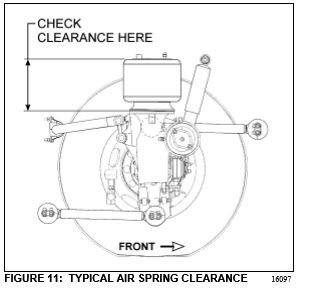
I think the dimension called for is 11.25″ between the top and bottom air bag mounting plates at road or driving height. I used a flat floor in my garage and measured about 11″ from the bottom of the bay doors to the floor. Getting it exact and repeatable is an exercise in futility so I was happy if it got close every time.
It is my strong opinion to NOT drive the coach with the suspension set higher. The specified height is the center of the low and high extremes and it provides needed suspension travel in both directions for various road conditions. If you raise it up I don’t think you protect anything, and in fact may expose some low hanging components to damage unless you are going over boulders in which case a bus with a long wheelbase that can be high centered may not be the best choice of vehicle.
-
No less than 2% for proper lube to u-joint. just a fact I picked up setting up new drive train. Ck Prevost manual like Jon suggested. Use last letter in your serial number plus last 4 didgets. That was drive shaft angle info. Bob
-
thanks. I will be checking out in the spring. I am snowed in now.
Thanms for the help. Petar
-
Petar,
When spring comes and you are still contemplating raising the coach above the Prevost specs, try this. Raise it above ride height, leave it in the level low position (or the new higher position if you do not have level low) and go for a ride. It not only will not handle bumps and dips in the road, but I suspect the handling will be seriously impacted.
I have had to raise the coach many times for various reasons ranging from steep driveway approaches to highly crowned railroad track crossings and the coach feels and handles kind of goofy. That is not a technical term, but it does describe how you know for sure something is not right. Short term, low speed driving with the coach raised is probably OK as long as you don’t twist the coach by transversing high spots at a diagonal, but intentionally raising it above spec I suspect is asking for trouble.
-
Somewhere close to 11″.
Being lazy I use the bottom of the bay doors to the road, but I think the Prevost service manual calls for the space to be measured between the top and bottom air bag support plates.
-
Jon is correct, kinda
Make sure the bus is level first.
My manual says 11.5″ plus or minus .25″ on all 8 air bags.
The steel plates where the measurements are taken are each .25″ thick. The mauual doesn’t say weather the measurement should be taken on the inside or outside of these plates.
So, for example, you could measure inside to inside and get 11″(like Jon said), at the same time if you measure outside to outside you get 11.5″ ????
-
The reason for my lack of precision is that I was too lazy to look up Dan’s service manual ride height measurement, but there is a reason everyone who is dealing with ride height adjustments needs to know.
The tolerance is ridiculous. Anyone that has adjusted the ride height will understand that if it is tested after an adjustment is made the best that can be hoped for is after a lot of up and down cycles the height will average the specified dimension. The ride height valve works by having the arm that is connected to the axle (or equivalent) stop the coach (up or down) at the desired height. It will get close but it has small repeatability variations so sometimes it will stop a little above or below the correct location or height. If after adjusting the linkage the coach is manually put in a high or low position and then the suspension control on the level low is set to the road height variations in where it will end up are going to be seen.
So the best way is to adjust it and then check the accuracy by going to the road height from lower or upper heights a number of cycles and if the average is within the specified range it is set OK.
-
Prevost sets the ride height for the air bags at 115/8 inches from the top plate of the air bag to the bottom of the piston on the bottom of the air bag. This is the nominal value and it can vary wspecialy woth the independent suspension that has larger air bags on the front. So in effect you are measuring from mounting plate to mounting plate. Adjustments should be done on as flat of ground as possible. Once you have found and set the correct road height yoiu can then measure from a panel to the ground for a quick reference. But if you want to be correct the measirement is at the airbag itself.
The factory setting are done with overall comfort in mind, but generally for charter coaches with full loads. Remember the shock lengths and the positions of the radius rods that link the axle to the chassis are ideally set so that the rdius rods are parallel to the ground. On motor homes where the overal weight is constant, the height adjustment once set usually stays pretty close. But with wear, possible slippage of the connector pieces on the leveling valve rods and even bending of that rod may cause you to check the height of the airbags. Remember also that correct road height is essentail to the stability of the vehicle on the road. A suspension set too low will seem mushy and lean too much in corners. A too stiff suspension makes the coach feel like you are driving a truck. Remember also that correct air pressure in the tires should be checked before you set road height. This is all stuff that should be done before you have an alignment of the axles.
Log in to reply.