
-

I don’t collect the data Jack has, but I have a few observations.
First, My usage tends to be running from power pole to power pole so my inverters are not working hard as chargers or inverters. As a result I likely do not see the temps Jack is experiencing. However he is correct in describing the situation and I can only suggest that the air intakes for the electric compartment which are likely located in the bay floor should be pulling air from a cooler location. The likely spot is from the area at the side of the coach and not beneath the coach. U don’t know if there are rubber 90 degree elbows available but something pulling air from the side of the coach and not beneath it would help.
I had gel batteries on our first coach gathering data for Interstate and found exactly how intolerant they are of heat. I believe AGM are more tolerant, but wet cell are the most tolerant. Too bad we cannot use batteries with that ability to handle heat.
-
My inverter bay never exceeded 105 last year during the hotest part of the summer including out west. I keep a remote temp sender in the inverter bay. I’m going to add one to the battery bay just to see how hot they get.
-
The batteries typically found in RV’s have a standard
temperature of 80oF. The
life of a lead-acid battery is reduced by 50% for each sustained 15oF
rise from the standard temperature. The
closer you can keep the battery to 80oF the better life, maintenance
and performance the battery will deliver.
As Jon is so fond of saying, it’s all a
compromise. Do the best you can with
what you’ve got or are willing to spend.
The best thing is to temperature control the battery compartment.
Mike
-
I don’t know about other coaches but on our later model Liberty coaches the batteries are in the center, and are isolated by panels from the compartments. They have a screen floor adjacent to the battery stack so if they do get heated it is from Cruise Air condenser exhaust that exits to the rear and is directed to the rear. I cannot imagine any other location on the coach being any better. However, as was pointed out there is hot air exhausted beneath the coach and it might impact the batteries to an extent. Maybe someone who is measuring battery temps has the answer.
Other coaches have batteries mounted in a bay, but I don’t know if they are ventilated bays or if the bay picks up heat, such as when the generator is running. In a Liberty the generator heat is exhausted away from the batteries.
This might just be another case of picking the least bad location for all the converters.
-
Tom do you recall the brand or type remote sender you are using. Searching the net last night I didn’t find the right combination of the ability to transmit enough distance or the right temperature range. Sounds like a great idea.
-
Jack,
It might be worth a call to Outback to see if they can provide a conversion chart for the numeric battery temperature reading you should find on your Outback’s remote panel. The only problem this might have is that it may not measure past a certain high temperature that may be lower than the actual battery temperature.
Once parked the air temperature of the ground should be a none factor after the first overnight stay. So, the air temperature should be very close to the temperature of the air going into the battery compartment. The only thing that needs to be done is exhausting the air from the top of the battery compartment away from the air entering the bottom of the compartment.
A charger/inverter will get pretty warm when it is charging at a high rate of current or dischaging while in inverter mode. Power pole to power pole users won’t experience the heat build up a person that dry camps will. Air needs to be drawn into the compartment opposite the end air is exhausted. Although it’s intuitive to understand the effectiveness drawing in from the bottom and exhausting from the top, it’s not the only way. With sufficiently sized fans, you can take air in from the top and exhaust it from the bottom. This is now somewhat common with high tech telecommunications gear. The rationale is that reversing the flow provides a more uniform heat signature throughout the area being cooled. In a coach, this could also result in cleaner air being pulled through the compartment as you aren’t drawing air from so near the road.
-
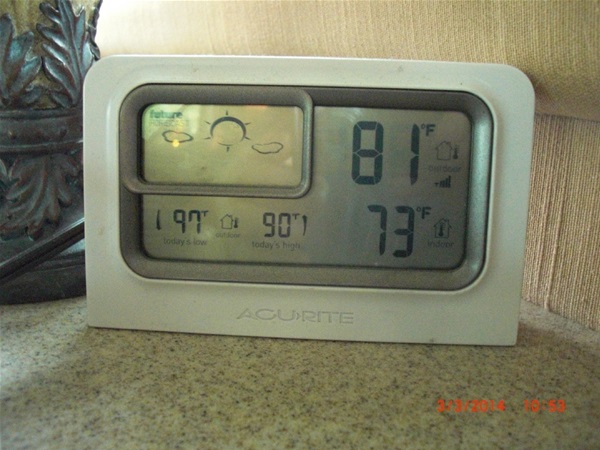
Hey Tom, does that say the High in the inverter bay was 90F and the Low 97F?
-
Jack: Never had a problem with inverter bay temps on mine. I have a single (maybe 4″ diameter fan) mounted lower rear of compt which exits air to the center batt/ac compartment BUT, it pulls cool side air in. The gen radiator intakes air through the rear side of the bay door and an open access to the inverter compt in the front of the same bay allows unheated radiator intake air into the inverter compt.
-
Gil,I think that I will just get a remote thermometer and I decided to use a fan to blow cool air into the top rack of the batteries and it should exhaust under the bottom of the coach.Joel,Because I have 3500 watt inverters and 6 batteries the amount of heat generated is much greater when inverting and charging than coaches with 2500 watt inverters and 2-3 batteries,also sometime in the past Liberty decided to pick up the air from under the coach instead of through the bay doors which I am sure would be cooler than from underneath.I replaced all of the batteries today and all of the old ones look perfect,I can only guess that the corrosion could be from the gel battery that vented and I reused the terminals that came off the gel batteries,the terminals were likely exposed to the acid fumes and that could have caused the corrosion.The old batteries look like new with no buldging or stress to the cases,even though the voltages are the same on the Outback pannel the lights are brighter.Thanks to Tom for the discount and to Lifeline for having a warehouse 60 miles away and participating in additional discount.
-
So this whole exercise and me taking the time to discuss your problem with Lifeline was because of old cable corrosion from Deka’s and there was nothing wrong with the 5 year old Lifelines?
-
Tom yes but you proved that you are great at customer service.
-
Gil – Yes, but I haven’t a clue if it changes daily, I’ll have to watch it. Right now the bay temp is 88 at 8:30 PM, so we’ll see.
Jack – Spread the word, Jon doesn’t give me much fuel money.:)
-
An observation……..gel batteries tend to be extremely sensitive to heat. I think Jack is going to be OK with Lifeline AGMs without modifying the coach. I say that because I think they are not only more tolerant, but I know Jack has a higher percentage of life left when his autostart kicks in so he is likely not generating the inverter heat to the same extent as the standard set point.
And let’s get this fuel thing out in the open. I am unemployed, I have no income, and the only way I can travel is to sneak into truck stops in the middle of the night and drain the hoses like we did when we were kids and couldn’t scape up a dollar for gas. Don’t believe a word Tom says.

Log in to reply.