
-
Pyrometer/EGT Readings for S60
Posted by Gerald on October 10, 2015 at 2:49 pmI don’t have a pyrometer/EGT gauge for our S60 (1998). Does anyone with a similar vintage engine have any typical EGT readings?
I’d be interested in the difference in EGT pulling a long WOT climb with the standard Allison shift program vs the “mode” power setting.
I don’t have any temp issues regardless of length of climb but I’m wondering if I should make it a habit to always shift into the performance program on the Allison transmission before I start a long climb such as Siskiyous on I5. Higher RPMs should drop EGTs.
Gerald
PS: I have the Silverleaf PC adapter but have not found an EGT/pyrometer sender reading. Maybe my vintage S60 does not have a DDEC sensor for EGT.
Chas replied 11 years ago 7 Members · 8 Replies -
8 Replies
-

Gerald, I believe later model S-60 DDEC engines use EGT as part of the data, but earlier models, including my 05 engine with an EGR engine do not.
I do know from extensive study when I switched from leaning my plane from rich of peak to lean of peak that the EGT is a big factor in determining engine health. But our engines are programmed so we cannot hurt them.
I suspect all unmodified diesel engines run well lean of peak, and with DDEC functioning as intended it is controlling EGT such that it never becomes an issue. The older 8V92 engines had pyros on both manifolds and it was often repeated that drivers had to limit the EGT to 1100 or some similar value. But in all my reading I never found any limitations stated by Detroit. Now with the DDEC engines unless the program has been modified having the EGT is nothing more than a piece of information because we have zero control over it, regardless of how hard we drive the coach or what mode the transmission is in.
I cannot read EGT on my Nexus or message center.
-
I have an EGT probe just after the turbo and There is a difference in high RPM EGT readings up long steep grades.Ken can probably answer your question.
-
Wouldn’t an EGT and/or Turbine Inlet Temp gauge help us determine when the turbo had cooled down enough that we could shut the engine off without cooking the engine oil sitting in the turbo bearings? I’ve/we’ve been counselled to let the engine sit at high idle for a few minutes then regular idle for a few minutes to let the turbo cool down after running at highway speeds.
-
I have always used the 3 minutes of no load to decide when to shut down. Normally, by the time you get off the highway and get parked you could probably just shut down, but I will wait a few minutes. It is better safe than sorry.
If you are getting into a campground, by the time you get to your site and park and get setup, you can for sure shut down without worry.
BTW, we did not have a pyro in any of our trucks and had very few turbo isues. The electronics take pretty good care of things. The issues we had were not oil cooking related either…
-
I agree with Mark and Jon.
I don’t know what’s right, this is what I do. I can’t think of a
time where I have been in long wide open pull and then have an immediate
opportunity to shut the engine off. Usually you go down the hill you
just came up or get off the exit ramp and drive into Cracker Barrel’s
parking lot under something much less than WOT. This gives the turbo
time to cool. I usually wait about a minute or so before I shut the
engine off. This gives the turbo enough time to slow down to an idle RPM
speed before you shut the engine off and stop the oil flow to the turbo.
There is going to be a very brief period of time that the turbo is
spinning with no oil pressure no matter what you do (unless you have an
accumulator installed) Trivia, the turbo can reach speeds of around
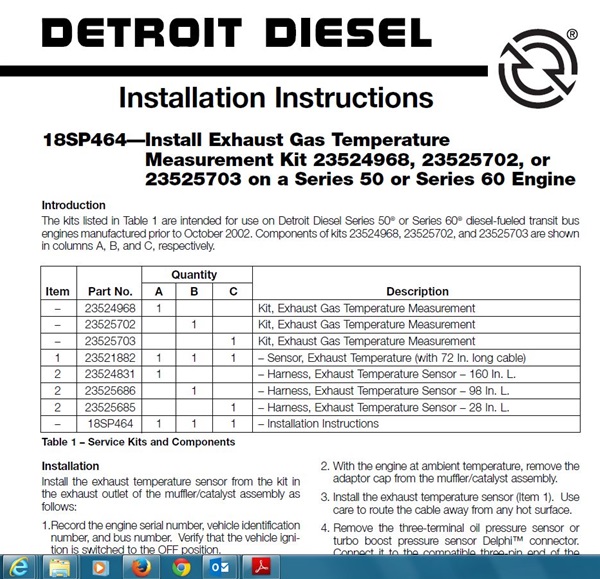
100,000 RPM under full load.There is a factory EGT
sensor kit available for DDEC IV, (I’ll add the part number when I find
it). A Detroit dealer should be able to upgrade the ECM to read the
sensor, if not I can. What I’m not sure about, will the Silverleaf
display it? I think so but a call to the folks at Silverleaf could
answer that question. So far I haven’t been able to get the factory EGT
sensor to work with DDEC V but just recently I found a document that
showed a 330 ohm resistor inline with the sensor that I didn’t know
about. I have not had time check that yet. As Jon said you probably
don’t need the EGT temps unless you’re wanting more HP, but if you want
EGT I understand. I want and have a lot of things I don’t need.DDEC VI and after have the EGT sensor from the factory, it’s part of the DPF system.
Ken
-
Jon, thanks, if your engine model does not have a DDEC EGT sensor, I’m sure mine won’t. I could install one after the turbo and run the wire to the front but it sounds llike it is not worth it.
When I first got the coach I used to drive it everywhere using the normal transmission shift program and cruise control. It gets the coach over all the hills/mountains just fine but speeds sometimes fall to around 40mph and I always have the feeling that I’m lugging the heck out of the engine between 1200 and 1500rpm.
More recently I have started using the performance “mode” shift program just before I start an extended climb. This keeps the RPMs between 1500 and 1800 going up the hill and the engine seems happier- but that could be just my imagination.Thus the question if someone has an EGT gauge installed and has used both shift programs to see if there is a difference.
Gerald
PS: I just now looked at the hp/torque curves for the S60 again, and peak torque is indeed flat from 1200-1500 rpm. 100% load at peak torque should be fine even at such low rpms.
-
I don’t know how others drive up hills, but I drive it like I stole it.
In anticipation of the hill I accellerate. As I hit the bottom of the hill I drop to 5th and go to performance mode. When my speed has dropped to my cruise control set speed I take my foot off the pedal and let the cruise control do the work.
The reason for letting the cruise control do the work is it provides more power (I think).
-
I have always felt like the cooling fan needs to be at high RPM up the steep hills so I too try to go up the hills at higher RPM.With the EGR engine that I have I have found that high RPM and 80-90% throddle will usually not set off codes so that is how I drive mine.
Log in to reply.