
-
Pneumatic System Maintenance
Over the years it seems the majority of questions that trouble owners relates to the coach pneumatic systems.
I get a sense the reason for problems and questions is split because of the seeming complexity and the fact the systems are under the coach, not readily accessible.
With regard to the first reason it is not important an owner knows how the pneumatic systems work. I don’t know how my computer works. But I do know some important things like it needs electric and I should not spill coffee on the keyboard. The same simplicity applies to the pneumatic systems. All an owner needs to know is how to do a brake check and what performance to expect from the systems. If an owner does a brake check and monitors the systems so leaks or potential problems are recognized there is not that much more to it for an owner that has no interest in the nuts and bolts. If an owner wants to learn more there are articles on this web site, and there will be no lack of folks willing to answer questions on the forum.
Knowing the pneumatic system is out of sight (and out of mind) it is important an owner has a plan for routine maintenance however. Whoever does get beneath the coach for routine maintenance needs to know and understand the pneumatic system has to be included. The pneumatic systems on our coaches includes the primary and secondary brake systems and the auxiliary air system which includes the Prevost auxiliary system and the portion installed by the converter. Every system needs to be leak free and dry. Leak free is obvious. If the pressures drop when they should not drop then there is a leak and the leak needs to be found and repaired. It sounds easy but it is not so easy, especially if the systems have multiple small leaks that have accumulated over time.
Keeping the system dry is easy, but few owners recognize how serious moisture in the pneumatic systems can be. As a result when folks get beneath the coach to lube it, change oil and check for leaks some fairly simple and inexpensive things can be done to keep moisture out of the system and they are not done. Moisture in the air precipitates out in the pneumatic system so to prevent that there are two simple tasks required. The first it to keep it out in the first place. Make sure the air dryer or moisture traps are serviced as often as required. Replace the air dryer elements, media, or cartridges as often as required. How often is sufficient? Don’t know. The interval is dependent upon so many things such as miles driven, quality of the air (humidity), condition of the compressor, etrc. I have used every 2 years and so far so good.
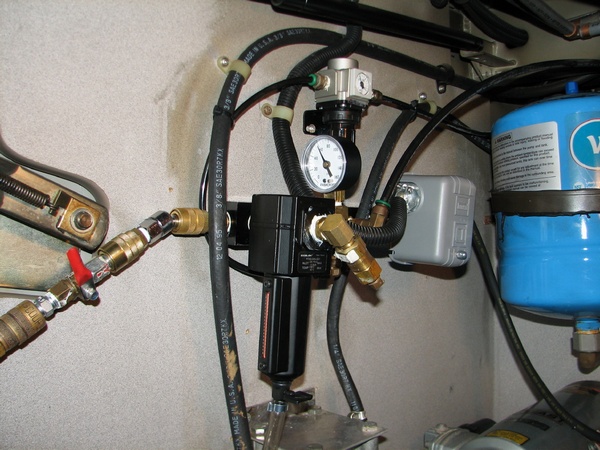
The aux air system is likely to have a converter installed air compressor. Downstream from that compressor should be some device to separate or trap moisture. Whatever the converter has installed to prevent moisture from getting into the system needs to be cleaned or drained as needed. How often? That is totally dependent upon how often the aux compressor is used or runs. If the coach is relatively leak free and the compressor rarely runs not much moisture may be trapped. But if the compressor runs a lot during the day it is adding a lot of moisture and very frequent draiining and cleaning is required.
The final defense against moisture in the pneumatic systems is the numerous air tanks throughout the coach underside. Our coaches are going to have a “wet tank”, a primary brake tank, a secondary brake tank, and an auxiliary air tank. They need to be drained often. I drained mine every time I lubed the coach (about 5000 mile intervals) or when I was beneath it doing other things. I admit having a pit makes it convenient, but regardless of how easy it is to get at the drains it is something that should not be ignored. I rarely got more than a spoonful of liquid from the wet tank. I never saw any evidence of moisture when I pulled components and inspected them such as the Norgren valves.
The final maintenance item is an inspection. Our coaches are equipped with various protection valves and check valves intended to maintaint air pressure in all leak free systems if one of the systems has a large or catastrophic leak. The Prevost pneumatic systems diagrams are readily available on the Prevost site and they show clearly where all the various safety valves are. To verify they function should be a part of system maintenance. I drain my tanks in sequence and although I have the aux tank open to atmosphere such as an air bag leak would create, I can verify the primary and secondary tanks will still maintain their pressure at about 75 PSI but insuring they have pressure when I drain them in sequence.
So pneumatic system maintenance is simple. Keep the system dry, drain the tanks and traps frequently, and inspect to verify the safety devices are working.
I can say with conviction if moisture reaches the working parts of the pneumatic system a substantial and expensive amount of failures can occur and the labor to dry out a system that has been allowed to get wet is going to be very costly.

Log in to reply.