
-

Jon has a Bus Butler to take care of the manual labor chores he no longer has time to perform.
I always try to park next to Jon when we’re dry camping because the rose petals all over the ground allow me to sneak out at night and dump my black tank and nobody knows any different!
All my toilet paper is in the shape of, that’s right, rose petals. (Red, Yellow and White) -
Jon,
It appears obvious to me the solution to your “rose petal” leakage problem is quite obvious. That would be to replace the gaskets, which must be really old and hardened to be letting “rose petal” leakage onto the garage floor. While you are replacing gaskets you might just want to do the complete set so nothing, including “rose petals”, leak from you dump hose connections.
-
is what I have been using very successfully for the past couple of years. No bulky and ubruly hose to fight with.
The setup comes standard with a 10 ft hose and connectors abd you can add a 25 ft extension hose. I keep both in a shallow plastic tray. Sine we do have a macerator, I do not use the waterhose flush connection. Simple gravity drain. It takes longer than the standard sewer hose but that does not bother me because the conviience of a small diameter hose outweighs the cons.Sewer Solution is being sold on Campingworld.
Cheers,
Ronald
-
I am sure if you ever showed your solution to a licensed plumber he would go crazy. What you have is a potential for cross contamination which is an industry term and there is not a plumbing jurisdiction in the entire country that would allow that product. I know the risk is slight, but products like that and products you connect to a holding tank to flush it are health hazards, not necessarily to you, but those using the water supply you connect to.
If you connected to your fresh water system you would be at risk, but when you connect to any other water system you put those other users at risk.
Maybe the plumbers on her would want to chime in.
-
I’m confused on this cross contamination issue.
I have tank rinses for both black and grey and use them. Of course I use a dedicated hose for that purpose just in case, but how the hell can anything get back into the water supply since there are check valves on both rinses and sometimes a backflow preventer on the city water?
Are you saying a micro turd can back up through my hose and push 45 psi of city water back into the supply?
-
A real plumber can explain in greater detail, but plumbing codes all across the nation forbid there to be any potential for waste to backflow into the fresh water supply so that is why on some campsites you see vacuum breakers on the hose bibs, some water supplies have backflow preventers and all plumbing codes require at the very least air gaps so waste water cannot be siphoned back into the fresh water supply.
One glaring example of an illegal plumbing connection is how Headhunter connects its toilet to the fresh water supplying it. The water supply to the toilet bowl is under the contents of the toilet bowl and their response is to require a water supply check valve to prevent backflow. That is great as long as the check valve never ever leaks and we all know that is not likely. Our toilets at home have an air gap between the supply of water from the tank, and the contents of the bowl. In our Headhunter equipped coaches it is probable our own fresh water holding tank is what will be contaminated in the event of a failure. Anyone whose flush would not stop due to a timer failure or flush valve issue should sanitize the water system because there could have been back flow contamination when the pump was turned off and system pressure went to zero.
When fresh water is connected to a waste tank a drop in supply pressure such as a water line break, can cause the waste water to siphon back into the fresh water system creating a health hazard. A check valve is not an acceptable back flow preventer when public safety is involved. If anyone feels their tank flush or tank emptying system is safe then use water pumped from the bus water tank to do the flushing, then if there is a failure of any device to prevent backflow it is only your own coach whose fresh water supply is contaminated and not the public water supply.
-
Perhaps, I have not have explained my setup properly.
First off, instead of the typical 4 inch sewer hose, mine is 3/4 inch only. So it is slightly larger than the typical garden hose. That saves a lot of storage space and the hose is much easier to handle because I can roll it up. The disadvantage is that draining takes longer.
The drain attachment has an optional use connector for a garden hose and if the valves are turned the proper way, it can be used to back-flash the tank after the dump. It does have a backflow preventer and all of the flush water is directed to the drain hose.
I do not use this function because a) we have a macerator and b) I do have a built-in tank rinse.
Anyways, I find this solution works well for us.
Cheers,
Ronald1984 96" with 8V92TA
(remodeled Liberty Coach)
Greenwood, MO -
Ronald, My point is you have a potential waste water to fresh water contact point if the check valve fails. Cehck valves are not viewed by the plumbing industry as an acceptable solution to potential cross contamination. As someone who may share a water system with you I would feel more comfortable if you would disconnect from the campground (municipal) water supply and do your tank flushing and draining using water and water pressure from your water tank and coach water system pump.
-

The blue connector here is too long… I need one that curves downward… any one know where to get one… very tight fit and I have the new Rhino here tomorrow and would like to get it right from the get go ?? Any ideas?? Thanks…Diane
-

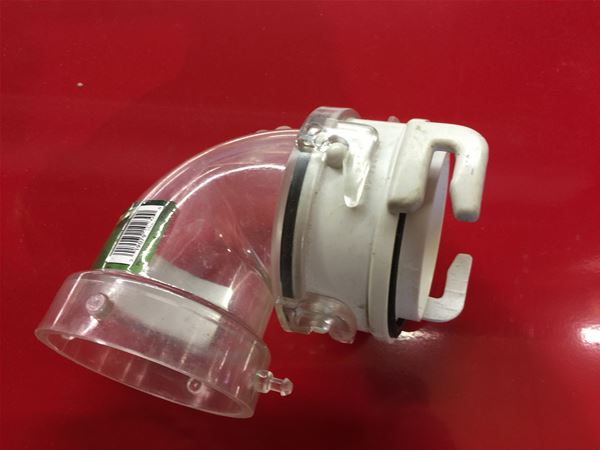
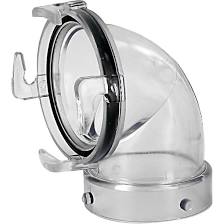
Diane, I use a Thetford to conventional hose adapter, which will allow you to use the 90 degree to connect to the Rhino.Jeff and Lindsay
91 Marathon XL -
The only way that waste water could be siphoned or pressure fed back into the fresh water is if the fresh water pressure fell below the static pressure of the waste tank being flushed. If the waste tank flush valve were 2 feet high and the flush connection were at the bottom there would be less than 1lb of pressure at the inlet. (assuming you accidentially tried to flush the tank when full!). The chances of the park water dropping to zero during the flush procedure is slim to none. The chances of contaminating your fresh water tank would be more likely because there are more scenarios in which our coach water supply could drop to zero.
-
Park your coach on a higher part of an RV park, have a construction crew accidently break a water line 100 yards away, but at a lower elevations and you have a siphon.
Is that scenaroi likely given that someone has to have been doing something in or on their coach at the same time that will cause waste to be siphoned back? Probably not, but if the risk is so slight why not use your own water supply to flush your holding tank then there is no risk to anyone else?
I don’t wrtite plumbing codes but I know why they have been written and it is all about public health.
If you have a Headhunter toilet and your water pressure in the coach has to go to zero for some reason, such as a flush valve that won’t shut off or maybe you are just changing the water filters, and your only protection against having water in the toilet bowl siphon back into the fresh water tank is a single check valve that can leak will you still be drinking water from your water system? The chance you will have a water pressure go to zero and at the same time the check valve will allow leakage is also a slim chance, but are you willing to take it?
Log in to reply.