
-
Jon: I suspect that either (1) something has gone wrong in the DDEC and/or ECM/U boxes that is creating the parasite drag or (2) there is a run of DDEC and/or ECM/U boxes that were unintentionally configured to significantly draining the batteries beyond the 250 milliamps indicated. One would think that this would be a long term warranty issue.
When Jeff Rowe walked us through our coach when we took possession of it, he counselled me to turn off both chassis masters when letting the coach sit for any length of time (I can’t remember how he defined “length of time” but for this discussion lets say if you think the coach will sit for a week or more; might have even been a shorter period of time).
So … not all coaches are going to equal with respect to being able to sit for extended periods of time with the chassis masters “ON” and still having enough juice to start the Detroit when called upon. The reasons varying:
1. Unexpected high parasitic drain from the DDEC and/or ECM/U unit.
2. Unknown and unexpected direct wiring to the chassis batteries by a previous owner.
3. A light left on that is hidden or the switch for a bay light that is broken and leaves the light on 24/7.
So until a coach owner learns his or he coach that is new to them, I would recommend turning off the two chassis masters to protect the batteries.
There is NOTHING more disheartening to get the coach loaded and ready for a trip to slide into the driver’s seat, turn the key, and NOTHING happens.
-
Deleted User
Deleted UserAugust 6, 2016 at 12:52 pm“There is NOTHING more disheartening to get the coach loaded and ready for a trip to slide into the driver’s seat, turn the key, and NOTHING happens. ” how about in the fuel lane after filling up for a long vacation.
-

I cannot quarrel with what Dick posted and the advice provided by Jeff. But as an owner gains experience he should know if leaving his master switches “on” is going to result in short term battery discharge or a barely noticeable current drain.
My first coach had an owner installed feature that sucked the life out of my batteries and it took serious detective work to find an unprotected circuit he added that was a constant drain. Subsequent coaches have not been modified and I have no problem leaving the master switch(es) on.
I have owned my current coach more than 4 years and have never turned off the master, including when I just swapped out the chassis batteries. I have the Guest charger shown, but have only used it when I was drawing current from the chassis batteries such as when working on coach exterior lights.
-
Our bus came to us with several manuals. One is from Liberty wherein it says to turn off the 12 and 24 volt master switches if the bus will sit for more than 24 hours. Another manual is from Prevost, and it says the same thing. So I have been doing just that the last nine years. The manuals say if you don’t shut them off, the batteries will become unequalized. And when we are traveling and overnight anywhere we are not plugged in, I do not shut off the master switches. Next morning traveling again, the battery balance light on the dash comes on a few times for a few seconds each time.
I installed new chassis batteries in May 2009. The bus sits in a shelter at our house all winter (November 1 through at least March 1). We have the oem built in 24 volt battery charger but have never had a need to use it since May 2009. The bus has started in March every year. The batteries are Sears diehard group 31 Platinum.They have stopped selling them though, so when it’s time, will go to the Deka group 31. So I wonder if our luck with batteries is correlated to shutting off the master switches?
Last week I installed two new Magnum inverters, having retired the 22 year old Hearts. The Magnum set up manual showed a charge schedule for each type of house battery, i.e. flooded, gel, agm 1, and agm 2. The agm 1 is for lifeline batteries, while agm 2 is for batteries made by East Penn, such as Deka (what we have for house). I noticed that the charge voltage for agm 2 was a little more than for agm 1 in the absorb and float modes. I mention this because it surprised me. Is more better?
-
Oh No!!!!!!!!!
By not turning off my chassis batteries they are unequalized. Heaven forbid. Sorry if I am making fun of that comment, but I can assure you my Vanner equalizer keeps them equalized whether they are on, off or the engine is running.
-
Charge setting for Deka AGM and Lifeline are basically the same.
Deka Absorption 14.1 – 14.4. Float 13.4 – 13.5
Lifeline Absorbtion 14.3 Float 13.3 -
Agree Tom.
Magnum’s setup manual has the numbers:
Deka absorption 29, float 27
Lifeline absorption 28.6, float 26.2 -
Jon, if heaven cares about unequalized batteries, I’ve got no chance, despite my diligence.
-
Would you by chance have a wiring diagrahm of how that charger would work on my 96 45XL? I know that the battries are wired 24 volts however there is a 12 volt connection also. I like the idea of the onboard charger/maintainer helps to ease the mind when parked for some time..
Thank’s
-
I do not have a wiring diagram, however Bill Daugherty at Liberty North Chicago does. He will want to know your Liberty production number. Mine is 276 for example, so yours will be a higher number.
Install is pretty easy. Close to the batteries you are charging is good. Good air space around the charger case is good. The red wire from the charger is connected to the positive side of the battery and the black (or white) is connected to the negative side of the battery. Check with a meter the voltage at the battery to make sure it equals the charger output voltage. There will be an ac cord from the charger to be plugged into an outlet you are accustomed to seeing.
-
In the mid nineties vintage Liberty coaches if a charger was installed it was mounted to the ceiling above the chassis batteries. There might be an outlet already there, or maybe even a charger.
If adding a charger the Guest charger shown below is a good one
http://www.marinco.com/en/2620a
That is not the only one that will do a good job, but it is ideal for the 12/24 volt chassis system and is waterproof. As a smart charger it can be left on continuously.
The easiest place to connect a charger is at the equalizer, although you can do it at the batteries also.
-
Jon wrote “The easiest place to connect a charger is at the equalizer, although you can do it at the batteries also.”
If you connect at the equalizer, should one disconnect the wires to the equalizer to protect the mechanic form inadvertent short circuits?
The information about the charger indicates to mount it vertically. How critical is that? Can it be mounted flat to the ceiling of the engine bay of an XLV with air space?
-
I replaced my original charger with the one Jon mentions. It was a direct replacement for my Guest and flawless so far.
-
Would you have a photo of how this is hooked up on your Liberty? I am at a loss on the wiring. Any infor would help
Thanks
-
Darrell,
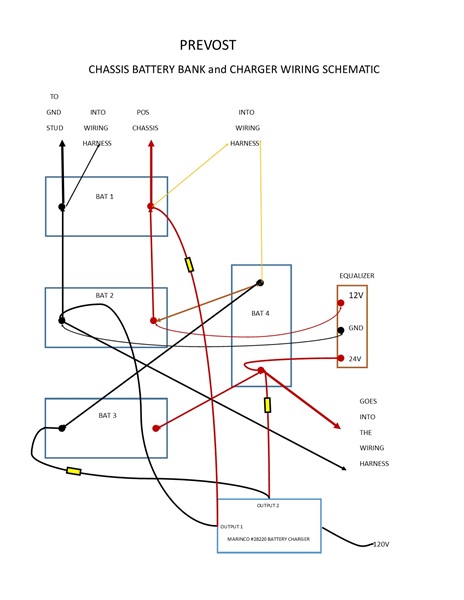
Here’s how I hooked up a 24v/12v battery charger to my chassis batteries on an ’03 Marathon XLII. I don’t know if your year Prevost is the same as mine.

Log in to reply.