
-
Master Switches
Posted by Darrell on July 11, 2016 at 12:52 pmHi Everyone
I Replaced all the bus batteries on my 1996 XL45 Liberty and when I am parked for some time I turn off the master switches both 12 and 24 volt, However if after one month i try to start the coach the battries are low and the bus needs to be jumped.
The light on the dash for the 12 volt master is lit even when the switch is turned off, should that light be off? i think I may have a bad 12 volt master switch any thoughts?
Thanks
Bryan replied 10 years, 1 month ago 20 Members · 35 Replies -
35 Replies
-
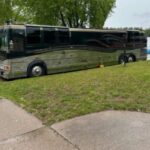
When you have the master off, can you find any voltage readings with a multi-meter on the back side of the master switch or downstream from the master?
If I recall correctly, the running lights on the side of coach are 12 volt. With the master switch in back “off”, can you turn the running lights on?
Its also possible that a previous owner “jury-rigged” something to bypass the master and that is what’s draining the batteries. How long have you had the coach?
-

We have had the coach for one year and when i replaced the battries last fall i had them on a battery Maintainer, now that we are on the road and at a rvresort i found that they will drain even with the switches off. I have disconected them and have them on a trickel charger. I will check to see if the switch is truly working at the back of the switch. The light on the dash for the 12 volt master through me as i thought it would not lite if the switch was turned off.
Libby
-
you are also correct that the side lights are 12 volt.
Libby
-
Went out to the coach a few minutes ago.
Both the 12volt and 24volt indicator lights on the dash were very faintly lit up, the DDEC Master indicator light was brightly lit up. I turned on the four way flashers and the running lights.
Went to the engine bay and turned off the 12volt chassis master. Four way flashers quit, running lights went out, DDEC Master indicator light went out, but the 12 volt indicator light sayed on (still faintly).
Then I turned off the 24volt chassis master. The 24volt indicator light on the dash went out.
I’m puzzled as to why on our coach the 12 volt indicator light on the dash didn’t go out when the 12 volt chassis master switch was turned off.
Jeff Rowe might jump in here with an explanation.
I would look closely at Darrel and Malia’s coach to see if there is something wired directly to the chassis batteries and/or the hot side of the chassis switches that is putting a draw on the chassis batteries. If you have a multi-meter with a clamp you might be able to detect the amount of the draw. One problem is that it looks to me that getting access to the back sides of the chassis master switches isn’t easy and probably fraught with danger if one doesn’t the proper caution.
-
Thanks for checking your coach, looks like maybe the 12 light is supposed to stay on as it is the same with our coach. I will disconect the battries and then check continunity of the switches if they show open when the switches are off then i know the problem is down the line, I am hoping for a bad switch as you all know,, tracing wires and shorts can be drive you to drink
-
I have no answers as to why you are getting power to the dash with the master off, but here is what I know based on my 97 which should be the same as the two coaches discussed previously.
First, My practice has been to leave the master switches on, even when the coach is not used, and to never use a chassis battery charger unless I have depleted the batteries such as by working on lights. After several months there is ample battery power remaining to spin the engine and start the bus. My practice was to monitor the chassis battery voltage and when it got down to 24.5 or thereabouts I would charge the batteries. It would take several months of non use to get to that point.
If you want to shut down the batteries on a coach of the vintages being discussed you have to turn off the 24 volt master and the smaller 12 volt master. It takes two switches to shut down the batteries.
Coaches of those vintage do have power going to 3 of the DDEC circuit breakers at all times. The power comes directly from the batteries, by-passes the master switches and I believe powers CB 19, 20, and 21.
Tom, Andre and I saw a coach at Bella Terra at an Oysterfest once that you could start when both master switches were off. When the master switches were off on that coach, if my recollection is right there was also a buzzer going off on the dash. The point is some coaches get screwed up by people for reasons that are unknown so unless the entire system is checked out, assuming it is supposed to work as intended may be wrong.
-
Thank you for the reply, I only get about 4 weeks before i have to boost the battries and that is with all masters in the off position, so it looks as if i have some hunting to do to find the source of the drain. I have been working to replace and restore everything to the orignal specs but it can be challenging, thanks everyone
Darrell and Malia
-
As Jon mentioned above CBs 19, 20, and 21 are all connected to a bus bar and are fed 12 volts directly from the batteries. So they are hot all the time. CB 19 and CB 20 go directly to the ECM of the DDEC engine and are normally the injector driver circuits. Detroit required Prevost to keep these wires hot so that when the engine was shut down the small amount of “housekeeping” that the ECM had to do could be accomplished even though the systems were shut off. CB21 feeds Relay 23 and this is the engine run signal that is distributed once the key is turned on.
Normal draw on these two circuits (CB 19 and 20, wires 240 and 241) is about 250 milliamps. It is a very small parasitic load that should not deplete the batteries. But we have seen on some units where these wires begin to pull around 1 amp. This could cause you to have low batteries over a long period of time.
To check this, cut your 12 and 24 master switches when you turn off the vehicle and then trip the three circuit breakers, CB19, CB20 and CB21. Let the vehicle sit and see if you have the same issue when you go to start the vehicle.
In the XL series we also had a hot post in the front junction box ( stud #70) that was connected to the 12 power directly. It was for radios and CB radios or whatever in the charter coaches. Check this stud to see what is connected to it. It may be something that would draw enough to bring down the battery level over time.
If you still get a low battery level then you will need to open circuits to verify that they are truly open with no current draw. You may choosse to get this type work done at a shop like Jeff’s or at one of the Prevost service facilities.
Bill Jensen
for Prevost
-
I’ll settle for what he has forgotten.
For newer owners who have not had the opportunity to meet or deal with Bill, he was responsible for all Prevost conversion service and maintenance. He recently retired and until such time he not only advocated for owners who had issues and helped tremendously, he has a depth of knowledge nobody possesses.
-
Thanks, Tom and Jon!
It has always been a pleasure to work with the conversion people and the wonderful motor home folks that I have had the opportunity to meet and work with. I will jump in where I think I can help!
Bill Jensen
for Prevost
-
Bill has a very good point above.
Pay attention.
If your ECM and DDEC are pulling 1 amp instead of 250 milliamps, you are going to use 720 amp hours in a thirty day period. That will kill a bank of four Group 31 engine start batteries.
I replaced my four dead Group 31 engine start batteries Wednesday. They were only six months old, I had replaced them in late January of this year. It had been six weeks since I last started and drove the bus. I had about 10,000 miles on the batteries.
I had Prevost – Ft. Worth inspect the electrical system Thursday. They found no problems and said if there were any phantom loads other than the ECM and DDEC, they were too small to detect. They told me they had found busses that could not go more than a few weeks without killing their engine start batteries and replacing the DDEC and ECM solved the problem. That’s an expensive fix. Age of the bus was not a contributing factor. Just as many new busses had the problem as did older busses.
I called Country Coach and discussed my problem. They told me that the year after my coach, they began installing trickle chargers in the engine compartment to counter this issue.
Michael
-
I agree with Michael that a trickle charger is a far less expensive way to protect chassis batteries than replacing the DDEC associated boxes, but that raises a question in my mind about why there is the need when other coaches can go months with no charging at all, and still have capacity to spin the engine.

Log in to reply.