
-
Low Ride Height
Posted by Eric on August 1, 2015 at 8:49 amGreetings to all my Prevost friends. Before leaving Cleveland yesterday, I noticed a ride height issue – only able to bring the front of the coach up 8.5 inches. Back of the coach rides at an expected 11 inches. In manual mode, I can bring the back up full height. Not able to do the same in the front. Can bring the front down a couple inches in manual mode, but up no higher than 8.5. I verified this low ride height condition at several rest areas on our drive yesterday. So what am I doing wrong? Gauges show the air is holding steady with no leaks. Had the coach suspension zeroed out by Jeff a year ago. This is occurring at the end of a three and a half week adventure. We are now at Mammoth Caves, and will be returning home tomorrow. Concerned about damaging the underside of the coach.
On a completely unrelated note, how about that blue moon last night. Spectacular!
Fred F. replied 11 years, 1 month ago 7 Members · 12 Replies -
12 Replies
-

Eric and I talked last evening and I sent this email this morning.
Since we talked I have been trying to figure why your front will not come up as high as it should.
I think you said the following:
The bus will not come up in front any higher manually versus when it is in the “road” position.The front will go down, and come up to the road height which looks lowThe rear will go up and down as expected.The air system since the Norgrens were replaced has been dry.
This is my brain dump, thinking it through.
The ride height valve in the front is not likely a part of the problem because the front does raise.Even if the front is not coming to the required road height it is unlikely the ride height valve because you said that it will not go higher manually.The Norgren valve(s) that open the air flow path through the ride height valves or the level low system appear to be working otherwise the coach would not come up in the front. And the path is open for manual height adjustment as well as ride height.The above indicates all the valves in the 5 valve solenoid manifold are functioning.
So based on the above there are no issues with the ride height valve in the front. The Norgrens that control the level low, including the manifold appear to be working. Without seeing the coach and playing with it a little I have to focus on the air pressure or the front air bags. The front will take about 100 PSI to come to ride height. Can I assume you are seeing normal pressures in the 100 to 120 PSI range? If air pressure is OK I would look at the front air bags to see if they are correct. What we did not discuss is if the air bags were changed, and if the height issue has come about as a result.
If your suspension is working as intended the actual height adjustment calls for about 11″ between the top and bottom support plates for the air bags. For me it is just as easy to measure from the bottom of the bay doors to the ground (level surface). It will be around 11″ but it is not the height that is as critical is that the measurement at the front is the same as at the rear of the bus.
From that position the level low (Liberty’s modified version) should allow the coach to drop 3 to 4 inches, and to raise about 3 to 4 inches from the road height.
If you want to play a little to see if the front air bags are height limited, level the coach in the road position, go to the manual position and command the front to go up, and then lift the tag axle. Allow the coach to cycle the compressor once or twice. See if the front has risen. If it has drop the tag axle to see if it remains up. If that does enable the front axle to rise above the height you are experiencing it adds another data point and the focus shifts back to something restricting air flow to the front axle.
I haven’t checked to see if Eric has a single 5 port Norgren or a pair of 3 port Norgrens to control the front axle height, but I don’t think that matters.
-
I believe the converter pneumatic attach point has a protection valve that should be opening at around 75 PSI and then when open will allow the accessory air tank to match the primary and secondary air pressures. If you can measure accessory air pressures that is more information that will help.
-
Thank you for the great reply – both post an email. Getting ready to start the bus for the day and check the ride height. Yesterday I confirmed air pressure at 110. My guess is I’ll need to get under the bus when I get home and confirm what’s going on. Thank you again for your help.
-
Interesting, sounds like not enough air pressure up front for either the ride height or manual up command.
-
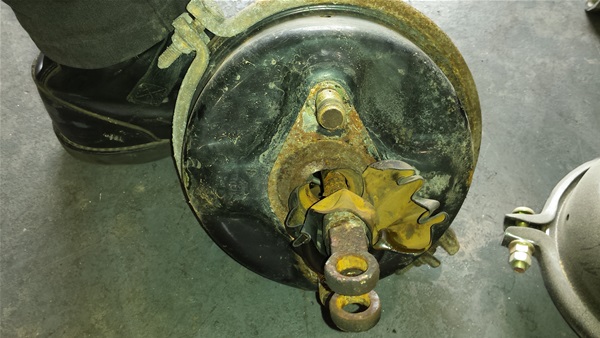
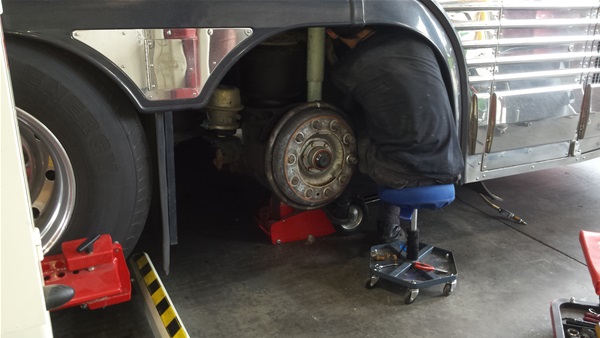
Problem Solved!! As previously posted – I could not get front suspension to raise over 8.5 inches.
Once I got home, I could hear a “leak” in the steering bay. After several hours of searching (lots of
soap/water), could not find the leak.
Wanted very badly to get under the front of the bus to continue search,
but I could not do so safely. So, I made
a trip to see Jeff – I am soooo glad I did.
ETLC found and fixed the leak,
and by “helping”, I increased my Prevost wisdom. The leak was actually in the driver’s side
tag axle lift chamber. The “leak” sound
I was hearing in the steering was not a leak, but rather the sound of air
shooting through air valves and lines. My dash gauges did not show a leak (steady 120
psi), but the engine compressor was working as hard as it could to keep up with
the leak. Once we fixed the leak, drained between 1 – 2 gallons of water from the air tanks.
Thank you Jeff and company, and the Prevost Community.
-
OK, now I am really confused.
Let me review what has been discussed.
First, the air system was reaching 120 PSI. (That has been stated from the beginning of this discussion)
With the air system at 120 PSI the front would still not come up to ride height. (That is the core of the problem)
The bus was leaking air at the tag axle lift chamber. (New information)
Now here is the problem I have and would love to get a better understanding:
If the system is reaching 120 PSI which I assume is both primary and secondary, it follows that the accessory air system is at the same pressure. I say that because when the protection valve for the accessory air reaches about 75 PSI, all three air systems build air pressure at the same time, and they drop in pressure simultaneously. At 120 PSI the coach should raise to any height easily. What is wrong with my thinking?
The tag axle lift chambers (which are nothing more than a service brake chamber) never receive air until the tag axle lift lever is flipped. At that point the tag axle air bag air is exhausted and the lift chamber pressurized. As soon as the tag axle lift is turned off, no air goes to the lift chamber, and the tag axle air bag is re-inflated. How would you even know the tag axle lift chamber is leaking unless you flip the lever? And most importantly how would you ever know it was leaking unless and until the lever is flipped, at which time there is a light on the dash and an audible alarm. Further, I believe the tag axle lift is disabled automatically above a certain speed so
The reason for pursuing this is because either my understanding of the system(s) is screwed up or there is something missing in the description of the cause.
-
I’m equally confused, I thought there was an issue bringing the front to ride height of which a tag lift chamber has no effect.
-
I hope I properly described everything. Both primary
and secondary gauges showed a very steady 120 psi. I did not have thetag axel lift lever actuated – I never use it.
I guess there is a possibility that my 3 year old may have flipped it
while we were on our 4 week outing, but my guess is that I would have noticed. Is
it possible the lever was actuated and I never knew it? No warning light or audio alarm. One
additional unmentioned condition was my aux air compressor would not shut-off,
even after the primary and secondary was at 120 psi. I was going to troubleshoot that after I
solved the front end height problem. Replacing
the tag lift chamber also solved the aux air issue. I guess I was so happy about finding and
fixing the leak that I never considered what you are mentioning, Jon.I will ask Jeff to please chime in and verify all my facts.
1999 XLV X-6872, liberty #440 -
I am fairly confident of the following……..
To have the bus air pressure reach 120 PSI, the aux system cannot leak faster than the bus engine compressor can build pressure. Once the protection valve between the brake systems reaches its normal open pressure of around 75 PSI all three systems build pressure simultaneously. If the bus is low and the system is set for driving the ride height valves will have an open path from the accessory air system and the air bags. That means as the engine driven compressor is trying to bring all three systems up to its cut out pressure the accessory system is allowing pressurized air into all air bags and all four air tanks and all 8 air bags are being filled simultaneously.
The tag axle has nothing to do with any of this unless the lever was flipped, and if it was there would be a light on the dash and an audible alarm so that would not be overlooked. Unless the tag axle was to be lifted the lift chambers would receive no air, and the air path between the drive axle air bags would be open and the valve that exhausts tag axle air bag air would be closed.
Brakes will always have their pressures satisfied. If there is a leak downstream from the primary, secondary and wet tanks, and assuming the protection valve works the brakes will have at least 75 PSI. That is true even if the leak in the accessory system is so big the accessory system cannot build any pressure, such as a blown air bag.
It is my understanding there is another element that has not been discussed, but does explain how brake pressures could be at 120 and the accessory air to be at such a low pressure to be unable ot inflate the front air bags sufficiently. The Liberty coach has a “spitter” that discharges moisture whenever the aux compressor cycles. The spitter cup was not secured properly and it was leaking and preventing the aux compressor from reaching its set point and cycling off. I think that was the leak that prevented the accessory system from fully pressurizing.
So here I go sticking my neck out a country mile and offering what I conclude as a potential answer. Jeff has to sign on for this and offer his opinion.
The tag axle leak is a red herring. It had nothing to do with the issue, but was just a problem that was found as a result of diagnosing. For now, ignore that issue completely.
The problem was the leak in the “spitter” prevented the accessory system from maintaining air pressure. But the leak was only a part of the problem. In order for air to flow into the accessory system it has to pass through the protection valve. But air pressure can build in the brake systems faster than in the accessory system if the protection valve is restricting the flow especially if it has been damaged by moisture. Since primary and secondary air system pressure controls the compressor governor the pressures could easily be 120, but because of a restriction of flow into the accessory system due to the leak in the spitter that system could not build to a pressure great enough to raise the front.
Here is where I am making a bold diagnosis without all the facts………I suspect the coach has had moisture in the air system(s), the protection valve has corrosion and is failing to open sufficiently to raise the front because air was leaking out faster or at the same rate it was coming in. The coach has been repaired, but I would be surprised if an examination of the protection valve did not reveal it needs to be replaced also.
-
OK. Still not
explained is the fact that I and several people, including Jeff, heard the loud
air rushing sound in the steer bay, that went away once the tag axel lift
chamber was changed. Also, the front
then was able to be raised after the repair.
I agree the protection valve needs to be examined and replaced, if
defective. Now, all I have to do is
find and evaluate the valve ….. Help -
There is no doubt this is a puzzle. What we don’t know is under what conditions the air leak noise went away when the tag was lifted.
Was the aux compressor running? Was only the engine compressor running? Was the leak at the tag chamber so bad the pressure drop up front was so great there was no longer enough pressure to make it leak in the front.
The reason the front rises after the leak in the front was fixed was the aux system finally was able to hold sufficient pressure to lift the front to the ride height.
FWIW without putting a gauge on the air bags I believe the front air bags require about 100 PSI to come to ride height, and the rears a little over 70 PSI. Some time I will put a gauge on things just out of curiosity, but those pressures will be coach specific due to various axle weights.
-
When I read the post I did not answer but the tag chambers have no air to them when down ,so liike , Jon said unless the tag is lifted there is no air to chambers, the spitter cup could have not being on but there is a versa valve after the spitter cup if it sticks open it can leak through the head of the aux comp or the spitter cup and it can loose a lot of air causing the bus comp to run lots , we replaced one on a coach at Jeff’s when I was there that had that problem , the protection valve in the steering bay and the one on the tank under the steer axle could be bad , and that could cause it not to come to ride height or above that, that coach has the right bags on it I know that for a fact so it’s not the bags in front , every time a coach won’t go above ride height people say lift the tag and try it that’s bullshit if it has the right bags it will come up if the aux is up to 120 you may have to let the comp cycle once to get it back to 120 but it will come up,,, just my two cents worth
Log in to reply.