
-

Sorry for the the thread creep, but in light of the recent brake disintegration issues, I did some quick back of the envelope calculations:
If we assume weight of 52000 pounds, elevation change of 4000 feet, 14% grade ( the grade is irrelevant to the potential energy, but will be used for other calculations later). The potential energy created when ascending this elevation difference or conversely dissipated when descending is 67,259,559 calories or 78,336 watt hours.
To put it in English it is the amount of energy you would use (and the heat you would create) by running 78 1000 watt toaster ovens for an hour.
Some further analysis show with our 14% grade 4000 feet of elevation change happens over 5.4 road miles. Lets assume 30 mph. This give 10.8 minutes to traverse the distance, which is about .18 hours. So we divide the 78 toaster ovens by .18 and we get 432 toaster ovens on high for 10.8 minutes. And we wonder why brakes get fried! Of course in our proper technique, we don’t dissipate all the energy using the brakes, but it is dramatic.
As a sanity check to the above numbers I converted this energy dissipation rate (67,259,559 calories/648 seconds) =103795 calories per second. Converting this to horsepower, gives 583 horsepower. Which says for sure Olivia was not going up the grade (assuming same steepness and elevation change up vs. down) at an average 30 mph, even without a trailer.
A lot of assumptions here and no adjustments for energy conversion efficiency, wind resistance, etc. etc. But directionally it makes sense. Forgive any significant figure issues, or other physics “stuff” I’m a doctor not a geek. I took the physics without calculus in school.
Edited to add this chart I found online. It is from a post citing some MCI /Allison data. Shows Allison trans retarder can dissipate what looks to be about 800 hp. Link to the post, it is by a Foretravel owner and there are some remarks in there about Jake vs retarder and I express no view on validity of his opinions, but the chart appears to be an MCI document:
http://beamalarm.com/Documents/transmission_retarder_operation.html

-

David, that really puts things in perspective. Everybody should know and understand there are going to be circumstances when we all truly have to manage the energy in our coaches. And your figures clearly explain to slow or stop a coach a lot of heat is created and if we do not make an effort to control how that heat is rejected we are going to have problems.
Every single means at our disposal to slow or stop a coach generates heat and if unmanaged that heat can be destructive. If we heat our brakes through frequent hard use we affect not only the pads or shoes, we can damage the discs or drums. We can heat the oil affecting wheel bearings, and in extreme instances the wheels and tires are going to be subject to extreme heat.
But the solution is not limited to brakes, but can impact the retarder. The retarder is generating a lot of heat and it has the potential to heat the engine coolant, or to add excessive heat to the transmission fluid.
A Jake also creates a lot of heat, typically the heat of compression and engine coolant has to reject that heat also, just like the retarder. A jake may not generate as much heat as a retarder, but it nevertheless is adding serious heat to the coolant. If a coach is equipped with a pyrometer it will be seen the exhaust gas temperature generated by the Jake can sometimes exceed the exhaust temperature from driving on level ground.
So as drivers we have to manage the coach to reduce the amount of heat that needs to be rejected and it starts with reducing the energy that has to be dissipated by reducing speed. On steep grades a failure to do that can result in total brake failure.
-
David said: “I took the physics without calculus in school.”
Well, I took physics WITH calculus, twice. The first time it took me so I had an opportunity to repeat the course… 🙂 I had to work a little harder on the following courses.
Love your analysis… thanks! Science is real.
-
David: Thanks for sharing that article. Very informative.
I also found your mathematical approach and comparisons to put things into perspective to be very, very interesting.
I notice the article (which I presume is about the Allison trans retarder in a Foretravel motorhome) is silent about high transmission fluid temperatures during operation of the trans retarder. I wonder why. Does the Foretravel have a more robust trans fluid cooling system than our Prevosts?
I have come to the conclusion that the best system for braking on our Prevost coaches beyond the service brakes is (1) trans retarder AND (2) a Jacobs/Jake (compression) brake, which I plan on having installed on our coach when the valves and injectors are looked at.
When I am going down a steep hill and fully invoke the tran retarder, the trans will downshift and try to hold the coach back, but will upshift once the tach gets around 2500rpm (which is presume is close to operational “red-line”). I suspect this is normal.
During the first couple of years of ownership, I would notice the “OIL TEMP” gauge on the dash (which I understand is really Trans Fluid Temp, don’t get me started on the label on the gauge) would go up with the retarder full ON. Now it doesn’t appear to me that the temp is as likely to go up as it was in the past.
I wonder if the transmission needs service or adjustment? Anyone experience the same thing?
-
Allowing the bus to push engine speed to 2500 is a very bad thing. That is why I would urge as drivers we limit engine speed to 2100.
Additionally, a retarder generates a lot of heat that in transmitted to transmission fluid, but also to engine coolant. Theoretically the transmission computer is going to limit those temps to 300 and when attained it is going to reduce the effectiveness of the retarder.
We as drivers have to use all our coach’s assets and manage temps, speeds and RPM.
-
Good point by John on watching the engine rpm during all this.
I use the DDEC display panel to monitor transmission temperature. With my coach and my diminuative Z3 toad, I have been able to go down any hill I have encountered so far in up to 90 degree ambient temps and keep the trans temp under 230. Why 230, well I read a post by Jon once on another forum from a long time ago, and he said he liked to keep his under 230 so it seemed like a good number. I am getting old and I learned a while back to respect or at least consider the opinions of those older and more experienced.
I managed the transmission remanufacturing business when I was at Ford and know that nothing kills more automatic transmissions than heat. It damages the fluid affecting its friction characteristics, the clutches slip and you end up with even more heat, disintegrating the clutch plate friction material and bad ending.
My trans tends to run about 208 or so cruising down the road on a hot day. The trans is cooled by a oil to water cooler that dumps heat to the engine coolant. There is a smaller maybe 10″ by 15″ oil to air cooler in front of my radiator that I suspect is in series, I’m not sure if before or after the oil to coolant cooler. As small as it is, hard to believe it does much, is similar size to those on pick up trucks.
So bottom line, I manage my downhill speed by watching my trans temp using the DDEC display temperature. If the temp is rising it tells me I am turning potential energy of altitude into heat faster than my vehicle systems can dump it to the air. I brake to slow it down, shift to a lower gear. I use whatever retarder setting is needed to keep the vehicle from speeding up without braking, all the way up the “highest” setting. If it won’t keep it from speeding up at max, repeat the cycle, brake to slow down, lower gear, set retarder to prevent speed increase, watch trans temp.
Has it never gone over 230? Yes it has a few times, but not much over and I let it creep a few times when I knew I was near the bottom of the hill and it would not be going much higher.
As I said in the post on the brake pad thread, the slower speed is all about the rate at which you dissipate the energy. Going faster does not create more potential energy to dissipate, that is determined by the mass and the altitude difference. What going faster does is force that energy dissipation into a shorter time period. Going slower takes you longer to get down the hill, allowing more time for the energy to dissipate into the air.
Yes a faster moving vehicle has more kinetic energy than a slower moving one, but that only applies to figuring how much heat you generate and have to dump when coming to a stop or slowing from some speed to some-x speed, but that is a one shot deal, and that is not what we are talking about here – which is a long ride down a mountain.
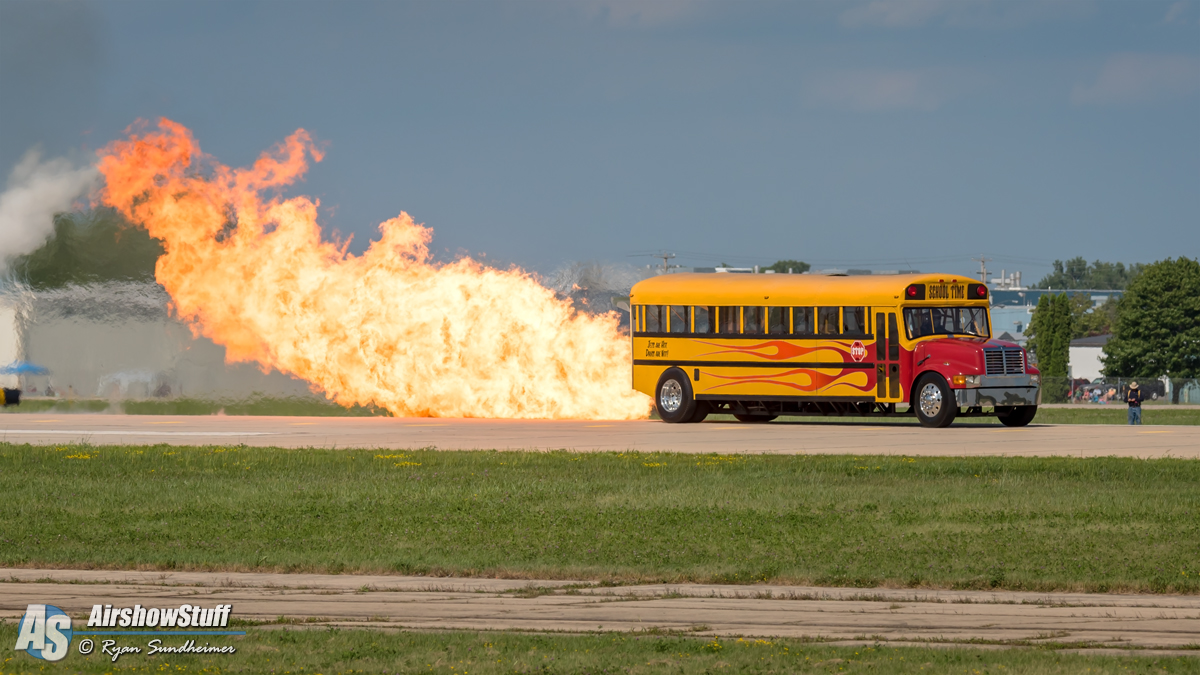
Then there is always this option – looks like the brakes – or something – is smoking on that baby, maybe lonestar can tell us how it works on his drag car . . .

-
I really don’t see how the Jake would add much heat since there is no heat added at the compression stroke other than the heat from compression, which is not much. On the intake stroke the engine draws in cool, fresh air, helping cool off the engine.
There is a lot of braking power from the Jake between 2,100 and 2,500 RPM. The 2,100 RPM limit is for the engine under power. The no-load RPM limit is 2,250 RPM, as per the placard on the side of the engine, and the redline is 2,500 RPM per the manual. There is no reason not to use the Jake braking power between 2,100 and 2,500.
-
Dare you laugh about a parachute on a bus . . .
Incidentally, this is a good example for kinetic energy being the problem, versus potential energy coming down a mountain, he only has to stop once and quickly at that.

-
On a side note, why is it that drag racers always have chicks – oh excuse me, rather young ladies, wearing short skirts hanging around?
-

Per, A Jake does not change the laws of physics. Regardless of the method used to slow a bus or at least arrest increases in speed heat is being generated.
Brakes use friction. A retarder functions much like a torque converter in reverse, and a Jake does its work by doing work and then releasing the results of that work to coolant or to the atmosphere via the exhaust. What a Jake is doing is allowing the compression stroke so when the piston is at the top of its travel, having compressed the air in the cylinder, that compressed air is dumped into the exhaust rather than used to push the piston back down the cylinder.
If you had a pyrometer or an exhaust gas temperature gauge you would see almost no exhaust gas temperature reading with the Jake off and your foot off the accelerator, but when you engage the Jake the exhaust gas temperature can range from 300 to 500 degrees. That is the heat of compression. Compressing the contents of a cylinder in the cylinder creates heat and in addition to dumping that heated air to the atmosphere like our brakes are doing, our coolant is also absorbing some of that heat where it is rejected by the radiator and fan.
The Jake is the most user friendly supplemental braking because it is unlikely to cause anything to overheat as a retarder can do or as misuse of the brakes can do. But in my experience with both a retarder and Jake it is also less effective than a retarder. But in terms of use by a non-involved driver it is least likely to require any monitoring or adjustment to driving.
-
Just hope you visited the Cliff Dwellings in Chinle while you were there. This town is the only place where I have seen signs on light poles that basically said “Please don’t feed the Indians”! Beggers are a real problem. We pulled into a fast food place and an Indian (the “How kind”, not the “dot kind”) immediately knocked on our door and asked for money. Despite that, great historical site.
-
Jon,
I have no idea what a non-involved driver is. If a driver is non-involved he/she has no business being on the road,much less piloting a Prevost!
-
West bound on I-70 at gross weight leaving Eisenhower tunnel Per, you will be braking. Of course mine will never see 2500. Ever watch your boost while on the jake, heat is being made.
-

A non involved driver would be someone who has no idea how to operate a bus but can buy one and with a retarder allows him to go done a mountain with less chance of hurting himself or others. In trucking we call it dummy proofing.
A Detroit screaming at 2500 rpm has to sound like 26 cats in heat bouncing off the walls.
I won’t argue about how one comes down a mountain but I have a different thought then most when I start a descent. What will I do if my jake or retarder fails half way down.
I know the only people that know the answer to that question is a driver who was taught how to come down a mountain without a jake or retarder without setting it on fire.
We never turned a driver loose in the mountains with a jake brake until he knew how to come down without one.
Just an old truck drivers thoughts.
Later
bv
2000 Featherlite H3-45
2024 Jeep Grand Cherokee
Leesburg, FL -
Bernie,
The DD at 2,500 with the Jake on does not sound a whole lot different than at 2,100.
1999 XLV X-6872, liberty #440
Log in to reply.