
-
Jeff Pulls My Fat Out of The Fire Again!
We pulled out of the Fying J in Effingham, Illinois after spending the night nearly two weeks ago and had not driven 5 miles when a dash warning light came on that I had not noticed before. It said House Batteries Low. What? How could that be?
First, my batteries have been in great shape and when the batteries are good we have enough battery power to run an air conditioner for several hours without plugging into electric. After we turned off the generator at bed time Monday night we ran the fan but no air. The batteries should not be low.
Second, IF the batteries get too low the generator was set on auto and should start and run. That did not happen. Therefore the batteries should not be low.
Third, when the batteries were bad three years ago and they did get very low this House Batteries Low light did not come on then.
All this went through my mind in about 10 seconds while I was looking for a place to get off the road.
I pulled into a very conveniently placed rest area and went to the electrical panel to check the inverters. Both inverters were in error but the house battery voltage was not low. It was high. Evidently the warning light is for low AND high house voltage. I thought something might be wrong with the inverters so I cleared the errors and started the generator to see if things would even out. Nope, right back into error for high voltage on the house batteries.
The eight 4D AGM house batteries are too expensive to boil. I turned off the engine and the over charging of the batteries stopped immediately. Ok, there is a clue, Shaggy. No engine, no overcharging.
That told me there might be a problem with the bus alternator. I went to the back with my voltage meter and had my wife crank the engine and the alternator was putting out 35 to 37 volts instead of 25-27. Oops, that is not good.
I checked the wires and connections and everything seemed good. That was pretty much the end of my trouble shooting ability. That’s where Jeff Rowe comes in. I brought him up to speed and he had me do some additional tests. With the information I gave him Jeff came to the conclusion that the external voltage regulator was probably bad.

More importantly at the moment he told me what I needed to do in order to roll. He told me to disconnect the field wire so that the alternator would not charge and then instructed me on how to proceed. I turned on the 24 volt trickle charger I installed last August, cranked up the bus and rolled on down the highway.
The trickle charger kept pace with charging the chassis batteries as long as we did not run the bus air conditioning or the headlights. We ran the generator all day to keep the house batteries charged, run the roof airs and to have power for the trickle charger. We needed the trickle charger to top off the batteries over night so when we stopped that night we plugged up in a campground.
We tried to find a voltage regulator in St. Louis, Springfield and Tulsa but no one we called had it in stock. I finally ordered it from Prevost and had them ship it to my destination at the end of the week. I had to travel like that for two more days but we made it fine.
Just for information the Prevost part number for my voltage regulator is 563439 and the Delco or Detroit number is 10503805.


I installed it when it arrived and it did not solve the problem. That was not Jeff’s fault because he did not know a crucial piece of information and I did not know it was important. The alternator does not go directly to the batteries. There is a multi-battery isolator installed between the alternator and the batteries with another lead going from the isolator to the house batteries.

Model 3002

When I mentioned that to Jeff he knew exactly what the problem was. It had to be the isolator.
When I checked the voltage I had 37 volts coming from the alternator, 37 volts going to the house batteries but only 24 volts going to the chassis batteries. Since 24 is not enough the voltage regulator was doing its job and telling the alternator that more power was needed. The alternator was cranking out more power but that power was not getting through the isolator so the house batteries were getting too much and the chassis batteries too little.
That was on a Monday I did not have to roll till Saturday. Jeff got one to me and it was a simple install Friday morning. I have a “24 Volt Emergency Alternator Disconnect” that cuts the connection between the isolator and the house batteries so with it off and the chassis batteries off the isolator has no voltage.

I sent a quick text to Ben Cummings to confirm that. I appreciate his reply and willingness to help and Diane getting his number to me.
The change out was easy. I labeled the leads, took pictures, removed the leads, taped the ends and tied them up out of the way. The isolator was fastened to the floor with two bolts with nuts underneath. Both bolts broke on the first turn which I half way expected. (I feel like I am going to break after not moving for 20 minutes and these bolts have been on 20 years.) I sent my wife to the lumberyard for bolts while I finished.
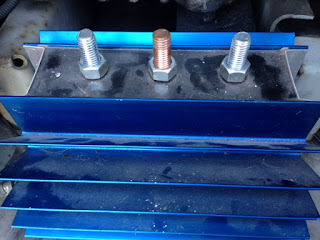
After the new one was bolted in I cleaned the leads and hooked it all back up.
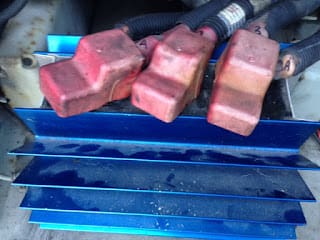
It was 30 minutes start to finish including my wife’s trip to the lumberyard. It took longer to get my tools out and put them back than to do the job.
The really good news is that it worked. Jeff pulled my fat out of the fire again! Thanks much, friend.
As I type this I am back at the Flying J in Effingham 5 miles away (And a 1655 mile loop) from when this problem started.
I adjusted the voltage regulator down a touch yesterday but it is still running a shade over 28 so I knocked it down a tad more after I stopped last night. I will finish the run to Ohio today and see what it does.
Davy



Log in to reply.