
-
Indicated Air Pressure
Posted by Jerry on February 8, 2014 at 10:31 amI’m on a trip in Florida this week, and I noticed that my air pressure was showing lower than normal on front and rear air and aux air. Normally all 3 show 125 lbs. I turned the aux pump on, and they came back up to 125 after a few minutes. When I turned the aux back off, it would maintain for a while, then slowly go back down.
The DOT brake check shows fine, I hear no leaks with the parking brake released, and the bus off.
No unusual loss of pressure when applying the brakes.
Also, when parked, the front and rear brake pressure stays up for days with the bus off.
The aux air will leak down after 2-3 hours.
The pictures show with the aux air on, then off.
Sorry for the blurry pics, but it was at night, while driving, with phone.
I even ran my speed up to see if that made a difference .
Any ideas?

 Bernie replied 12 years, 8 months ago 8 Members · 15 Replies
 -
15 Replies
-

The engine air compressor kicks out when you hit your 125 rating and does not kick back in again until you get down around 100 pounds +/-. I can’t tell from the pics but did you let it drop enough for the compressor to kick back in? I had an air line that somehow was too close to an exhaust run (or did it rub on something) and eventually caused a leak. The air gauge going up and down while driving and not touching the brakes was the indication that something was very wrong.
-
Bill,
At times, it would get down as low as 90, and would not come back up until I turned the aux comp on .
Could it be the regulator on the engine compressor?
-
It certainly does sound like it’s air compressor related, but then the pressure should also not be dropping while driving if you don’t touch the brakes.
-
Not saying my coach doesn’t have a problem, but I often see pressures that low while driving w/o aux compressor on. I’ve always considered it normal unless the gauges are cycling quickly. Seems to me the behavior in my previous coach was similar.
-
Your aux compressor is set with a higher cut in pressure than the engine driven compressor has which is why it kicks on first.
You can either leave it off while driving, or reset the cut in / cut out pressures to be below the coach compressor pressures.
Typically our coaches have a 120 to 125 PSI cut out and a 20 PSI differential. The differential is a fixed value so whatever it is, it is. I think some later models might have a 30 PSI differential so don’t worry if that is what yours is.
It may be the phrasing, but some of your words concerned me. “No unusual loss of pressure when I apply the brakes” was one sentence that I question. You should experience a few pounds of pressure drop when you apply the service brakes, but after the initial pressure drop there should be none. The DOT allows a certain leak down rate, but none is the only one I would consider acceptable.
If the aux system leaks down within 2 to 3 hours it reads as if it goes from max to zero. Or do you mean the compressor cycles every 2 to 3 hours? Big difference, and while neither is good, dropping to zero within that time frame is very bad. You will wear out an aux compressor pretty quickly if that is the case.
-
If there is an aux leak that bad, you’re also cycling the engine compressor trying to keep up with leak.
-
It was my phrasing. The test on the brakes are good.
Sounds like my leak chasing continues with Aux leaks now!
Thanks
-
Jerry,
The first place to start is to learn how your aux house system pneumatics are set up, plus go to the Prevost Car site and pull up the pneumatic diagram for your coach.
Start with the easy, most accessible stuff using the most basic tests, listen and if nothing is heard move to soapy solution. You will likely be able to see and get at a lot of the system’s devices and fittings. The reason for the diagrams is because when you are through doing the obvious and accessible stuff from that point on you are probably going to find the origin of the air supply for the various systems and portions of the systems and then go to the next step which is likely to be airing up those individual areas and monitoring the pressure loss if any.
It is time consuming, requires patience, and once you get the easy stuff fixed, each succeeding improvement is either harder to find or harder to fix but when you are done you will do a happy dance.
-
10-4 on the Happy Dance!
What is the lowest air pressure reading that is acceptable, if everything is operating normally at cruise speeds?
-
Jerry,
When you were working on your AUX system did the AUX air filter reseal completely? On our Marathon it’s located under the drivers seat. Filter has an auto drain tube to street.
What happens when the AUX system is perged you must hold your finger on the discharge tube. As they age the seal is not perfect and needs to be checked for tight.
Do you have the yellow gate valve in closed position that seperates AUX and Prevost Air ?
I can get a picture of the filter but I’am sitting here in xxxx……it’s chilly outside.
AL
-
Jerry,
You asked kind of a trick question. Others should jump in here because they may be set up differently.
The normal chassis range for air pressure is going to be a 90 to 100 PSI compressor cut in, with a 120 to 125 PSI cut out. That is more than enough air pressure to operate the braking systems and level the coach for driving or when on a campsite.
Your auxiliary compressor set points are determined by your converter or you depending on what you need and how you use it. I set mine on the low side which is a 60 PSI cut in and 80 PSI cut out because I have no need for any higher pressures when parked. Notice I said “when parked” because unlike your set up I do not want the aux compressor kicking on when the engine is running.
I have noted that some owners have an HWH system for leveling, and the way their system is set up it is active when they are parked. In that instance a high aux system pressure is required otherwise the coach will never remain level because it usually takes a lot of air pressure to raise the steer axle. As a practical matter however that automatic leveling feature is only masking suspension system leaks because if the suspension is leak free if the key is off (along with the HWH) the air is locked in the air bags and the coach will remain level with no help required from the aux compressor.
Except for the suspension the only air pressure required is typically for slide seals, generator air bags, bed lift, pocket doors or the dump valves, none of which take a lot of pressure.
-
Al,
Yes, I replaced the Norgren air filter with a complete new one, housing and everything. But, I don’t have , or see a gate valve.
I’ll look further for that. Maybe I should install one. Just can’t isolate the Gen air bags, because we dry camp a lot.
-
Drivers bay
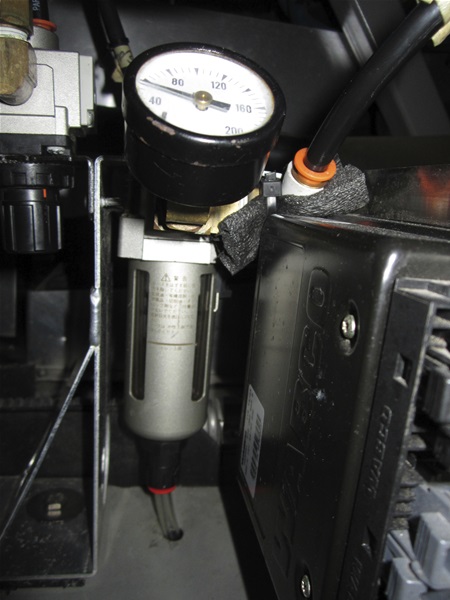
This filter was found to be the source of a frustrating leak hunt for my neighbor. Slow AUX leak out of discharge tube.

Normal—- closed
-

Mine does use the Aux compressor for leveling through the HWH, so I have that pressure set at 120 psi max.
Just made the trip back home, and everything worked as it used to. Showing steady at 120 psi.
I think the warmer climate helped a bunch. Still have some leaks in the aux system that I will continue chasing. Just hope the leaks are not pocket doors, or step slide. Seems like they would be hard to get to.
Al, where in the line is that valve, before the aux filter, or after?
Log in to reply.