
-
Hub leak?
Posted by Archived on February 28, 2015 at 5:33 pmI need you experienced folks to confirm what I think is a drive axel hub leak.
I changed the oil and tranny fluid 2 weeks ago and initially thought I had some spillage I did not get clean up when I saw this puddle under the drive side drive tire.

Then I looked up and saw where the fluid was comming from. It’s clear (not red tranny fluid and not used 40wt oil) so it must be gear oil.

The outside looks dry.

I assume the top plug (about half way up) on the pumpkin is the fill and check plug.
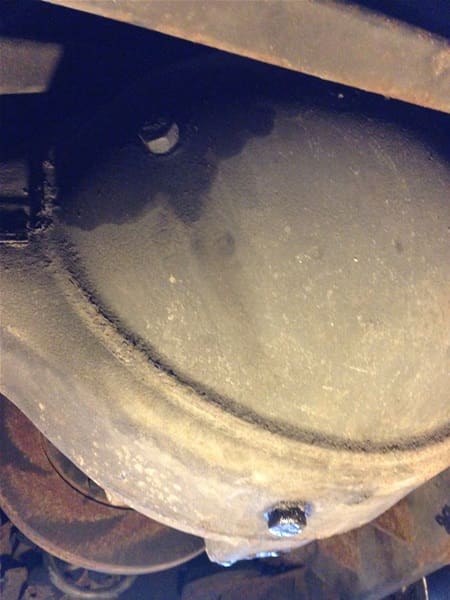
Can this be changed without pulling the tire via the bolt circle in the 3rd photo? I don’t have the impact wrenches and jacks to pull the tires and was getting ready to see Jeff for air bags and shocks. But it looks like I have one more thing to take care of before hitting the road.
I’m certain this just happened in the barn, I would have noticed the puddle when I did the fluid change.
I’ll look for an article but any advice is appreciated.
Dan replied 11 years, 7 months ago 12 Members · 19 Replies -
19 Replies
-

Joe
Your inner seal is leaking. If you’ve never changed one I wouldn’t start now. It is a simple job with the right tools but it can be a nightmare if you don’t know how to do it.
The main thing is keeping the seal lined up flush and clean when putting it back together or it will leak again.I don’t know how far you are from Jeff but if it’s a long haul most large truckstops could fix it. If you have heat gages in your bus watch it or take and IR gun and shoot the axle every 30 miles to get to Jeffs and take some oil with you.
Jeff could probably change it out in 30 mins or less.Once you get rolling a few miles you can see how much oil it’s throwing and gage your check points on when you need to stop.
Later
bv -
Joe, I’m not sure if I’m interpreting your photo correctly, but if I am, your lug nuts look seriously funky. I would check that out before you drive anywhere.
-
I don’t know what kind of wheels are on a 93 but those don’t look anywhere close to right.
-
like the other guys say. Are those nuts into wheel holes?
-
Joe’s wheels look that way because he has stud piloted wheels. So they are fine. That’s the good news.
Yes his hub seal is leaking. Yes he can pull the axle, remove the 4 1/2″ nut and pull the entire hub without removing a wheel, but to do that he is pulling the dual wheels, brake drum, and hub all at once. If he has one of those hydraulic wheel carriers it can be done that way, but the danger is damaging the seal trying to slide that entire assembly back in place.
So Joe, fear not. You have a choice. You can drive XX hours (or minutes) to a competent shop, pay for the 2 hours it will take to replace the seal and drive XX hours home, or you can do the job yourself.
You need to take the wheels off yourself. To do that you can buy an X12 torque multiplier for over $700, or you can buy a 1″ impact wrench if you have a big enough compressor and air line. You can get one as low as $200, likely $400 to $500.
You need a socket and 3/4″ drive for the center hub nut. Then the job just involves pulling the brake drum (the countersunk screws sometimes are a pain to remove, and then the hub, or leave the drum on the hub and fight with 200 pounds of iron.
The seal can get pried out, and the new seal can be inserted using a tool specifically for that purpose or you can carefully tap it in place using a short section of 2X8 and a hammer and a little patience.
It is not a difficult job in the sense it is highly complex. It is a dirty job, you need to be creative to be able to move the heavy parts around (I use a common floor jack so I don’t have to lift the brake drum) and it just requires a degree of care. In addition to the hub seal you need a ten hole gasket for the axle flange and a willingness to get dirty cleaning things up real well so you keep the hub seal clean and have clean bearings to inspect..
BTW, if your differential is full you can drive a considerable distance as in hundreds of miles with no concern about if the bearings are getting lubed. If that was a big leak making driving impossible you would have oil all over the place.
I have no hesitation encouraging you in doing the seal replacement because if you can get it apart, you can get it back together. And you will learn a whole lot about your brakes, how they work and will see first hand their condition. You will likely have to clean the brakes and drum real well because from the looks the oil has gotten on the shoes and in the drum effectively eliminating braking from that position.
I’m curious because I am finding a pattern to hub seal leaks. Is it on the passenger side?
-
BTW, I have an X-12 torque multiplier if it will help along with the big socket to use for the drive axle nut. I am having dinner with a PC member from NC Monday night, and if it helps he can carry them back with him if that gets them close enough so you can do the job yourself.
Then all you need is a floor jack to help handle the brake drum. I usually grunt and groan and handle the hub myself.
You can return them at Oysterfest, or I can give them to you at Oysterfest.
Send me an email if interested.
-
If have used a 4 foot long heavy steel pipe over 3/4″ drive breaker bar and 33 mm or 1 1/2″ socket to loosen the lug nuts. It helps to have a second person to keep the whole deal aligned while you apply presuure (using body weight) to break the lug nut free. Then use just the breaker bar minus the 4 foot pipe to spin the nuts off. If you are doing the drivers side look at the end of the stud for a small “L”, if it is there the lug is “left hand thread” so it is “righty loosey, Lefty tighty”. The reverse of normal. I mention that beacuse I have had two tire changers that did not realize that the drivers side lug nuts were left hand thread. The X-12 works great if you can get one.
-
Thanks as usual for the prompt and useful feedback. I have an appointment with Jeff for a March 20 drop off. I wasn’t sure if I could drive it to Jeff’s knowing the differential holds 7 or 8 quarts of fluid. But it sounds like the 325 mile run via the flat land route Augusta, Atlanta, and Jeff’s via US411 should be no problem.
I will fill the differential before I leave. And shoot the hub temperature (w/o the hub cap) every 30 minutes. Should I overfill the differential by a quart? Any downsides to doing so?
Thanks for the tool loan offer Jon but I’m headed to Jeff’s for shocks and air bags in part because still being a working man I’m out of time to get those things done. I’m slowly building my inventory of tools and doing more and more of my own work but as a multi year plan. I can handle the routine stuff and being able to inspect the underside has been invaluable as this has shown. This job is still above my pay grade.
I parked the coach after Thanksgiving weekend in the barn and about 3 weeks ago made a 20 mile warm-up run and put it up on the ramps. There was no fluid on the floor when I set the ramps into place. So it has been leaking a limited time. Even when I changed the oil and tranny fluid I’m certain there was no fluid on the floor.
It is the driver’s side. The $64,000 question is as always should I have Jeff change both sides?
Jeff, if you are monitoring this thread, add it to the list, I’m coming.
1999 XLV X-6872, liberty #440 -
Joe, the question is up to 64 million now – inflation.
Regarding the torque multiplier. I’ve never had one, but just ordered a new car with center locking wheels requiring 370 lb ft of torque. So been researching it, and found one for less than 200 dollars. It is the Neiko 03715B (google it). It allows you to use the common half inch drive torque wrench and it multiplies the torque (through a planetary gear set in the head of the wrench) by 3.3. My understanding is that our aluminum wheels require 450 lb ft of torque, which would require a torque wrench to be set at about 140 lb ft. It is a tool you may use for many years.
-
Joe,
Judging from the photo the hub seal has been leaking a while. Sometimes it collects in the recess in the wheel and when you stop it sometimes leaks out one of the holes. If you fill your differential I don’t think you need to worry about stopping to check temps. I am sure you are going to be OK.
If your brake shoes and drum have a lot of oil, and if the inner drive wheel is loaded with a lot of gritty, oily crud the seal has leaked for a while.
As to replacng both…………I wouldn’t. That is one case where if it ain’t broke, don’t fix it.
I sold two buses when they had about 250,000 miles on them. On both I replaced a couple of seals, but all the rest were original and working fine. I have no clue why some seals leak in 50 to 100 thousand miles, and others seem to go forever.
-
Jon wrote: ” if you have a big enough compressor and air line.” How much pressure and how much volume do you need to run the appropriate big impact wrench?
Joe: Are you new to this coach? Do you know if the coach sat for any length of time? From what I read on this Forum and what Jeff told me, the seals you’re having a problem with will dry out over time and start leaking. If your coach has had little use recently this is what is likely causing your problem.
Our coach had been stored for many years only 18 miles from Jeff’s shop. Tracking back we discovered it had only 1,600 miles over the last three years or so. The day before Jeff looked at it for us, it was driven out of the heated storage garage onto the driveway and then backed in. I didn’t recall seeing any oil under the coach while it was outside. The next morning Jeff found a leaking seal. When he zero’d out the coach for us, he replaced that seal. We brought the coach back to Wisconsin, used it, and had the other seal leaking!
Talk to Jeff. Rely on his advice and counsel. If you’re coach has had little use over the last few years, the other seal might be getting ready to leak! It might even start leaking on the way to Jeff’s shop!
If you decide to have the seal replaced before you get to Jeff, make sure you talk to Jeff to make sure the procedure is done correctly. If the axle isn’t tilted from side to side, the lube doesn’t get into the bearing and you could have a catastrophic experience. Jon might have more thoughts on this.
Good luck!
-
A 1″ impact wrench needs a 1/2″ line and a fairly large tank of around 60 gallons. Smaller might work, but doing a lot of work with the impact wrench may require you to wait sometimes for the compressor to catch up. I think a 60 gallon tank at about 130 to 150 PSI has enough air to loosen all 10 lug nuts before the compressor cycles back on.
-
Dick,
I purchased the coach about 2 1/2 years ago. It is hard to say how much it was used by the prior owner especially his last two years of ownership. I believe little. I got a fair number of maintenance receipts but no usage log.
I add to the low usage. we use it to tailgate at fall football games it is parked and not run for 3 months unless we put a trip in the middle like for the Branson rally. I have only run it it about 6500 miles since purchase. The coach only has a little over 100k miles total. I bought it with intent to “get it right” before my retirement and have put the zero out the rubber parts on a 3 year plan. I’m essentially on that plan with intent to use it more this summer and fall. I don’t really want problems on our 3 planned trips between now and August.
i’ll let Jeff get a look at the leaky seal and let him call changing the other side. I did have the differential fluid changed after purchase as that is a 100k miles item. The fluid in the puddle is clean . Did that help or hurt? I have no clue.
the bottom line is I need to use it more, and work is in the way!
-
If you want to go with an impact to remove the wheels, the subject wrench will do the job and weighs only 7.4 pounds. It makes 1350 ft lbs in reverse and 900 in forward. You would need to use forward on the drivers side wheels to loosen, but they should have only about 450 anyway. I’ve been using this through a 150 foot long 3/8″ line choked down to 100 psi from an 80 gallon compressor, and while this works, the power of the tool is probably not fully used.
Log in to reply.