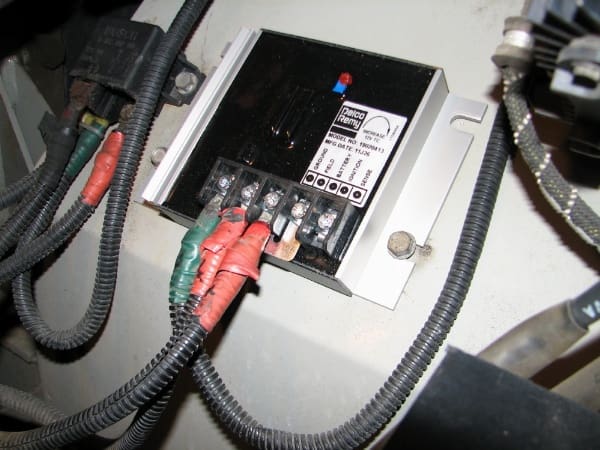
Karl,
Unless a new owner was a bus conversion designer, mechanic, or builder in a previous life most of what we have on our buses is puzzling until we get an opportunity to learn what they are and how they work.
The voltage regulator that Truk has pictured maintains the alternator output at a specific voltage level. It regulates the voltage. Some regulators are internal to the regulator. They can only be accessed by opening up the alternator. Some external regulators are adjustable, some are not. But they all function in a similar manner. The regulator allows electrical current from the batteries to pass into the alternator windings. When that happens the spinning alternator generates voltage. The amount of voltage will keep climbing unless that voltage to the “field” is interrupted. As soon as the voltage drops, the regulator restores the flow of electric to the alternator field post, and when if gets to the upper limits the regulator has them set at, the flow of current is interrupted. This goes on a a rate we cannot see on a voltage meter. To us the output voltage looks steady but the regulator is actually working cycling current to the field wire as required to hold that steady voltage output.
If your alternator stops producing voltage and your indicator light on the dash comes on, it is usually very easy to determine if the alternator is bad or if the problem is in the regulator. Using a jumper from the battery to the field wire on the alternator will instantly tell you if the alternator is working. If it is the voltage output from the alternator will shoot up (uncontrolled) because it is not regulated you know the alternator is good.. If doing that does not change the ouput on the alternator it is probably the regualtor that has gone bad.
I think in the very near future we will be adding some articles that will help. The above is an oversimplification.