
-
Front Tire Wear?
Posted by Mike on September 2, 2014 at 4:00 pmAfter approximately 1500 miles of towing, I have noticed some tire wear on the outside edge of the tread on the front tires of our towed 04 Dodge 2500 4×4. The wear is fairly even around both front tires. Is this normal?
Archived replied 12 years, 1 month ago 7 Members · 15 Replies -
15 Replies
-

Not normal…. First question is your tow bar level ? If my memory serves me right margin is only 1 or 2 inches.
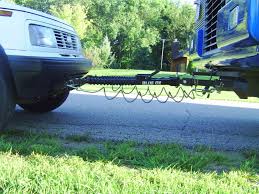
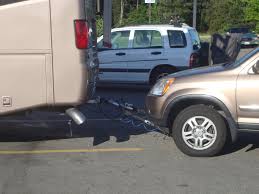
ideal hook up….appears pretty level not good…
-
It’s a Blue Ox tow bar and the truck is slightly above the tow bar hitch height. There’s a riser on the hitch to raise the tow bar, but it’s still an inch or two below the truck. The truck tracks nicely behind the coach.
The truck has a diesel engine and it’s a bear to turn the steering wheel without the engine running for power steering.
-
We have a couple of members who tow or have towed Ram pickups, me included. I know of a couple who have towed the 2500 but they have never mentioned unusual tire wear. I towed a 1500 and never noticed any unusual wear from towing, but that truck was lighter than a 2500.
-
Most of my towing has been with Jeeps, Avalanche and a Dodge Dakota. All of them wore down the front tires pretty quick, it’s just the nature of the beast. When towing the steering wheels don’t turn like when your driving, they move a little in the direction of the turn and then are dragged through the turn. I suppose a heavier vehicle as you mentioned with really hard steering may grind them off quicker than say my Wrangler. That’s why we all seem to get the burnt rubber smell when we start our toads, that ground off rubber is stuck to the exhaust.
I did forget to unlock the steering once, you only get 350 miles out of a set of front tires that way. I have to disclose that, since Jon was there…
-
And I would think a vehicle without power steering, which most are, will be even less inclined to turn and therefore scrub. I just know how hard my F250 was to steer when the pump went.
-
Not so. First, our cars are designed for people with no interest whatsoever in the act of driving. So cars of today are designed with the intent to remove prople from the process to the maximum extent so they can text and talk on the phone, play with their GPS or upload photos onto their car’s display. People who occupy the seat immediately behind the steering wheel don’t want to be bothered with participating in actually driving so now we have devices that maintain cruise speed and apply the brakes if you come upon an obstacle, we have cars that alert the driver when a he begins to drift from his lane, we have alerts to tell the driver a car is along side of him so mirrors become useless because no one uses them anyway.
Virtually all cars have automatic transmissions because actually shifting a car into another gear requires the use of the hand holding the cell phone as well as a minor degree of skill so nobody is expected to be required to shift. We have power steerin, power brakes, power windows, heated seats, heated steering wheels, air bags, and idiot lights.
So getting back on topic, cars have gotten fat because of all the goodies now installed so power steering is a given. With power steering it takes considerably more effort to turn the steering wheel, or turn the wheels than it does on a car without power steering. If a car did not have manual steering it is likely the front wheels would be more responsive as the bus makes a turn and would be easier on the front tires. I really doubt if any car that is towable can be found without power steering so the only solution to excessive tire wear is frequent tire rotation.
-
Here Here, Jon. I have a RAM 1500 with the “special ordered” manual transmission, roll up windows, unheated cloth bench seat, no plug for my I-Pod, alas it does have power steering because it is 4X4. That said, transmission to neutral, parkng brake off and away you go. No unusual tire wear at all, course do to the slight additional height of the vehicle, the tow bar is dead level.
-
OMG….look who showed up on PC ?
flyu2there, where have you been ? Can’t still be fixing the tire problem in New Mexico or Texas.
I know you had to wait but 6 months is a little long
-
Got extremely busy on a car restoration project, thought I could knock it out out in 6 weeks, now 7 months later I am halfway through. 10-12 hours a day, 7 days a week….guess that’s what you get when the only thing that was running good on the project car turned out to be the paint! Heat finally drove me out of Arizona for a month or so at the beach.
-
What Fly boy is not saying is the planes you fly on vacation are now the same way. In fact the planes are even more computerized than the cars of today. A pilot only has to push buttons or twist knobs to fly the current commercial airliners. One major US airline has gone so far as to replace the co-pilot with a monkey.
The pilot can “fly” the entire flight from takeoff to landing (yes the landing) without touching the yoke (stick to you old farts). And that is exactly how today’s flights are conducted.
What about the monkey? He’s just there to slap the pilot in case he tries to touch the yoke.
OK, no more picking on Fly boy. BTW, he is a pilot and flies like a pilot, not a button pusher.
-
The last “pilots” airliner was the B-727, if you didn’t pay attention it would bite and bite hard. Stay with the old girl and she was a dream, depending on the engines fitted, you could out run, out climb and out descend anything in the sky, save a fighter! A guy that was good with the airplane could coax a decent of 12-14000 feet per minute out of that machine w/o breaking the sound barrier (which has been done with the airplane). While the flight controls were normally boosted with hydraulics, the yoke, the pedals, the throttles were hooked directly with the intended recepients. Today the pole is attached to a bunch of springs to give the pilot “artificial feel” when in reality the yoke is hooked to a number of proximity switches that then, via a flight control computer, will move the flight controls. Same with the throttles, nothing but a ball of bell wires from the cockpit to the engines where FADEC (full authority digital electronic control) decides how much and when to apply fuel to the motor.
Same thing for automobiles and now even the Prevost conversions. A computer for this and that, electric this and that, automatic this and that….. Perhaps many of these gadgets can contribute to safety, as long as they are working, but cameras everywhere, lane incursion monitors, forward brake applying radar….gimme a break.
Back to airplanes, even today a pilot must go through extensive training and be able to explain and understand what and how things work below the floorboards, not so for the automobile and associated. Also airplanes are under constant progressive maintenance so there is a reasonable assumption that everything electronic works save the spilled cup of copy on the control console in the cockpit when all bets are off.
So back to the wheeled vehicles, one can now text, talk, go online without a worry because “mother, the computer” is watching after you, as long as “mother” is there…trouble is rely on that stuff too much and the first notice you will have of her absence is the sound of breaking glass and the smell of %$**.
-
It’s about time your back Fly Dude, we love commercial airline stories. Any story I tell about my Aztec get’s lost in the gaze, “what the hell is an Aztec.”
I want to hear your worst turbulence story flying the big iron….
-
KC Slugo wants the big story . Give it the big headline…..like
“what the hell is happening” or “they don’t pay me enough for this s*** or ” I knew I should of called in sick”
BTW…on your post I Googled B-727 and that my friends is an amazing production story. Sort of at that time a home run for Boeing.
-
We too get the burnt rubber smell when towing the Jeep Wrangler. What is interesting is that we never got that smell all the years we towed a Honda Pilot or the Chevy Silverado. I just thought it was the more aggressive tires on the Wrangler Rubicon.
-
We have had that smell on every toad. It is the rubber coming from the coach tires or off the road. I suspect but have no information to verify this, that if a vehicle does not have that smell after being towed it is likely the exhause system is routed in such a way that rubber dust is not going to land on or remain on hot exhaust surfaces.
We have towed a Dodge Raider (MItsubishi Montero rebadged), a Jeep Grand Cherokee, a Dodge Ram 1500, and an H2 Hummer.
Log in to reply.