
-

Dont know I havent had it but 3 weeks. Im sure that the more you use it the faster it runs out. They did give me two extra refill bags with the unit. Im guessing that if you wash the coach the regular way and then use the deionizer to rinse it off that it will last much longer. -
I get a year out of my Invisable Chambois, but have to send it back for a recharge. Wouldn’t buy another without being able to change the resin myself.
-
The Cr Spotless said their resin is good for 300 gals but
that depend on your water condition. I use a water softener before the water
goes into the DI unit. I am hoping I can get twice the amount of DI water. -
Hish,
I was doing the same thing with a softener and Invisable Chambois told me not to do that as it’s adding salt that has to then be removed and actually shortens the DI life. Not sure if it was fact or fiction.
-
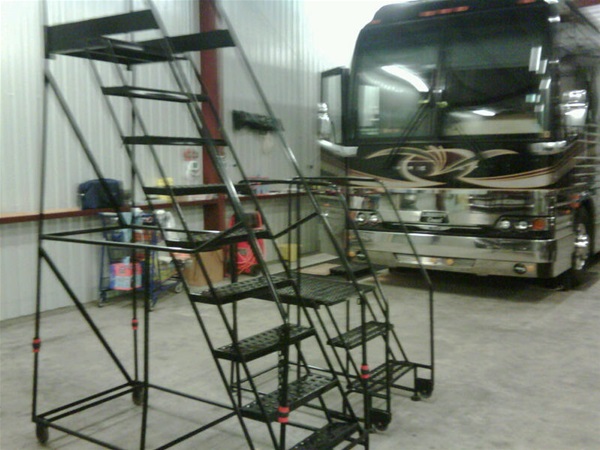
For bus washing and drying, these rolling ladders are safe and efficient vs. traditiional ladders that have limited reach … still can’t find an automatic wash i like better than doing it myself…… at least i can wipe down once back inside before the sun drys and leaves streaks!!!
-
Brady is a man after my own heart. I don’t have a rolling ladder like he does, but like him I am on my ladder drying it off before the water spots dry.
No stinkin fancy deionized or soft water for me. I use the hard stuff.
-
Enjoy yourselves . I will be relaxing with a cool one while the coach dries itself. God I love technology ! Sometimes
-
Tom
This the answer I received from CR Spotless this afternoon.
Hish
Good morning Hisham,
You can use your water softener but it really doesn’t save on your resin life. A lot of the softeners puts salt in while our system tries to take it out. It won’t hurt the system but it can make It work a little harder. Yes that resin is to refill your cartridges when you are ready to change it out. You won’t have to till your meter reads 020. Your meter will read 0 for 90/95% of your resin life. I hope this helps you out have a wonderful day.
Warm Regards,
Josette Shields
Spotless Water Systems LLC -
Having owned and operated an electroplating line for many
years, I’ve gained some experience in obtaining spotless water rinsing at the
lowest cost and least inconvenience as necessary.Running water through a salt softener doesn’t significantly extend the life of the deionizer tank.
What really prolongs the life of the deionizer cylinder is running the
water through a purifier membrane first.What we did on our plating line was softened the water with
a potassium based system, then ran it through a purifier membrane and stored it
in a tank to be pumped through the deionizer prior to adding it to the
plating line. Sounds more complicated than it is. The reason we used Potassium rather than salt
to soften the water is the run-off from the salt unit will kill vegetation and
the run-off from the potassium system is beneficial to vegetation. The reason
for softening the water first is to take the load off the purifier as salt is
easier to remove than minerals. However, if you have soft water to begin with
you can skip that step.If you don’t mind spending the money to replace deionizer
tanks frequently, just run the tap water through it. However, you can get much greater used of each
deionizer cylinder if you run the water through a purifier membrane first.The bottom line is; you should test your water supply for
hardness then determine what system will give you the best results. If you have very hard water, then running it
through both a softener and purifier before the deionizer is the best and most
economical solution. However, if you have a yard blower, a long pole with a
soft brush that you can throw a towel over and don’t mind the physical work,
you can skip all the water treatments and do a section at a time – wash, rinse,
blow, and wipe. It’s good exercise and
you get to know every nook, cranny, chip and ding – up close and personal. -
Sounds like it’s no big deal Hish, we probably can’t measure the the resin performance loss using soft water anyways.
-
Jon…
No ladder for me … did that the first time… never again… I use the long handled boat brush with big thick towels over the end… builds up arm muscles too. I don’t get on top of the bus anymore either, but I can reach every part of the bus except for the roof and drys beautifully and NO streaks.
BTW make it a scotch please Jon !!
Diane
Log in to reply.