
-
bus pit
Posted by michael on June 30, 2014 at 9:18 amA neighbor and fellow Prevost owner and I have deceided we need to build a pit for bus maint. This pit will be outdoors. We have what we think is an ideal spot behind the shop where the ground drops off about four feet allowing for one end to be open. All walls and floor will be a min of 6″ steel reinforced concrete. Our thoughts are to make it 22.5 ft long allowing us to work on/ inspect half of the bus at a time. The floor would have a three inch drop from the closed end to the open end to allow for water to run out.
Now the questions: What would be the ideal depth of the pit ? How wide ? Any thoughts,ideas or input would be greatly appreciated.
Michael
Archived replied 12 years, 1 month ago 8 Members · 15 Replies -
15 Replies
-

Make the pit 24″ wide inside. Any wider and the tires and chassis support points get too close to the edge of the pit. You need some margin for safety and you do not want chassis supports right next to the edge of the concrete plus to raise the tires off the ground you want a generous flat spot for the jack.
The depth should be 48″. For almost all of the routine tasks that is the perfect height. You have to lean down to get under the bumper and move to between the wheels, but once between the wheels you can stand upight and do almost everything at a comfortable height.
There are a couple of high mounted tasks and for the rare occasions when I work on those items I use a small 2 step ladder or a stool. There are a few air relays or valves located high, just under the coach floor that I need the ladder to reach, on my 97 coach the air dryer was mounted high, and I had a couple of coolant hoses I needed the ladder to reach, but other than those items the 48″ depth put me at or near eye level for everything from grease fittings to brake chambers to the center of the axles.
I mentioned body support points and I want to stress that you absolutely need to support the chassis anytime you are beneath the coach, even if you are not working on the suspension. There are too many places and tasks going to put your arms or torso between pinch points and having the pit will not protect you. I always have supports beneath my coach any time I go into the pit.
-
That’s awesome that you’ll be able to keep one end open. Ventilation is one of the biggest problems with pits. FWIW, many local codes now prohit the construction of pits. Even though your open ended pit helps with the safety issues a lot, you may not want to ask for a building permit.
Jon, certainly has the experience, so his 4′ height must be good for him. One thing to keep in mind that you can’t make the pit any deeper once it’s done. It’s easy to raise the floor or use a movable platform it the pit is too deep. Personally, I’d opt for shoulder depth and adjust later if I had too.
This may be a none issue with your pit being it’s a walk out. Some pits are outfitted with a removable raised grated floor with a sump pump located below the grate. This is good to keep your feet dry, but can be a pain it you are working with small parts.
-
Gil,
Think about what you just said. If you have a shoulder height depth on your pit your working level for EVERYTHING is going to be over your head. At the normal ride height the bottom of the bays is 11 inches approximately over the floor or the level of your shoulders. Everything else that needs work is going to be above that level which is over your head.
My guess is you don’t spend much time in the trenches so to speak.
-
Nope, not a lot of time in the pits. I do have far too many hours under cars on lifts though. I felt most comfortable and had the best leverage with everything above me. That wasn’t my point though. My point was you can’t make it any deeper when it’s done. Make it deeper than you think you need and raise the floor later if needed.
-
The bottom of a car is at the same approximate level for all items serviced from below within a few inches.
Our coaches are an entirely different situation. There is almost no service work that takes place below the level of the bottom of the bays. Maybe a few clamps or minor items, but the real work takes place from the bottom of the bay doors, all the way up to the underside of the floor. That range of about 30″ is why you need the 48″ depth of the pit to place you within reaching distance of most work. Even then you will still need to use a stool or a two step ladder for some things.
Trust me.
-
After much discussion we have deceided that 48″ depth is the best compromise. For oil changes and lube it would be better to be deeper. For leak checks,norgren valves, shocks ,air bags and general inspections less would be better. Add in my neighbor is 5’2″ and I am close to 6′ , we deceided 48″ is the best “compromise.
However, we are thinking 24″ width seems a little narrow. The distance between the rear duals is approx 4.5 ft. The center to center of the rear jack points is approx 43″. If we make the width 30″ it will place the jack/jackstands just to the outside of the vertical wall . This puts the base of the jack (s) in approx 3″ from the edge of the wall of the pit .
Does this make sense ? Also, we plan on a 2X2x1/4″ angle iron embedded in the concrete on the inside edge of the pit to protect the concrete and allow for rolling tool trays etc.
As you can tell we are still in the design phase so any and all input is certainly welcomed!
Michael -
Michael,
Before I made my pit I went to a number of commercial shops and measured theirs. They were all 24″ wide.
Now that I have 14 years of experience under my belt using a 24″ wide pit I am confident it was the correct choice. On all my coaches (3) the rear support points are such that using my support stands I have ample space between the edge of the concrete and the stand.
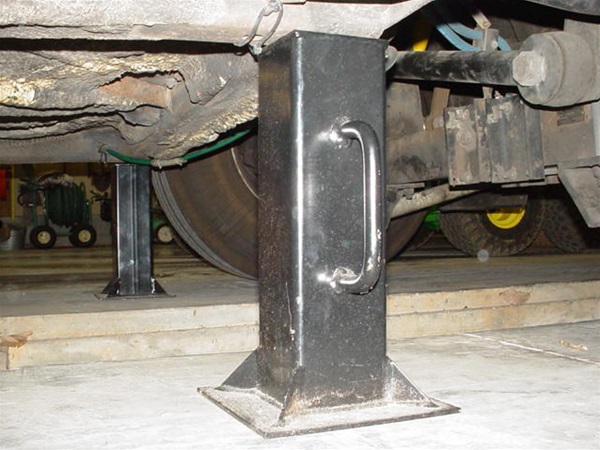
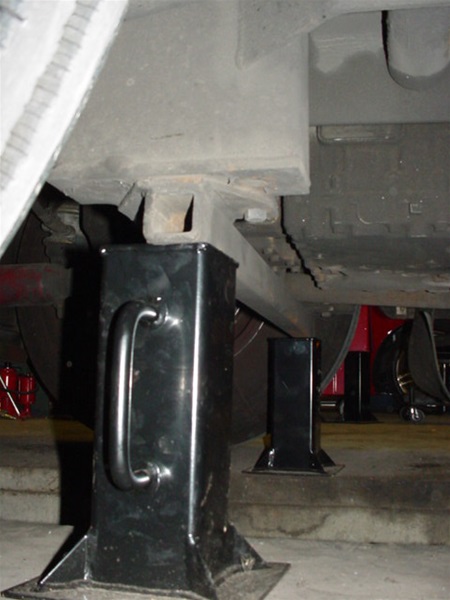
The photos show the front and rear respectively. Note the rear stand in the background is near the edge and the one in the foreground is a little further from the edge. All it takes is to have the bus 2″ one way or the other off center and the distance from the edge goes from a little over 4″ to almost nothing. If the pit was wider I would have to be perfect in centering over the pit every time, something a whole lot easier said than done.
The step at the top sides of the pit is so I can cover the pit when there is no bus over it if necessary. I have 2 X 10 planks that drop in the grooves on each side. I use them under the oil drain pan or to hold tools when I work in the pit.
I can tell you that to center the coach you will find it a whole lot easier to back over the pit than to drive over the pit, especially if you have white stripes or some reference to guide you. If you have a helper that will also make centering easier. However you configure the edges of the pit opening try not to have anything protrude above floor level because there are times when you will benefit from sliding things in or out from under the bus such as a filled oil drain pan and going over a lip will be an issue. I also always raise the coach to its maximum height when I am working on it from the pit. With the exception of servicing my current air dryer access to everything is much better with the coach raised.
-
Once again you bring up a very good point. I was calculating all of my dimensions with the bus perfectly centered. Thats not likely to happen very often. Two inchs off center makes a significant difference with the support stands. So, now I get to redraw my design…..which is OK because I hate after the fact “woulda,coulda, shoulda” done it differently ! Thanks
Michael -
This thread proves the beauty of this site. Thanks again Jon and Tom.
-
I’ll add a few more points to consider.
I made my pit with a sump and no way to let anything drain from it. The sump has a pump in it, but I have to plug it into an outlet before it will pump the contents of the sump. I did that so if there is an accidental spill of anything I can capture it and it never gets where it can do any environmental damage.
I have a drain pipe at the side of the pit dedicated to the sump pump. I stick the hose from the pump into it whenever I drain anything from the pit, usually water with oil and grease contamination from washing the underside of the coach or the floor of the garage. That drains through an oil water separator with oil free water draining to the ground, and the oil retained for disposal.
I cannot think of the consequences if I lost coolant, engine oil, or fuel in large quantities and it escaped onto the ground.
I plumbed the pit with air and electric. That is very convenient because I seem to always want lots of light, and the air is used for all sorts of things, including impact wrenches, descalers, blowing things clean, spraying engine cleaner, etc.
-
Not wanting to rain on the pit parade …
Will the pit be on your property or the neighbor’s? If the neighbor will working in the pit on your property, you’re likely responsible for anything that might happen.
Think about the liability of what you’re doing. If it turns out your municipality requires a building permit, get it. Document the concrete and rebar. An engineer could easily give you a set of specs to follow.
-
The pit will be on my neighbors property. We have discussed the liability issue and they don’t seem to be concerned given that we are in the country on 30 acres and the area is fenced. I plan on fabricating panels to cover the pit when not in use. Ultimately, we plan on building a 24′ X 60′ steel building over it . According to my grandson (structual engineer) my design is a little overkill. All concrete 6″ thick, 1/2″ rebar on 12″ centers and 3500 psi concrete. We will photo document the entire construction. Given the sue happy nature of people today I still have some concerns but not sure what else we could do make it any safer. You bring up a valid concern. Thanks for the input.
Michael -
The lawyers on here may wish to offer some insight, but it appears to me if the pit does not fail structurally (that’s a whole different can of worms) there is no more or less exposure because whether the work is over a pit or on a flat concrete floor the potential hasn’t changed.
Where someone’s potential for a liability ramps up significantly is if a personal injury is involved especially if it was caused by a lack of observing good safe practices (always uses supports for example) or deviating from the procedures and specifications available in the Prevost service and operator’s manuals.
-
From a liability perspective … I’d rather use my neighbor’s pit than having my neighbor and his family using my pit. 😉
Log in to reply.