
-
Bus Fires
Posted by Rod on May 20, 2013 at 9:36 pmWe looked at a bus for sale just 20 miles from our home. Most coaches are several states away so we dashed over to see this one. It had had a fire in the engine compartment that seemed to start in the battery area. It was in a repair shop being repaired.
We have read about bus fires from time to time and are wondering, what is thought to be the most common cause of these fires? Wiring? Batteries? ___?
What is the best way to prevent these fires?
Is there a fire suppressant system available? If so, does anyone here have one?
Thanks!
Gerald replied 13 years, 4 months ago 4 Members · 6 Replies -
6 Replies
-

Fires happen but are relatively rare. Not having propane powered systems on board helps. Here is my best guess from a while back
- Turbo (main engine and generator). Oil or fuel on hot turbo and exhaust components. This is the primary cause of fire in marine diesel applications. Make sure your turbo heat blankets are in good shape and are not soaked in oil. There should be no leaks in the turbo area.
- Batteries. There is a lot of energy stored in the batteries. A short or loose connection can cause an electrical fire. Look for loose connections and chafing of main battery cables ahead of any breaker and fuses.
- Brakes. A stuck parking or service brake can get hot enough to burn up a tire and coach. Checking tire and wheel temps after 20 miles of travel might catch this.
- Auxiliary heat. Diesel or electric. A regular check for loose fittings and wiring would be appropriate. There was a recall for Cadet toe kick heaters a few years back.
- Galley. Lots of ways to get into trouble here.
- Modifications. Our buses are well built but over the years modifications accumulate that may not be up to the manufacturers standards.
An oil or fuel leak in the turbo area would get my immediate attention. I double and triple check any work around batteries or high amp circuits and I typically stop after the first 30 min of driving and check tire and axle temps.
Gerald
-
Several coaches have had fires, and the ones we usually get to hear about are in entertainer coaches just because somebody “famous” was involved. One of our members is finishing up his conversion on just such a coach.
Over the years I have learned some basics that I hope will help me never repeat my own coach fire.
First, based on the number of trucks I have seen burned on the side of the highway I would never try to drive with a bad tire. I stopped a driver whose trailer was on fire because he had been driving with a bad tire and it started burning. Dragging brakes can create enough heat to create a fire.
But in my own case I had a fire that was caused by battery cables whose nylon ties failed allowing the cables to rest against the engine and when the insulation melted there was a short. Unfortunately the point of the short was between the batteries and the circuit breaker so there was nothing to open the circuit. The net result was the insulation caught on fire. Fortunately I immediately saw the indication of a problem in the voltmeter above the dash and was able to cut the cables before further damage.
The second incident was far more serious and it was the result of faulty repairs. I had the AC compressor manufacturer change the OTR compressor. When I picked up the coach they left off the valves which protect against high internal system pressures. I argued and they prevailed because they convinced me they were trained and knew the systems. I got 400 miles before a trucker told me we were on fire. The internal system pressures had evidently reached a point where the seal on the compressor behind the clutch failed and the freon and refrigeration system oil was blowing out under pressure and once ignited it did serious damage. All the coach batteries were in the engine compartment and once they started burning the results were widespread. So modifications to the way the coach was built were the root cause. The protection valves would have never allowed the seal failure in the first place.
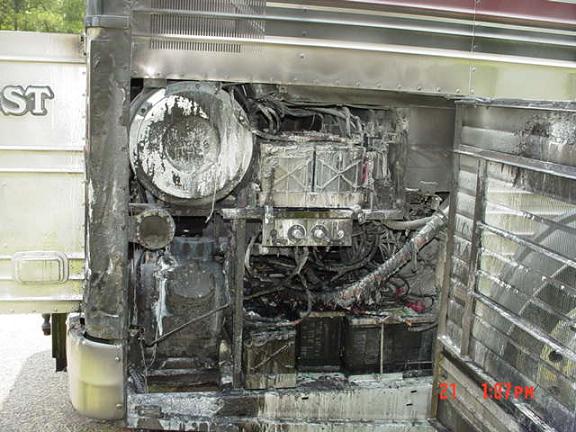
As complex as our coaches are there is no end to potential causes of fires, but if as an owner you are observant, do not allow any modifications without safety devices, and understand leaks and build ups of grease and oil can contribute to risk the coaches are relatively safe.
-
Jon, wow! looks like you were able to put out the fire just in time. What did you use? Was the coach repairable or totalled by the insurance company?
Gerald
-
The fire never got into the interior. Both Prevost and Liberty did an excellent job of keeping the firewall intact. We never even had any odor as a result.
It was towed to JAX Prevost and for $82,000 they repaired it like new. Insurance company paid for it and my guess is Carrier Corp. paid the insurance company.
We got to the side of the road as soon as the trucker told us of the fire. There was no smoke or flame visible in the mirrors or the TV camera. We used all our three fire extinguishers, Two truckers used up theirs, and because the freon was still spraying out under pressure the compressor clutch kept reigniting it so we drained water into the biggest pots we had in the kitchen and my nephew and I kept throwing water on the hot clutch until the freon no longer ignited. The flames got so hot the air cleaner element caught fire even though the pleated portion never made contact with any metal parts.
Needed new batteries, equalizers, isolator, battery slide, AC compressor, air cleaner, hoses, cables, rear doors, side door, fiberglass cap and the entire rear wiring harness. The engine was OK.
-
If you google Mac McCoy The Fire Guy you will get some hits showing systems he markets. I don’t have a system but have been researching the last couple of evenings to get some info on systems and the best type of suppressant for bus purposes. One system is even available for refrigerator compartments. It seem a particular manufacturer had a problem in the past and a system was created in an appropriate size. Engine compartment, generator compartment and battery compartment systems seem to all be available. Basically the same type system just sized differently and in foam or halon.
-
Jon, when I was in the business, I heard all the horror stories. Your’s is the first time that I have heard of an AC caused fire.
The other source of fire that is very prevalent in the RV industry is the propane refrigerator fires. It is not the propane causing the problem (most of the time), but the leakage of the amonia coolant. We have all heard of the recalls (many). I suspect most of your coaches have house type fridges, but if not, make sure that your fridge has the latest recall updates.
There were studies of commercial bus fires in Finland and the two most common causes were high amperage 12V cables that grounded and fuel tubes that leaked. In our case, our Detroit engines (both two stroke and four stroke) have the fuel tubes inside the valve cover. However, we have lots of hoses with all kinds of flammible materials in the engine compartment (antifreeze, transmission oil, engine oil, fuel, PS, etc). Guess I can now add AC freon hoses to that list.
I had lots of folks come to the booth worried about Aqua-Hot fires. I never was able to document an Aqua-Hot based fire. I did hear several cases where the pan filled with diesel but no fire.
Jim
Log in to reply.